===================================================
Laura Ingalls Wilder – Little House in the Big Woods
Chapter 5.
SUNDAYS.
Now the winter seemed long. Laura and Mary began to be tired of staying always in the house. Especially on Sundays, the time went so slowly.
Every Sunday Mary and Laura were dressed from the skin out in their best clothes, with fresh ribbons in their hair. They were very clean, because they had their baths on Saturday night.
In the summer they were bathed in water from the spring. But in the wintertime Pa filled and heaped the washtub with clean snow, and on the cookstove it melted to water. Then close by the warm stove, behind a screen made of a blanket over two chairs, Ma bathed Laura, and then she bathed Mary.
Laura was bathed first, because she was littler than Mary. She had to go to bed early on Saturday nights, with Charlotte, because after she was bathed and put into her clean nightgown, Pa must empty the washtub and fill it with snow again for Mary’s bath. Then after Mary came to bed, Ma had her bath behind the blanket, and then Pa had his. And they were all clean, for Sunday.
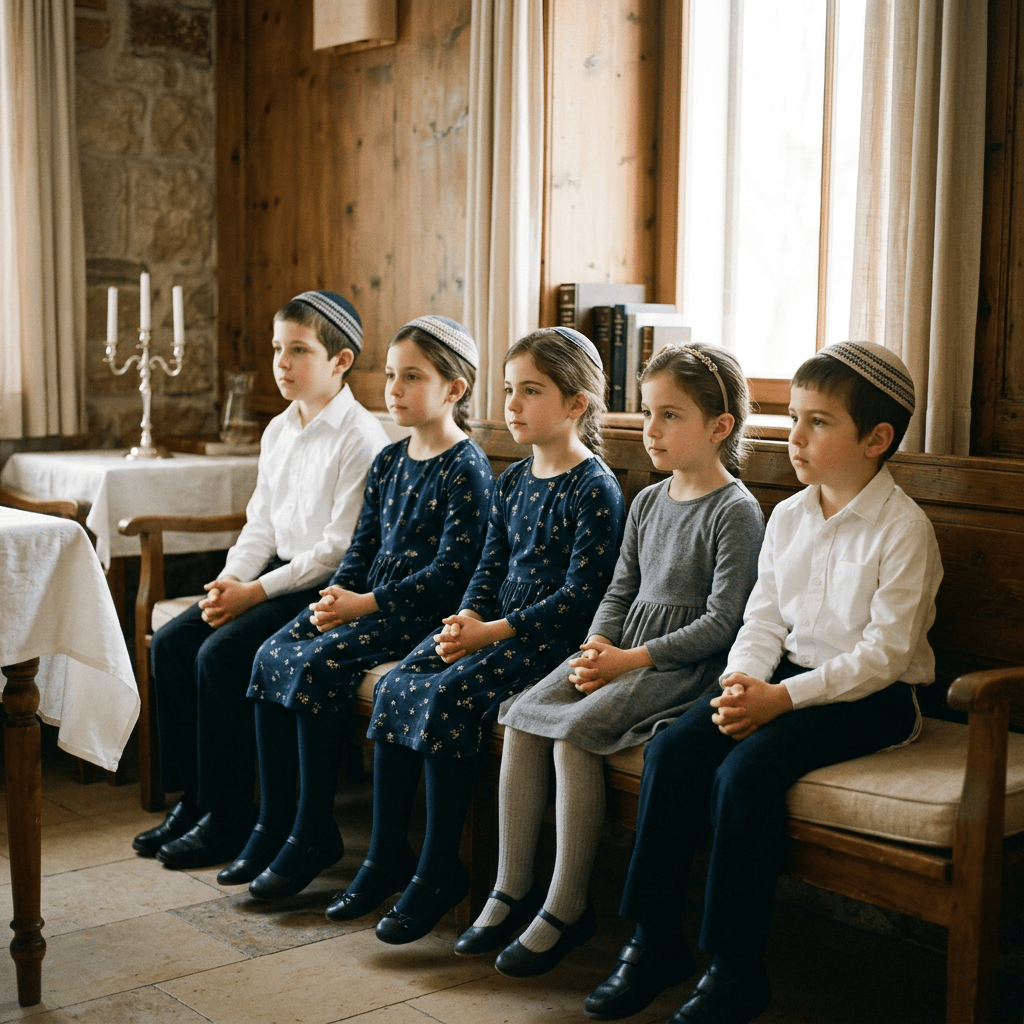
On Sundays Mary and Laura must not run or shout or be noisy in their play. Mary could not sew on her nine-patch quilt, and Laura could not knit on the tiny mittens she was making for Baby Carrie. They might look quietly at their paper dolls, but they must not make anything new for them. They were not allowed to sew on doll clothes, not even with pins.
They must sit quietly and listen while Ma read Bible stories to them, or stories about lions and tigers and white bears from Pa’s big green book, The Wonders of the Animal World. They might look at pictures, and they might hold their rag dolls nicely and talk to them. But there was nothing else they could do.
Laura liked best to look at the pictures in the big Bible, with its paper covers. Best of all was the picture of Adam naming the animals.
Adam sat on a rock, and all the animals and birds, big and little, were gathered around him anxiously waiting to be told what kind of animals they were. Adam looked so comfortable. He did not have to be careful to keep his clothes clean, because he had no clothes on. He wore only a skin around his middle.
“Did Adam have good clothes to wear on Sundays?” Laura asked Ma.
“No,” Ma said. “Poor Adam, all he had to wear was skins.”
Laura did not pity Adam. She wished she had nothing to wear but skins.
One Sunday after supper she could not bear it any longer. She began to play with Jack, and in a few minutes she was running and shouting. Pa told her to sit in her chair and be quiet, but when Laura sat down she began to cry and kick the chair with her heels.
“I hate Sunday!” she said.
Pa put down his book. “Laura,” he said sternly, “come here.”
Her feet dragged as she went, because she knew she deserved a spanking. But when she reached Pa, he looked at her sorrowfully for a moment, and then took her on his knee and cuddled her against him. He held out his other arm to Mary, and said:
“I’m going to tell you a story about when Grandpa was a boy.”
The Story of Grandpa’s Sled and the Pig.
“WHEN your Grandpa was a boy, Laura, Sunday did not begin on Sunday morning, as it does now. It began at sundown on Saturday night. Then everyone stopped every kind of work or play.
“Supper was solemn. After supper, Grandpa’s father read aloud a chapter of the Bible, while everyone sat straight and still in his chair. Then they all knelt down, and their father said a long prayer. When he said, “Amen,” they got up from their knees and each took a candle and went to bed. They must go straight to bed, with no playing, laughing, or even talking.
“Sunday morning they ate a cold breakfast, because nothing could be cooked on Sunday. Then they all dressed in their best clothes and walked to church. They walked, because hitching up the horses was work, and no work could be done on Sunday.
“They must walk slowly and solemnly, looking straight ahead. They must not joke or laugh, or even smile. Grandpa and his two brothers walked ahead, and their father and mother walked behind them.
“In church, Grandpa and his brothers must sit perfectly still for two long hours and listen to the sermon. They dared not fidget on the hard bench. They dared not swing their feet. They dared not turn their heads to look at the windows or the walls or the ceiling of the church. They must sit perfectly motionless, and never for one instant take their eyes from the preacher.
“When church was over, they walked slowly home. They might talk on the way, but they must not talk loudly and they must never laugh or smile. At home they ate a cold dinner which had been cooked the day before. Then all the long afternoon they must sit in a row on a bench and study their catechism, until at last the sun went down and Sunday was over.
“Now Grandpa’s home was about halfway down the side of a steep hill. The road went from the top of the hill to the bottom, right past the front door, and in winter it was the best place for sliding downhill that you can possibly imagine.
“One week Grandpa and his two brothers, James and George, were making a new sled. They worked at it every minute of their playtime. It was the best sled they had ever made, and it was so long that all three of them could sit on it, one behind the other. They planned to finish it in time to slide downhill Saturday afternoon. For every Saturday afternoon they had two or three hours to play.
“But that week their father was cutting down trees in the Big Woods. He was working hard and he kept the boys working with him. They did all the morning chores by lantern-light and were hard at work in the woods when the sun came up. They worked till dark, and then there were the chores to do, and after supper they had to go to bed so they could get up early in the morning.
“They had no time to work on the sled until Saturday afternoon. Then they worked at it just as fast as they could, but they didn’t get it finished till just as the sun went down, Saturday night.
“After the sun went down, they could not slide downhill, not even once. That would be breaking the Sabbath. So they put the sled in the shed behind the house, to wait until Sunday was over.
“All the two long hours in church next day, while they kept their feet still and their eyes on the preacher, they were thinking about the sled. At home while they ate dinner they couldn’t think of anything else. After dinner their father sat down to read the Bible, and Grandpa and James and George sat as still as mice on their bench with their catechism. But they were thinking about the sled.
“The sun shone brightly and the snow was smooth and glittering on the road; they could see it through the window. It was a perfect day for sliding downhill. They looked at their catechism and they thought about the new sled, and it seemed that Sunday would never end.
“After a long time they heard a snore. They looked at their father, and they saw that his head had fallen against the back of his chair and he was fast asleep.
“Then James looked at George, and James got up from the bench and tiptoed out of the room through the back door. George looked at Grandpa and George tiptoed after James. And Grandpa looked fearfully at their father, but on tiptoe he followed George and left their father snoring.
“They took their new sled and went quietly up to the top of the hill. They meant to slide down, just once. Then they would put the sled away, and slip back to their bench and the catechism before their father woke up.
“James sat in front on the sled, then George, and then Grandpa, because he was the littlest. The sled started, at first slowly, then faster and faster. It was running, flying, down the long steep hill, but the boys dared not shout. They must slide silently past the house, without waking their father.
“There was no sound except the little whirr of the runners on the snow, and the wind rushing past.
“Then just as the sled was swooping toward the house, a big black pig stepped out of the woods. He walked into the middle of the road and stood there.
“The sled was going so fast it couldn’t be stopped. There wasn’t time to turn it. The sled went right under the hog and picked him up. With a squeal he sat down on James, and he kept on squealing, long and loud and shrill, ‘Squee-ee-ee-ee-ee! Squee-ee-ee-ee-ee-ee!’
“They flashed by the house, the pig sitting in front, then James, then George, then Grandpa, and they saw their father standing in the doorway looking at them. They couldn’t stop, they couldn’t hide, there was no time to say anything. Down the hill they went, the hog sitting on James and squealing all the way.
“At the bottom of the hill they stopped. The hog jumped off James and ran away into the woods, still squealing.
“The boys walked slowly and solemnly up the hill. They put the sled away. They sneaked into the house and slipped quietly to their places on the bench. Their father was reading his Bible. He looked up at them without saying a word.
“Then he went on reading, and they studied their catechism.
“But when the sun went down and the Sabbath day was over, their father took them out to the woodshed and tanned their jackets, first James, then George, then Grandpa.
“So you see, Laura and Mary,” Pa said, “you may find it hard to be good, but you should be glad that it isn’t as hard to be good now as it was when Grandpa was a boy.”
“Did little girls have to be as good as that?” Laura asked, and Ma said:
“It was harder for little girls. Because they had to behave like little ladies all the time, not only on Sundays. Little girls could never slide downhill, like boys. Little girls had to sit in the house and stitch on samplers.”
“Now run along and let Ma put you to bed,” said Pa, and he took his fiddle out of its box.
Laura and Mary lay in their trundle bed and listened to the Sunday hymns, for even the fiddle must not sing the week-day songs on Sundays.
“Rock of Ages, cleft for me,” Pa sang, with the fiddle. Then he sang:
“Shall I be carried to the skies,
On flowery beds of ease,
While others fought to win the prize,
And sailed through bloody seas?”
Laura began to float away on the music, and then she heard a clattering noise, and there was Ma by the stove, getting breakfast. It was Monday morning, and Sunday would not come again for a whole week.
=======================================================
Of all the Ten Commandments the fourth is the least understood. Sabbath keeping – and breaking – was a big part of the Gospels’ telling of Christ’s ministry.
True Fasts and Sabbaths
Isaiah 58 – NIV
1“Cry aloud, do not hold back!
Raise your voice like a ram’s horn.
Declare to My people their transgression
and to the house of Jacob their sins.
2For day after day they seek Me
and delight to know My ways,
like a nation that does what is right
and does not forsake the justice of their God.
They ask Me for righteous judgments;
they delight in the nearness of God.”
3“Why have we fasted,
and You have not seen?
Why have we humbled ourselves,
and You have not noticed?”
“Behold, on the day of your fast, you do as you please,
and you oppress all your workers.
4You fast with contention and strife
to strike viciously with your fist.
You cannot fast as you do today
and have your voice be heard on high.
5Is this the fast I have chosen:
a day for a man to deny himself,
to bow his head like a reed,
and to spread out sackcloth and ashes?
Will you call this a fast
and a day acceptable to the LORD?
6Isn’t this the fast that I have chosen:
to break the chains of wickedness,
to untie the cords of the yoke,
to set the oppressed free
and tear off every yoke?
7Isn’t it to share your bread with the hungry,
to bring the poor and homeless into your home,
to clothe the naked when you see him,
and not to turn away
from your own flesh and blood?
8Then your light will break forth like the dawn,
and your healing will come quickly.
Your righteousness will go before you,
and the glory of the LORD will be your rear guard.
9Then you will call, and the LORD will answer;
you will cry out, and He will say, ‘Here I am.’
If you remove the yoke from your midst,
the pointing of the finger and malicious talk,
10and if you give yourself to the hungry
and satisfy the afflicted soul,
then your light will go forth in the darkness,
and your night will be like noonday.
11The LORD will always guide you;
He will satisfy you in a sun-scorched land
and strengthen your frame.
You will be like a well-watered garden,
like a spring whose waters never fail.
12Your people will rebuild the ancient ruins;
you will restore the age-old foundations;
you will be called Repairer of the Breach,
Restorer of the Streets of Dwelling.
13If you turn your foot from breaking the Sabbath,
from doing as you please on My holy day,
if you call the Sabbath a delight,
and the LORD’s holy day honorable,
if you honor it by not going your own way
or seeking your own pleasure or speaking idle words,
14then you will delight yourself in the LORD,
and I will make you ride on the heights of the land
and feed you with the heritage of your father Jacob.”
For the mouth of the LORD has spoken.
“Remember the Sabbath day by keeping it holy. Six days you shall labor and do all your work, but the seventh day is a sabbath to the Lord your God. On it you shall not do any work, neither you, nor your son or daughter, nor your male or female servant, nor your animals, nor any foreigner residing in your towns. For in six days the Lord made the heavens and the earth, the sea, and all that is in them, but he rested on the seventh day. Therefore the Lord blessed the Sabbath day and made it holy.” Ex 20:8-11
At that time Jesus went through the grainfields on the Sabbath. His disciples were hungry and began to pick the heads of grain and eat them. 2When the Pharisees saw this, they said to Him, “Look, Your disciples are doing what is unlawful on the Sabbath.”
Matt 12:1-8
3Jesus replied, “Have you not read what David did when he and his companions were hungry? 4He entered the house of God, and he and his companions ate the consecrated bread,a which was not lawful for them to eat, but only for the priests.
5Or haven’t you read in the Law that on the Sabbath the priests in the temple break the Sabbath and yet are innocent? 6But I tell you that One greater than the temple is here.
7If only you had known the meaning of ‘I desire mercy, not sacrifice,’b you would not have condemned the innocent. 8For the Son of Man is Lord of the Sabbath.”
23One Sabbath Jesus was passing through the grainfields, and His disciples began to pick the heads of grain as they walked along. 24So the Pharisees said to Him, “Look, why are they doing what is unlawful on the Sabbath?”
Mark 2:23-28
25Jesus replied, “Have you never read what David did when he and his companions were hungry and in need? 26During the high priesthood of Abiathar, he entered the house of God and ate the consecrated bread,c which was lawful only for the priests. And he gave some to his companions as well.”
27Then Jesus declared, “The Sabbath was made for man, not man for the Sabbath. 28Therefore, the Son of Man is Lord even of the Sabbath.”
From the scripture quotes above we know this for certain about Sabbath keeping. The Sabbath was and is a day of rest from all our labors and the troubles of this life. The Sabbath should not be treated like it’s just another day of the week. The Sabbath is a day for doing good, not evil. You should delight in the Sabbath. Jesus is Lord of the Sabbath. The Sabbath was made for man not man for the Sabbath.
So this should be our starting place when interpreting the meaning and purpose of the Fourth Commandment. We also can clearly understand that constant work, days on end, is not good for you. We also see that no labor at all is also not good for you. People need something productive to do. Watching video games or TV all day every day is destructive. You need one day, at least, in seven to recuperate and rest from your labors. As part of that day off from our normal labors we use some part of it to formally participate in corporate worship. Is this formal worship to be 12 hours, 8 hours, 4 hours, 2 hours or 1 hour?
As I have noted before, and this may be original with me (I’ve not seen it anywhere else – but it may be), that strictly speaking the Sabbath commandment also contains a positive duty: Six days you shall labor and do all your work. We know from the words of Jesus that a day contains 12 hours (John 11:9) and so a work week was to consist of six, 12-hour work days. Strict sabbatarians should therefore work six, 12-hour days. No weekends only a week end. Saturday (or Sunday) is just another work day and that “day” is 12 hours not 8.
What does “keep it holy” mean? Holy, Hebrew qodesh, is the word consecrate or separate. We separate this day from the rest of the week. We remember Yahweh (I am) as the creator of the heavens and the earth and as Israel’s Deliverer from bondage. The primary bondage of the Hebrews in Egypt was endless, hard labor and the oppression of foreign “gods”. As we have seen throughout the world where the Judeo-Christian ethic does not reign there is either endless labor or practically no productive labor. “A song of ascents. Of Solomon. Unless the LORD builds the house, its builders labor in vain; unless the LORD protects the city, its watchmen stand guard in vain.” (Psa 127:1)
Also as noted in Laura Ingall’s story above it is difficult to decide if the Sabbath allows any recreational activities or should it require only sitting still and being quiet, i.e., nearly absolute rest. I know from my family’s experience that once you start recreating on Sunday the whole day seems to get taken over, especially with youth sports or NFL games on TV. Finding the happy medium in everything is always difficult and one of the great secrets to living a balanced life.
========================================================


Leave a comment