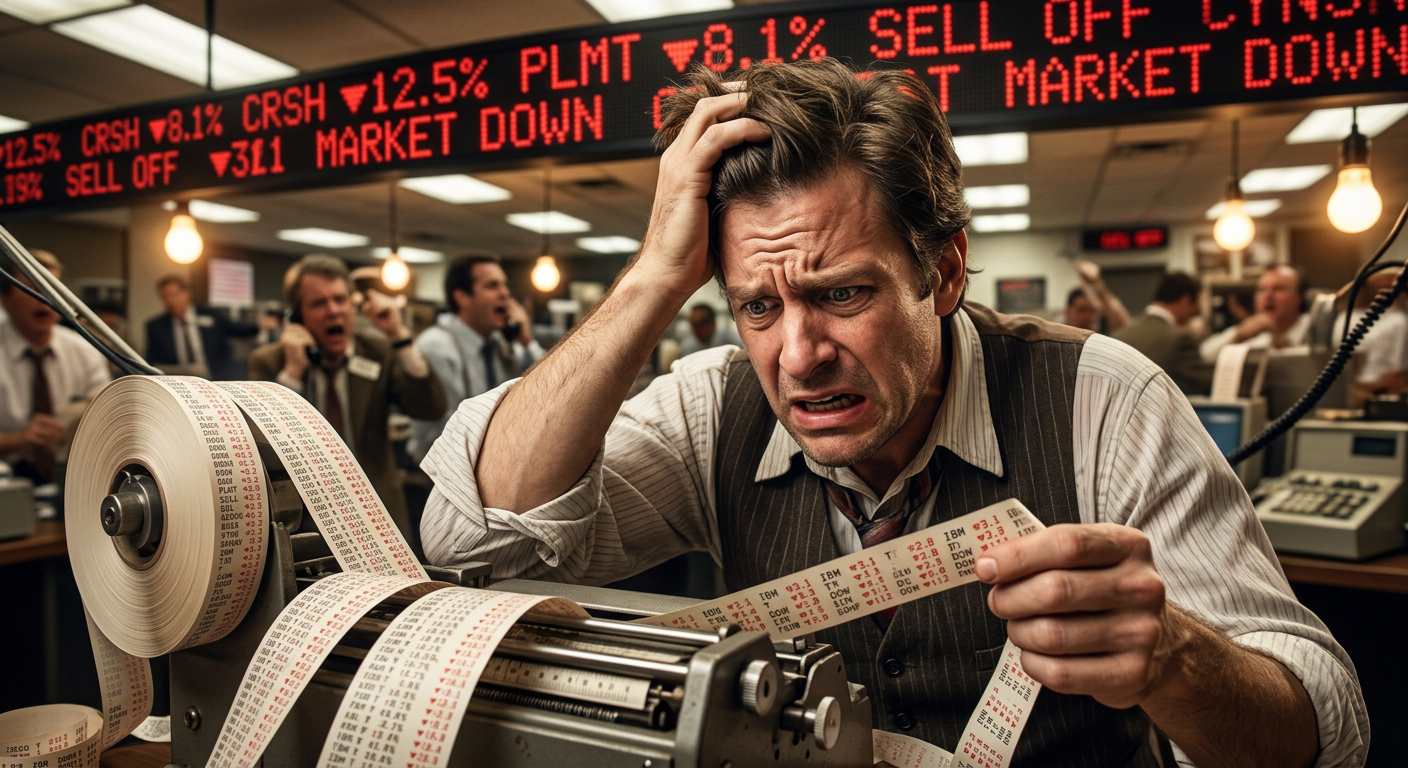

Wall Street sees biggest market cap drops ever after midterm bloodbath for GOP
My cmnt: Democrats’ ideology prevents them from making economic progress and causes them to do destructive things to our economy and country. All a dim can do is borrow (print) money and dump it into favored companies and constiuents to artificially inflate or prop-up the market. This leads to the uncontrollable inflation of the O’Biden years.

Hyperscalers like Meta, for example, have been working on data centers in Louisiana, Ohio and Texas that they hope will bring in huge revenues – but stunning blue shifts in this week’s midterms could halt construction.
Wall Street sees biggest market cap drops ever after midterm bloodbath for GOP
By Taylor Herzlich Published Nov. 5, 2026, 4:45 p.m. ET – New York Post
See more of our coverage in your search results. Make New York Post a Preferred Source
Fears of a Democrat-led clampdown on AI slammed the markets Thursday – sparking unprecedented dollar losses just a day after a massive, post-election rally.
S&P 500 firms shed $2.9 trillion in market value and Nasdaq companies lost $2.5 trillion – both single-day records. The Nasdaq entered correction territory as investors panicked over a looming data-center reckoning in the wake of Democrats’ midterm sweep.

The Dow Jones Industrial Average plummeted 1,833 points, or 3.44%, to close at 51,523.06. It completely wiped out its 1,500-point post-election rally – which was its best day in 18 months– as industry leaders grew convinced the new Congress will slow the pace of projects, potentially hitting revenue at top AI labs.
The Nasdaq dropped 5.52% to close at 24,315.00. The S&P 500 fell 4.36% to 7,353.73.
Those saving for retirement might have seen a roughly 4% drop across their 401(k)s, according to Ken Mahoney, CEO of Mahoney Asset Management – which is considered a severe single-day fall.
He nodded to an old Wall Street saying that he said came true Thursday: “Markets always go up by the way of escalators, a little bit at a time. But when they go down, they go down by way of elevators – several floors at a time.”
The Magnificent 7 stocks alone lost $1.04 trillion Thursday.
Jensen Huang’s chipmaker Nvidia shed a jaw-dropping $374 billion. Tesla and Microsoft were worth $161 billion and $117 billion less, respectively, by the end of the day.

Apple, Meta, Amazon and Alphabet also saw their market values fall by roughly $59 billion, $58 billion, $55 billion and $42 billion, respectively.
Broadcom and Nvidia fell 10% and 9%, respectively. Qualcomm slumped 9% after it issued a weak forecast due to rising costs, even after its earnings beat Wall Street estimates. Software giant Oracle fell 7%.

“Neocloud” firms – which buy AI compute and lease it to other companies – saw some of the worst losses, as CoreWeave and Nebius plunged 10% and 15%, respectively.
David Bahnsen, chief investment officer at The Bahnsen Group, said the correction was “driven by valuations that became completely disconnected from reality.”
“Thursday’s market action is what happens when euphoria and hype become the reason why stocks go up, rather than fundamentals, and that’s exactly what has been happening with tech stocks,” he added.

For months, investors have grown increasingly concerned over tech giants that have traded at jaw-dropping, multibillion-dollar valuations – even as their cash flows turn negative and earnings come in meek.
Executives promised during earnings calls that those premiums will pay off one day, arguing that massive spending will eventually translate into massive earnings.
Hyperscalers like Meta, for example, have been working on data centers in Louisiana, Ohio and Texas that they hope will bring in huge revenues – but stunning blue shifts in this week’s midterms could halt construction.
There were “many different factors” that played into Dems’ decisive victories, taking control of both the House and Senate – but data centers were front and center in exit polls across the country, Meta President Dina Powell McCormick said Wednesday.
Fifty ballot measures dealing with data centers — either allowing them or limiting them — were up for consideration across the country Tuesday. As distaste for the power-hungry projects has mounted across the political aisle, voters decided against building more centers in at least 47 cases, according to data compiled by Ballotpedia.

Roughly 26% of planned data-center capacity is located in Texas alone. On Tuesday, Democrat James Talarico won the US Senate race there and fellow Dem Gina Hinojosa beat three-term GOP Gov. Greg Abbott – while every county shifted left in a stunning flip.
“The growth rate into 2028 will clearly moderate significantly as the data center buildout comes at a much slower pace given the political map especially in the state of Texas,” Dan Ives, partner and analyst at Yorkville Ives & Co, wrote in a Thursday note.
About 30% of planned data-center capacity across the country could be impacted in 2028, UBS analysts estimated.
Chris Osmond, chief investment officer for Fifth Third Wealth Advisors, noted Thursday that while much of the focus has been on control of Congress, it could actually be governors and local regulators who play a much larger role in data-center construction moving forward.
Sam Altman’s OpenAI is already rushing to stem the backlash, releasing a new framework on Thursday including pledges to reduce power usage during peak times; share data about any impact to noise, water and energy use; and ensure residents don’t end up footing higher bills.
=============================================
William Holder
3 hours ago
Trump had this country running more smoothly and successfully than it has in decades. Anyone in the market who voted Democrat because of affordability / gas prices will find that’s the least of their financial worries now – not to mention the unlimited nonsense Democrats will endorse over at least the next couple of years.
Leave a Reply