The newly released diaries of the former top U.S. science adviser paint a picture of a fame-obsessed public official—and a mainstream media complicit in his untruths.
At the height of the pandemic, to question Fauci and the official guidance he helped establish was to be accused of spreading misinformation
 |
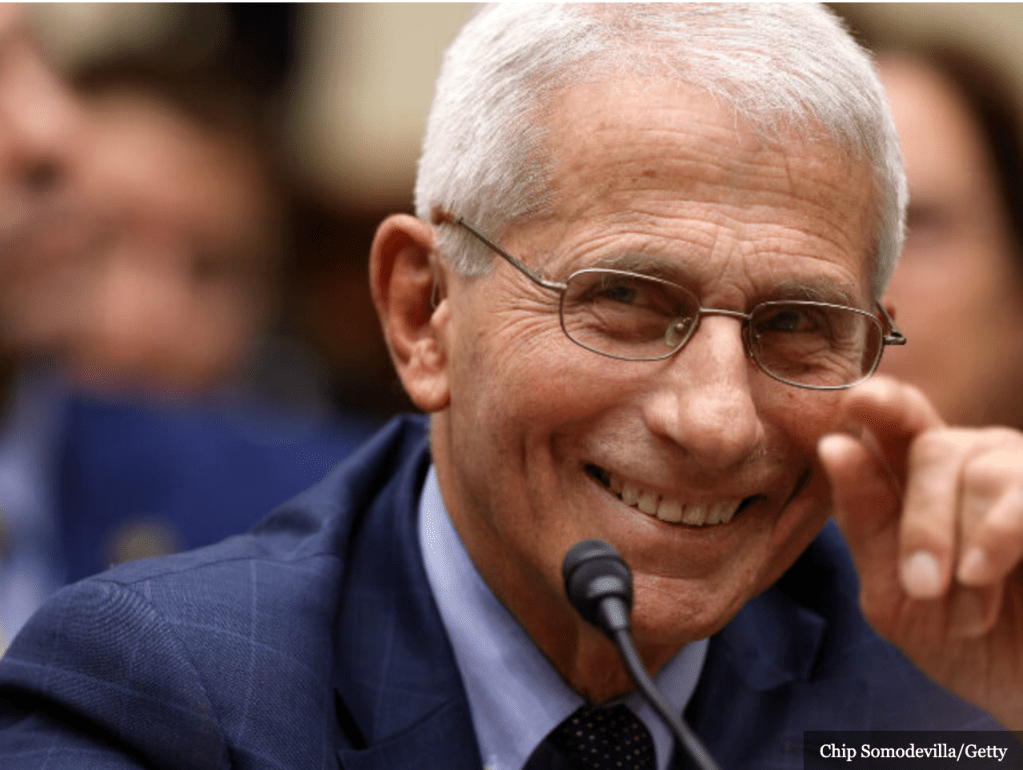
SENATOR RAND PAUL HAS SUBPOENAED DR. ANTHONY FAUCI (PICTURED) TO TESTIFY AT A HEARING RAND’S COMMITTEE IS HOLDING ON WEDNESDAY. (PHOTO BY CHIP SOMODEVILLA/GETTY IMAGES)
| By The Editors |
It’s not exactly news to Free Press readers that Anthony Fauci got a lot wrong during the pandemic.
The former head of the National Institute of Allergy and Infectious Diseases (NIAID)—and the government’s leading authority during the Covid crisis—Fauci led the call for lockdowns and school closures. Wrong. He said that it was “extremely unlikely” that people who had been vaccinated could transmit the virus to others. Wrong. He said that children as young as 2 should wear masks. Wrong. He argued that the virus had emerged from a “wet market” in Wuhan, China, jumping from an animal to a human—and shut down any suggestion that it could have resulted from a leak in a laboratory that was engaged in “gain of function” research.
As for those who disagreed, Fauci had an astonishingly arrogant response: “They are really criticizing science because I represent science.”
Back when both the public health establishment and the mainstream media hung on Fauci’s every word, Republican Senator Rand Paul was one of the few in a position of power willing to criticize him—going so far as to say that Fauci should “go to prison” for “his dishonesty” in dismissing the lab leak theory. Paul has long been convinced that the virus did indeed result from a lab leak, a position that is no longer viewed as heresy but is taken seriously by a number of officials in the intelligence community. And he has never stopped trying to get to the bottom of it. Paul has subpoenaed Fauci to testify at a hearing his committee is holding on Wednesday. Fireworks are guaranteed.
Over the weekend, Paul struck the first blow. In advance of the hearing, he released the contents of a diary Fauci kept during the crisis, all 1,141 pages.
It is a deeply embarrassing document, but it is also an important one, because it opens a window into the striking contrast between what Fauci was saying privately and what he was telling the American people throughout the pandemic. It also paints a picture of a mainstream media complicit in passing along Fauci’s untruths, with nary a skeptical note.
Fauci meticulously documents his own rising fame in the early months of the pandemic, and in doing so, he reveals why he believed himself to be beyond reproach. He notes that Julia Roberts and Stephen Curry wanted to shake his hand. People applauded him when he walked into a restaurant. Important people wanted his advice. Here is a typical entry, this one from March 1, 2020:
Got call at home this a.m. (Sunday) from Governor Andrew Cuomo (NY) asking advice [on] how he should handle the COVID-19 situation in NYC. Had long conversation in which he stressed a few times how much his father (and mother) loved me and used to tell Chris and Andrew how much they respected me and how proud they were that I was an Italian-American.
Here’s another he wrote five months later, at the height of the panic over the pandemic:
Big front-page article about me appeared in The Washington Post. Very flattering. The situation with my national and international fame is explosive and really unimaginable. It is not hyperbole to say that today I am the most famous and talked-about person . . . in the world.
No matter what was going on with the pandemic—no matter how many people were dying—Fauci kept close track of the interviews he granted. Sometimes there were a dozen in a single day. His diary conveys his obsession with his press profile—and his belief that he could get away with saying anything and the media would buy it.
The controversy over the origin of the virus is one example that stands out in the diary. In public, Fauci consistently dismissed the lab leak theory, even mocking it at one point as a “circular argument.”
“There was a study recently,” he said during an early press conference,“where a group of highly qualified evolutionary virologists looked at the sequences there and the sequences in bats as they evolve, and the mutations that it took to get to where it is now is totally consistent with a jump of a species from an animal to a human.”
In fact, there was no unanimity among the scientists. Two of the scientists believed the virus came from a wet market, Fauci writes in his diary. “The rest thought deliberate insertion was possible,” he wrote—that is, that the virus had been inserted as part of a chemical sequence in a lab and had somehow escaped.
Internally, Fauci argued that the issue needed to be investigated. “We could not let this go,” he said—exactly the opposite of his insistence in public that it could not possibly have been caused by a leak from the Wuhan lab. The fact that the lab in question had received a 2014 grant (through an intermediary) from NIAID for “gain of function” research may help explain Fauci’s reluctance to come clean about the need to investigate.
Given that so many of Fauci’s pronouncements were not backed up by anything that resembled scientific evidence, why was the mainstream media so eager to serve as his stenographer instead of digging into his claims the way journalists are supposed to? Why did they accept Fauci’s word as gospel?
The answer would appear to be found in one especially telling entry: “Chris [Fauci’s wife] and I went to a book party for our friend Ruth Marcus (Washington Post columnist), for her book Supreme Ambition about Justice Brett Kavanaugh. Party at the home of David and Katherine Bradley. . . . Elegant home. Super A-list at party: Senator Mark Warner, Kellyanne Conway, Andrea Mitchell, David Ignatius, David Frum, Zeke Emanuel, etc., etc. Rafe Sagalyn is Ruth’s agent and was there.”
Fauci was rubbing elbows with the crème de la crème of Washington media. They saw the world in the same way, celebrating a book that skewers a conservative justice. They were, all of them, friends. Like everyone else in the establishment, they thought Fauci was a hero. And which of them was going to knock him off his pedestal?
At the height of the pandemic, to question Fauci and the official guidance he helped establish was to be accused of spreading misinformation. Scientists like Jay Bhattacharya were damned by the press for daring to question the conventional wisdom—by both Fauci and the press. And don’t forget President Joe Biden, who granted Fauci a preemptive, blanket pardon as one of his last acts in office. Fauci might otherwise have been investigated for possible perjury in any of his many appearances before Congress. Instead, the president formally placed him above the law and foreclosed any possibility of setting his record straight in the courtroom.
As of this writing, AP, CNN, The Washington Post and The New York Timeshave ignored Fauci’s diary. Some things never change.
READ
A Miscarriage of Journalism at ‘The New York Times’
You might think all of this is too far back in the rearview mirror to still matter. But it does. As we have noted before, the public health establishment lost a great deal of credibility because of its response to the pandemic. It’s part of the general loss of faith in the institutions that govern American public life. Covid made people realize just how much the medical establishment was controlled by groupthink, and just how unable it was to even consider other views, much less take them seriously.
Is Anthony Fauci solely responsible for this crisis of trustworthiness? Of course not. But his hypocrisy, as evidenced by his diary, will make it that much harder to regain the trust the country needs to have in its public health officials.


Leave a Reply