UNL professor’s biographies highlight lesser-known figures in American history
- CHRIS DUNKER | Lincoln Journal Star
- 17 hrs ago – Sun. May 17, 2026
My cmnt: I’ve edited this piece for clarity and to balance the Leftist bent of the LJS and its owners, publishers, reporters and editors. With that we have an excellent interview worth the read.
=============================================
America at 250: The story still unfolding
This story is part of an ongoing series exploring the 250th anniversary of the United States in 2026.
=============================================
For many Americans, the word “founder” conjures up images of highly educated, well-to-do men in powdered wigs, who put all they had on the line when they swore an oath, “And for the support of this Declaration, with a firm reliance on the protection of divine Providence, we mutually pledge to each other our Lives, our Fortunes and our sacred Honor”, while putting the final touches on the Declaration of Independence in a Philadelphia meeting hall.
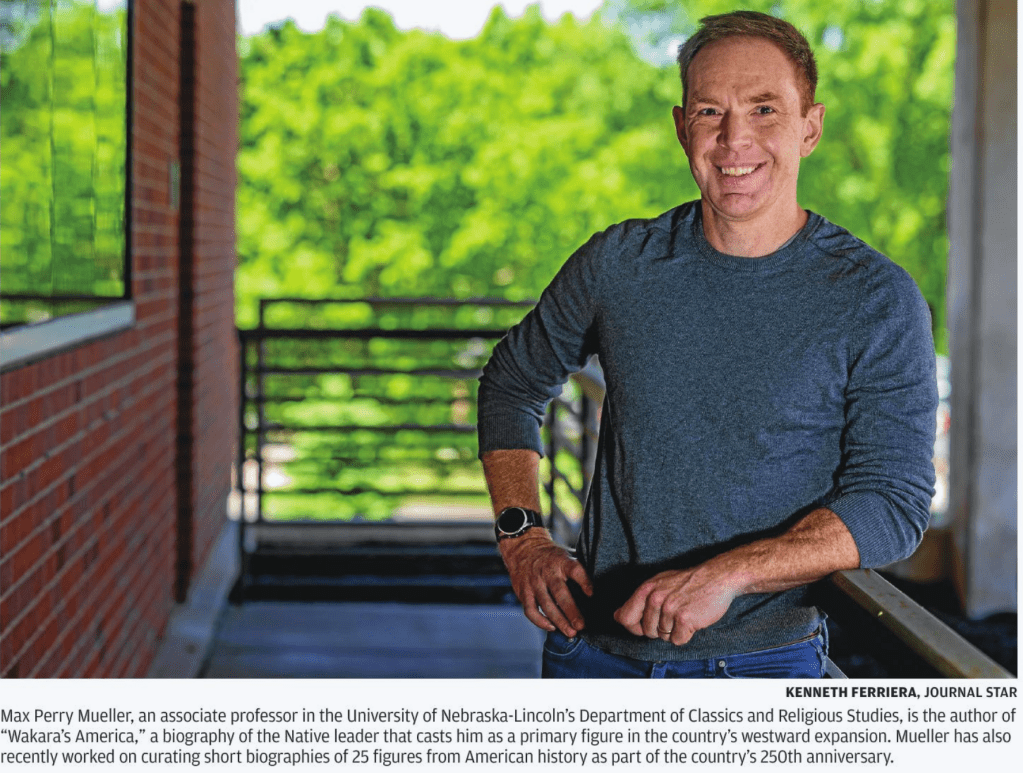
While this image is certainly true and of primary importance to the founding of our Constitutional Republic, Max Perry Mueller, an associate professor in the University of Nebraska-Lincoln’s Department of Classics and Religious Studies, sees other founders throughout America’s history playing their part in the ongoing building of the American nation.
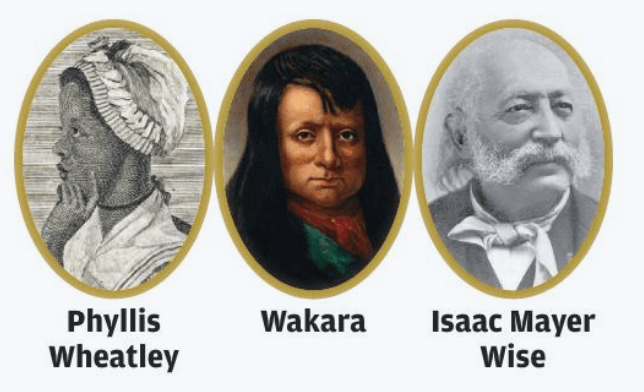
Among them are Wakara, the Native leader whose life and times were as complicated and nuanced as the figures more well-known in America’s origin story.
Wakara, or Walker as he Anglicized his name, helped explorers like John C. Frémont map the American West and helped the Latter-day Saints settle the Great Salt Lake Basin, eventually converting to Mormonism himself, Mueller said.
But Wakara also was a prolific slave trader and horse thief, someone who dominated the Old Spanish Trail in the 1840s and 1850s, and whose legacy was passed down to thousands of Americans still walking among us.
Mueller published a biography titled “Wakara’s America: The Life and Legacy of a Native Founder of the American West,” that cast the Ute chief as a primary figure in the country’s westward expansion.
The biography, which was published last November, was named a finalist for the Plutarch Award presented annually by the Biographers International Organization for the best work published in English.
Emerging from about 200 biographies considered, the selection committee called Mueller’s work “startlingly innovative” in how it presented Wakara as “an elusive but central figure in the shaping of the American Southwest.”
The winner will be announced at the annual Biographers International Conference in New York City on May 28-29.
In the meantime, Mueller has been curating short biographies of 25 figures from American history — one from each decade since the Declaration of Independence was signed — that have helped make the country what it is today.
“More, America,” the title of what he described as “a trial run” for a new book, looks at the lives and influence of individual Americans throughout the country’s 250 years, revealing “the United States has been founded again and again, often from its margins.”
It is available to read online at moreamerica.substack.com.
(The following Q&A has been edited for length and clarity.)
LJS: Your research is focused on the American West. What interests you about that topic?
MUELLER: America is the West in a lot of ways, at least in terms of the imagination. It’s a place of constant renewal, constant change, the intersecting of different people with different beliefs, both in indigenous people and newcomers like settlers. I think of America as one big West, but I’m particularly interested in the American Southwest and the influences of indigenous people because they have records of their role as historical actors in some ways better than a lot of other places, and they still live at least close to their homelands, unlike a lot of folks out east, where they’ve often been removed.
LJS: How did you hear about Wakara? When did you learn about him?
MUELLER: I learned about him through my first book, which is called “Race and the Making of the Mormon People.” It looks at how the early Latter-day Saints, the early Mormons, conceptualized race as a category. In fact, they wanted to get rid of it. They thought all schisms in the human family were not of God: the political schisms, religious schisms and racial schisms. So, they were trying to kind of remake the world as a unified body of Christ.
The Mormons are a missionary people, so they were brought out west. They were pushed west by persecution; they were pulled west by attraction to a larger population of Native Americans. But when they got to Utah, they soon discovered that Wakara was the most dominant person of the American Southwest. In fact, they got to Utah using the maps that Wakara helped design through John C. Frémont, the great mapmaker. Early on, Brigham Young, the second prophet of the Latter-day Saints who brought them to Utah, was both working with and fighting against Wakara for control of the Great Basin. He became a dominant figure in how Mormons understood Native Americans, so in the second project, I wanted to tell the story from his side.
LJS: Many indigenous histories are passed down through an oral tradition. Sometimes there may be written records. What sources are you using to tell Wakara’s story?
MUELLER: One of the key theses of my work is, and I’m not alone in this, that the written archive is no more reliable than the oral. The archive is not a neutral place. It’s where politics is made, or where race is made. Race is first written and described on the page and then read onto bodies.
How the Mormons, how the Californians, how the New Mexicans recorded Wakara wasn’t a neutral description of what happened. They had the means of production of history and the written word, so they got to decide who would be remembered as a savage and who was more civilized, who was a Christian and who was a heathen.
That said, the written archive is really invaluable. The Mormons have a revelation from the founding of the church: “Let there be a record kept among you.” So Latter-day Saints are always writing things down as part of their effort to record God’s favor in their lives. The Mormons become the biggest source without question as they’re occupying and colonizing Wakara’s homeland.
But oral histories are just as important. I read a lot of oral histories that were recorded by early anthropologists, ethnographers who worked with Wakara’s descendants. He died in 1855, but I work very, very closely with his direct descendants today. A good number of them are in the federally recognized Ute tribe, but he has a lot of descendants, and there are a lot of white-presenting people walking around today who have no clue that they’re directly descended of Wakara.
Wakara was a slave trader, he captured Paiutes in southern Utah and sold them along the Old Spanish Trail, and he sold them to Mormons when they arrived, sold them to Californians and New Mexicans. When I described that to some contemporaries who are now friends, they said, “You white historians have made that up to make us look bad.” They heard of the chattel slavery of the South. Wakara practiced a form of slavery that was brutal and dehumanizing, but it was much more fluid and complicated than the chattel slavery of the South.
Sometimes Wakara would enslave people who would become his own kin, his adopted children, his own wives. Sometimes the people Wakara gave away would also become kin to those families. It’s a much more complicated relationship, but the oral stories and pushback I got really helped me inform what I read in the archives.
LJS: What is the most surprising thing you learned about him in your research?
MUELLER: Because this is a trade press book instead of a university press book, it’s designed for wider audiences, so in some ways you need a hook or a frame. The frame was pretty clear: Wakara had a huge influence on the American West, so I started with that frame that he was a different kind of founder. When the Latter-Day Saints get there (to Utah) he helped settle a lot of the villages outside of the Great Salt Lake Valley. He brought the Mormons to a lot of different places, in part, because he wanted to drive out his indigenous rivals.
He’s a major cartographer. All the great western explorers in the 1840s, when he’s most active, are going out west and he meets with almost all of them. John C. Frémont says (Wakara) knows the West better than anyone, and what he describes literally gets written down in their journals and then is brought back to Washington and printed as maps. Those maps are used to bring settlers, including the Latter-day Saints, west.
He’s a road builder. He helped build the Old Spanish Trail, which should really be called a Ute trail, because it’s really the Utes who built it. He graded it, he built things, he established watering holes. He was really an infrastructure builder. And of course, he was a horse raider and slave trader, which is how he got most of his money and power, which he used to disrupt the Mexico-era California, softening it up to allow the U.S. to come and annex it.
LJS: You describe Wakara as a founder, and this year, you’ve been writing about other Americans you consider founders, but who may be little known or forgotten about. What gave you the idea to do that?
MUELLER: Wakara inspired me to think of founding differently. He clearly influenced and helped found a major part of America, obviously in relationship with other people. The 250th anniversary, like every anniversary, is an opportunity. I’m a scholar of religion, and what we find in religion is that humans are ritualistic people and throughout time, we use anniversaries as a time to re-remember what has happened in the past and re-narrate what has happened.
We will get a certain kind of narration of American history out of this federal government, a particular version which is not not-true, but it’s not complete. A very triumphalist version of American history that celebrates certain kinds of people with certain kinds of ideas from certain values. I think that’s a history that will always be incomplete.
America is always being reinvented, renewed, changed, right? The idea is to look at different people from different backgrounds from each decade of America’s history, to find people who often challenged America to live up to its ideals established in 1776 — all men and women are created equal being one of them, and equal rights under the law — who have been left out, purposely left out, but often called on America to be more inclusive.
The person I start with is Phyllis Wheatley, who’s a great poet of the revolution. She was an enslaved child brought directly from Africa to Boston in the 1760s when Boston was still a slave city. She was a genius and had these surprising connections with some really important figures like George Washington but wrote about her exclusion as a Black woman and challenged America to include her.
Other people, like Denmark Vesey, who led a planned slave revolt in South Carolina in the 1820s, thought America was, at its core, too rotten by racism to have a place for people of Africa. He thought America needed to be burned down and African people needed to leave, but his spirit and ideas helped found a kind of Black revolutionary politics.
And for the 1880s, I’m writing about Isaac Mayer Wise, who is the founder of Reform Judaism. One of the things that’s amazing about the United States is that all of the world’s religions come here because of America’s exceptionalism, which is a freedom of religion and allowing religion to flourish. Adam Smith, in “Wealth of Nations,” was thinking about the U.S. when he wrote in 1776 if there was a nation that broke up the monopoly of religion, that various religions could flourish, and that’s exactly what happened in the United States.
Isaac Mayer Wise helped create this new American version of Judaism. Global Catholicism was really reinvented in the U.S. Islam is being reinvented now and exported to the world.
LJS: Some of these lesser-known figures might be considered controversial teaching of American history by some. How do you see it?
MUELLER: Even Phyllis Wheatley was recognized by PragerU (a conservative nonprofit that has sponsored posters about American founders at the Nebraska State Capitol) as a kind of founding figure. I think people underestimate how resilient young people can be. When we say, “Slavery was built on white supremacy,” a student, I’m confident, has the ability to say, “That isn’t a critique of me and my experience directly.” They also have the ability to see the struggles that, say, Native Americans have had to gain autonomy as separate or independent nations, but also for inclusion in the American political experience. I can learn from that experience and that is my story too, right?
LJS: So you see students are receptive to and thinking about these ideas, no matter where they may fall on the political spectrum?
MUELLER: I’m amazed at my students. This is why a diverse student body is so important — religiously diverse, politically diverse, racially diverse — because we learn from each other. It’s not my job to impose a belief system and I don’t. I can’t make students believe in the theory of gravity. We can show them evidence, we can think of alternatives to the theory of gravity, but I can’t impose it on students. The idea that I can impose theories of American history underestimates the ability of our students to think critically for themselves.
LJS: As you are working through this history of America, you said these people have founded America again and again, often from its margins. Is there a common theme or arc you’ve found?
MUELLER: Maybe it seems symbolic, but often these people’s names change. Phyllis Wheatley got her last name from the family that purchased her as an enslaved person. Her first name came from the slave ship that brought her to America. That’s kind of ironic and richly powerful. The power of naming and self-naming is really an interesting act of self-creation, and I think it speaks to something that’s common in the stories I’m finding.
These people are attaching themselves to the American narrative that a lot of us share, which is an appreciation of individualism and individual rights. The celebration of America is a place where individuals, wherever they’re from, can act independent of their backgrounds but at the same time come from a certain place.
In America, we often have these kind of great dual identities, which was the subject of the great exhibition at the Sheldon, “Hyphen America.” It’s always Husker Catholics and not Catholic Huskers because their first identity is Catholicism, right? Husker is the adjective. Americans put the American identity first and then a political affiliation, a racial affiliation or religious affiliation. Some might say the part before the hyphen comes first, but I find it to be the case that all of these people really identify as Americans and want America to be a place where they can be Americans but also have their other identity included.
Reach the writer at 402-473-7120 or cdunker@journalstar.com. On Bluesky @chrisdunker.bsky.social
“Wakara inspired me to think of founding differently. He clearly influenced and helped
Max Perry Mueller, University of Nebraska-Lincoln associate professor and author of “Wakara’s America”


Leave a comment