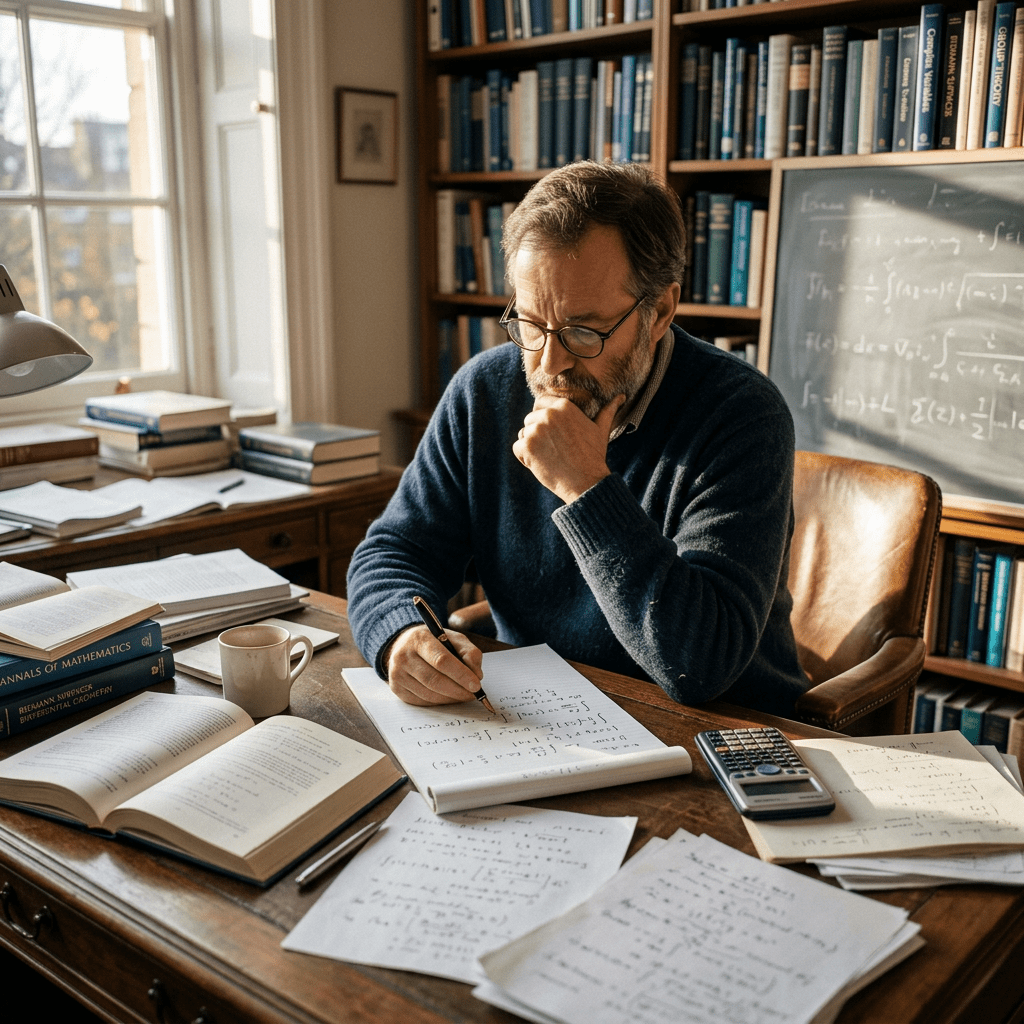
By Roland Hesse – Aug. 5, 2022 – UNL Grad Student, doctoral program in Plasma Physics
My cmnt: It is May of 2026 and Roland has graduated and is now Dr. Hesse. He remains among the most brilliant and thoughtful of men I have had the pleasure of calling friend.
When Niels Abel died in 1827, no contemporary recognized that one of the greatest shifts in world history had just transpired. At his death, his accomplishments amounted to having lived just short of twenty-seven years, having been engaged but not yet married, having officially published nothing, having toured the continent without recognition, and having returned to Norway in sickness and shame. By all accounts just he was just another prodigy failure.
However, to the contrary, something remarkable had just transpired: a mathematician had managed to do what no one had done before, in leaving behind a complete record of his life’s work, plainly recorded and free from the accolades, self-importance, or simple obscurity that consigned so many previous mathematicians to the dustbin of history.
In his eight years of work, Abel had managed to fully integrate the theory of modular structures, the classical polytropic question, and the complex analysis, all while developing an entirely new branch of thinking called abstract algebra. Yet these were not the greatest monuments to his labors. By dying a ‘nobody’, Abel managed to break the tyrannical cycle of institutional aggregation and truly unlock the power of individually wielded knowledge.
Indeed, the persistence of the damnable academic enterprise – supposing that knowledge can be preserved in some school or library or archive (or more subtly, among some collection of people) – is one of the most dangerous ideas still circulating today. Archaeologists continue to unearth discoveries from ancient and even intermediate civilizations that make it clear that whatever knowledge people think they possess, they do not truly own; when the civilizations crumble and the records burn, citations and references come to nothing. For those who do not understand, even what they think they know comes to nothing. But it is not so among those who in life actually grasp the intangible – whatever words or works survive them retain their value. Such are capable of surviving the inevitable collapse and loss of academic knowledge.
It is this astonishing paradox that brings us to the topic at hand: learning to see the world through mathematics. It would be a lengthy and detailed exercise to study the life and work of the twelve hundred most pre-eminent mathematicians who have yet lived. I guarantee that every real mathematician would jump at the opportunity, were the life expectancy of humans a thousand years. Yet even in that time, how could one keep pace with new discoveries? There is no way to cry, “Halt! We must figure this out first.” So, what do people actually do when seeking knowledge?
Some people absorb themselves in what we might call the descriptive paradigm of knowledge acquisition. This involves a lot of connecting dots, book-keeping, and construction. As an endless stream of new dots appear each moment, there is never a dull space or time to cease. But this world is very much a dreary one. A world of objects, categories, and relations “endlessly putting things on top of other things.” After all, much contemporary scientific inquiry is conducted in the view that knowledge builds upon knowledge like some set of toy blocks. People who are thinking in this way tend to try to accumulate first and sort later, or sort first and accumulate later. Both approaches are nothing but mess and pain, and subject to futility.
In practice, that spark of insight is soon forgotten and then lost in the bin of unsorted things. There is great consolation in always having enough ‘things to do later’ stored up for a rainy day. But what if such a day of rest never comes? How will the sum be reckoned? So many people have this mindset as something of an abstraction for their ‘real’ life, which remains likewise, a contented mix of mess and pain, consoling itself with the thought that someday it will be!
The dullness of this material view may be somewhat relieved through the shift in perspective towards a relational paradigm, in which the burden of cataloguing is mostly abandoned in favor of discarding all but the simplest interactions between constituent pieces, until the bare minimum needed to explain the simplest things is ascertained. This crown of the scientific revolution has, with the advent of the computational age, turned out to be a colossal failure.
It turns out that the analytic approach that is wildly successful in finding the simplest theory of algebra, geometry, discretization etc., or even applying it to the real world, becomes inconceivably difficult to synthesize and practically impossible when applied to non-ideal situations involving moderately nontrivial assumptions. The sufferings of this viewpoint are somewhat reversed from the previous. Whereas one comes to enjoy a much simpler matter of sorting and processing when relying on the relative rather than the absolute, there is the danger of blindness to actual recognition of internal contradictions. The disharmony relieved in relational thinking is only traded for ignorance with respect to ‘visible effects.’ This might be accepted as incongruity with the real world, provided the mind is safe. It is a simple matter to convince oneself that “of course I know how that works, who doesn’t?” and to become truly incapable of rebuilding the superstructure from scratch.
I have found that enough humility can provide sufficient common ground to survive any combination of the descriptive paradigm or the relational paradigm which one encounters in the process of knowledge transfer. Your job as student of any material becomes to learn the external language belonging to another, work-out the interpretation in your own external language, and then to deconstruct or reconstruct the whole in such a way as may be directly compared to the internal superstructure accompanying your mind.
Here is the problem: if there is tension at this moment, it becomes very time consuming to figure out whether your own superstructure or that of the person you are supposedly gaining insight from ought to be torn down and rebuild first. And if you choose wrong, you have not gotten anywhere! Not that anyone respectable would tear another down, per se, but this destruction exists in the context of knowledge imparted by another through reflection the mind of the individual to whom it is entrusted.
Spend any extensive amount of time in the academic world, and I am sure you will find that just as there are many who ride the coat-tails of credentials without the least understanding of the meaning of the works they cite, there are many who are confident they could boot-strap the entire programme of history in the self-perceived sharpness of their own minds. Both extremes are precarious mindsets, and one who does right “will do well to avoid extremes.” Yet is the middle ground any better?
I would argue that the ground between the descriptive and relational paradigms is not safe, but this matter is too difficult a tangent to address here. Instead, I will merely give my opinion that the compromise between two unfulfilling extremes is itself unfulfilling. Should you try to find the sweet spot, you will probably go insane while questioning everything, down to the very energy you spent on doubting the doubts about those doubts you undoubtedly forgot to doubt. This point, however, is probably better left to experience.
There appear to be many people who can survive the state of mind of disorder without going crazy. Perhaps the century hard-limit on lifespan explains the ability of the human civilizations to survive internal discord of the individual mind for a few hundred years of chained generations at-a-time. The population equilibration provided by antisocial tendencies of those with disagreeable attitudes probably plays a factor. It nevertheless must be conceded that there are a great many “poor in spirit” who manage to maintain both humility and goodness while never having the wit nor will to sort out the problems presented by the world’s ambiguities.
I make this remark with caution, because there is great risk that my elaboration on the essential paradigm of mathematical understanding will amount to nothing more than a dry and reductionist epiphany. My own route to uncovering the essential nature of mathematics came through my second course in abstract algebra, in which I learned that the structure of the logic in algebra is dual to the structure of the categories themselves.
“This language,” I thought to myself, “is just that, a schema. The master craftsman would have no trouble doing what he pleased with it. The rules of the game are so close to being binding, but so far from it.”
Some time later, I was looking at the reflection of light in a water fountain and saw, for the first time, not the ray within the water nor the ray from which it came, but both together – and for perhaps the first time in my life, experienced a synthesis of abstraction and simultaneous experience. Not long after that, I dreamed a very strange dream in which the question of construction of a ternary operator without reduction to binary operators remained in my waking mind. It bothered me that something which was clearly not impossible by description could yet be transcendental to description.
Altogether these experiences pointed towards a common observation: mathematics is an intrinsic and not extrinsic feature. Some have been trying to build a world by math, others have been trying to build a world in math, and still others have been trying to build a world out of math. What about a world that is math, ‘creato ex nihilo’?
A mathematical universe in which every conceivably good thing finds expression. After all, “The LORD is a jealous God.” Could this real world be a part of that created mathematical universe, and not just an instantiation as so often imagined?
Would it not necessarily follow that to preserve all good, some evil has been permitted within appointed limits? What about the possibility that the truly best is not rendered impossible on account of suffering? If all the evil in the universe were bound into a point, would anything be different than the test of the tree of knowing good and evil? Could the releasing of that void cause anything less than the broad corruption of our plane in the universe? Would not the restoration then involve the painful rebinding of all evil back into an abyss, and the equally painful rebinding of good by the equally unique and deadly tree of life? Might this all have been done to show the power of God to “overcome evil with good”? Might not the greatest danger be in looking within ourselves and our limited sphere to solve our problems?
In such an essential paradigm there is room not only to contain whatever one is thinking from day-to-day, nor merely the history of what one has thought or will ever think, but also for every naturally fracturing and branching expansion of valid scenarios of the mind as it struggles with and grasps the created infinite and the eternal God, uncreated. There is room for error and there is room for doubt. There is room for peace accompanying goodness and there is room for suffering accompanying evil. There is room for natural cause and effect as there is room for choice.
As one learns in studying the nature of mathematics, the restrictive property that exploration from the inside a system does not reveal external characteristics nevertheless also does not preclude the discovery of externally intuited connections. This beautiful freedom would allow something of a reconciliation point for the descriptive and relational camps, were both willing and able to grasp the larger picture. Both material paradigms can be seen as a misguided adventure to explain the whole of what can be known using the whole of what can be known, limiting the horizons of imagination and perception.
The futility of the enterprise of knowledge can also be surmised, seeing that “all knowledge will come to fade” in the exaltation of the narrow way of life into yet unknown horizons rather than by placement of some final item in catalogue or by some supreme terminal relation. But although “God is not a God of disorder but of peace”, yet “who dare ascend to heaven (to bring Him down) or to the deep (to raise Him up)? Such reveals the darkening of the mind that closes itself to what it knows it can control. Without sight there can be no recognition, and without recognition there can be no faith. Without faith, there is nothing but the material realm, leaving the soul to the whims of whatever powers play the strings of “eternity in the heart of man” to suit their own momentary desires.
The jewel of a world that is math is not some monster that grows by consumption of information and material, but “a seed that falls to the ground that it may spring to life a tree.” What is true becomes exceedingly honorable, while that which is false comes to nothing. Am I able to join that Seed and Tree of Life, or will my very self disappear down some awful never-ending abyss? In the essential paradigm applied to the real world, the question of information becomes not a matter of tracking material or entropy but of having one’s eyes open. The paradox of difficult faith and salvation comes alive to anyone who is able to see it, because the world around and within comes alive to the extent to which you are alive. There is a treasure that you must find, at any cost, though it cost you your life and everything else. Because nothing else matters when you have finally seen the invisible and realized that you cannot grasp it in your own power. Only the approval of the Creator is worth seeking.
I will end this essay with a remark on another unrecognized genius mathematician whose death marked the change of the world. His name is Jesus Christ. Pause there for a second and marvel at the shame of the statement. ‘Why would the Creator involve himself in the world? Isn’t working from within as well as above breaking the rules?’ Well – have you studied the rules of wisdom by which the math is designed? ‘Wait! That doesn’t count. “It is the glory of God to conceal a matter and the honor of kings to discover it.” God is not allowed to do anything but “create the integers” as it were, for that “is what the authorities have concluded” and I would risk all the undoubtable collective knowledge of my civilization to abandon it!’


Leave a comment