
- DENNIS RUDNER – Lincoln Journal Star – April 25, 2026
My cmnt: Look, I like trees as well as the next guy. I’ve planted plenty of them over 46 years of home ownership. And planting them in the city has generally been a good thing. But it’s time for the rabid environmentalists and nature worshipers to come clean. We do not live in the Midwest we live on the high plains. They are a grass-covered prairie with trees only naturally growing along creeks, streams and river bottoms. According to Lib-Left beliefs man is never to alter the environment. Planting trees is destroying the natural prairie. Plowing it up to feed the nation and the world is, again according to Lib-Left dogma, evil and wrong. Bison, deer and wolves are the natural inhabitants and the prairie should be returned to this natural fauna. Same with the Eastern U.S. It should be cleared out and replanted with trees from the sea to the Mississippi River. Arbor Day is a manmade abomination to the natural world.
We will go out on a limb and assume most people reading this know Arbor Day has its roots in Nebraska — and hopefully people will be inspired to plant trees.
“It’s about celebrating the impact trees have on our lives,” said Jasmine Putney, senior manager at the Arbor Day Foundation, which is in downtown Lincoln. “Trees do so much for us every day. In our communities, trees clean the air, provide essential cooling, act as a natural noise barrier, and improve people’s mental and physical health.”
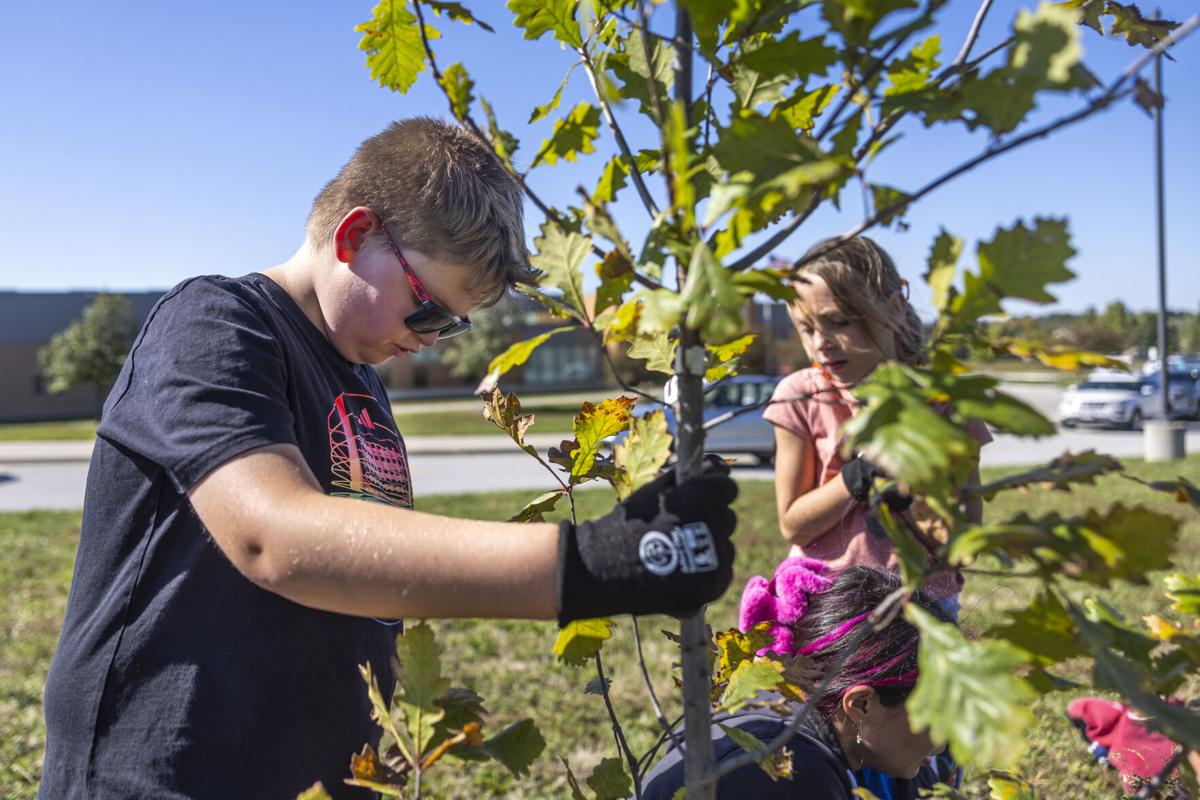
In recognition of the special bond we share with trees, the Arbor Day Foundation launched the Million Trees Project, Putney said. “We’re assembling the world’s largest collection of personal tree stories and planting another 1 million new trees in communities this spring season.”
Tree stories? Yes, everyone has a story about trees.
They can be about planting saplings and watching them grow. Or playing in trees and swinging from trees or sitting underneath a willow and reading a book. Maybe your story is just about admiring the beauty of nature.
Even though Arbor Day falls on Friday, there are events at the Arbor Day Farm in Nebraska City and in Lincoln with the fourth annual Arbor Day LNK celebration.
In Nebraska City, festivities on Friday begin at 9 a.m. at Arbor Lodge Mansion. Wine and cider tastings begin at 11 a.m. at the Apple House Market.
On Saturday, free guided tours of the Lilac Trail will be offered (reservations required), along with guided tree identification walks. The annual Arbor Day parade begins at 1 p.m. on Central Avenue.
Festivities continue Sunday with additional guided tours and a plant and tree sale.
The Arbor Day LNK event is set for Sunday from noon to 3 p.m. at Antelope Park. The event includes live music, tree planting and yoga.
We assume most people understand the important role trees play in our environment. So stick around — we’ll dig a little deeper to share some fun facts about trees. And we promise — no more tree puns.
You get a forest. And you get a forest. Everyone gets a forest.
There are about 3 trillion trees on Earth. The global population is about 8 billion.
Divide those 3 trillion trees among every adult and child, and each human gets about 370 trees — or their own little forest.
Nebraska’s state tree
Nebraska’s state tree is the eastern cottonwood. It was chosen in 1972 (the same year the Arbor Day Foundation was founded) because cottonwoods are tough, fast-growing, and they thrive along Nebraska’s rivers and streams. Early pioneers used them as windbreaks, fence posts and shade on the open prairie.
Record-breaking giants
The oldest tree in the world is a bristlecone pine in California, clocking in at more than 4,800 years old, Putney said.
The tallest tree in the world is Hyperion, a coast redwood in California that soars to about 375 feet. That’s taller than the Statue of Liberty. The largest tree by volume is General Sherman, a giant sequoia in California. General Sherman is over 2,200 years old and towers 275 feet high.
In Nebraska, the oldest known tree, the “Old Wolf Oak” in Ponca State Park, lived for roughly 380 years before it died in 2025, Putney said. As for height, Nebraska’s tallest tree is an eastern cottonwood at Pibel Lake in Wheeler County, which stands about 85 feet tall.
If trees could talk, what would they say about humans?
Probably the same thing we say at the Arbor Day Foundation, Putney said.
“We can’t do this alone. Trees have the power to shape a healthier, more resilient future for us all, but they need us to plant them. Together, we can put hope in motion.”
Do trees have personalities?
Putney said not in the same way that humans do, but when you spend enough time around trees you can feel a strong presence from them. There are so many species and varieties, sizes and functions, each tree seems distinct.
It makes it easy for us as humans to describe them in a way that evokes personality, like a “wise, old oak” or a “majestic elm.”
Any good movies or books about trees?
There are so many! Two that are on my desk year-round is “Now is the Time for Trees” written by our CEO Dan Lambe, Putney said. It’s simultaneously informative and inspirational, and really helps people understand how trees benefit people and the planet.
She also referenced “The Tree Book: The Stories, Science, and History of Trees” that not only has some incredible photography, but really digs into some of the lesser-known things about trees.
Global celebrations
While Arbor Day started right here in Nebraska, it’s celebrated around the world.
“In Japan, it’s called ‘Greenery Day’ (Midori no Hi),” Putney said. “It’s part of the national Golden Week holiday in early May. People plant trees, visit parks and show appreciation for nature.”
In China, the world’s most populous country, Arbor Day is a major event, with millions of students, ordinary citizens and government officials planting millions of trees each year.
Australia has National Tree Day. South Korea celebrates “Tree Planting Day.” Iceland and Brazil celebrate as well.
“National Tree Planting Day” is also celebrated in Iran.
What is Arbor Day? Here’s the meaning behind day for trees
It literally means tree day
The Latin word for tree is arbor. True to its name, Arbor Day celebrates the preservation and planting of trees.
Arbor Day started in Nebraska
Nebraska was the first U.S. state in the US to observe it as a formal holiday in 1872. However, the Arbor Day Foundation, based in Nebraska, says “tree planting festivals are as old as civilization.”
In 1872, Julius Sterling Morton, a newspaper editor and former U.S. secretary of agriculture, submitted a resolution to Nebraska’s State Board of Agriculture to set aside one day dedicated to planting trees. After the board passed the resolution, more than one million trees were planted on the first official celebration of the day on April 10, 1872.
In 1885, Nebraska moved the holiday to April 22 in honor of Morton’s birthday. The event eventually spread to all 50 states and other countries, including Australia, Brazil and Canada.
Nixon recognized it as a holiday
In 1972, former President Richard Nixon declared National Arbor Day to be celebrated on the last Friday in April. However, some states have designated different dates to ensure the trees are planted at the best time for growth.
“The planting of trees is an action that yields a long-range benefit on generations to come,” Nixon, who created the Environmental Protection Agency, wrote in his proclamation. “Arbor Day uniquely symbolizes the truth that the earth belongs to every generation, not just ours.”
Trees offer tons of benefits
Morton and his wife sought to plant trees in Nebraska to increase the amount of shade from the hot prairie sun. Trees also served as windbreaks, fuel and building materials.
Today, trees provide wildlife habitat, erosion control and natural beauty, the Arbor Day Foundation says.
In addition, they offer huge benefits when it comes to absorbing atmospheric carbon dioxide, which is the main driver of climate change.


Leave a comment