by Casey Chalk – Spring 2026 – Claremont Review of Books
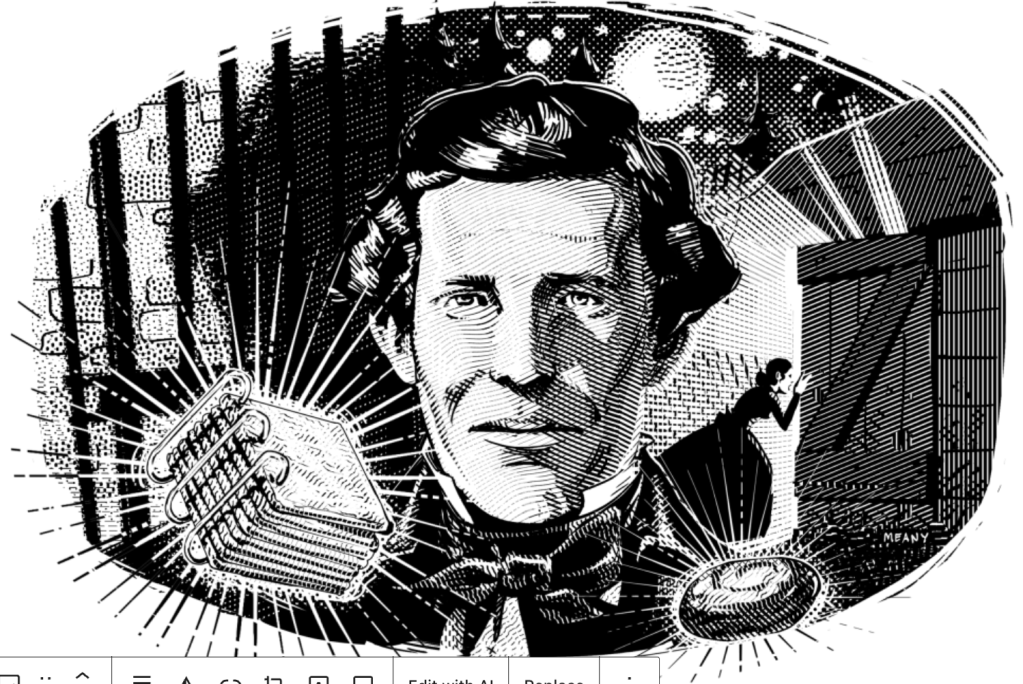
In November 1839, Joseph Smith traveled to Washington, D.C. Styled the prophet and president of the Church of Jesus Christ of Latter-day Saints, he sought an audience with then-president Martin Van Buren. The Saints, popularly called “Mormons” after the reputed author of their holy writ, had been hounded by vigilante mobs in Missouri. Van Buren expressed his sympathy for the Mormons but said regretfully that “if I do anything, I shall come in contact with the whole State of Missouri.” A little over four years later, Smith, then running for president, would call Van Buren a “fop or a fool” and blame him for corrupting the principles of the American Founding.
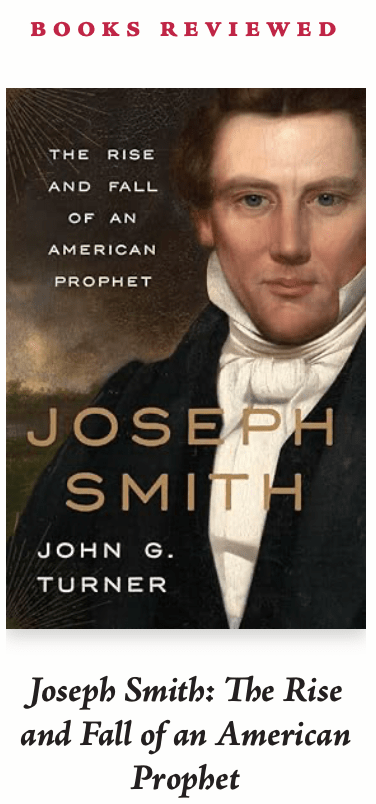
Van Buren was one of many prominent politicians to whom Smith appealed during his meteoric rise to national attention in the 1830s and ’40s. He even once dined with a young Illinois state representative, Stephen A. Douglas, and predicted that Douglas would “aspire to the presidency of the United States.” In his exhaustively researched biography, Joseph Smith: The Rise and Fall of an American Prophet, George Mason University Religious Studies historian John G. Turner tracks the Mormon leader’s astonishing trajectory.
Smith was in many respects emblematic of the populist Jacksonian era. He was a man of humble origins and minimal formal education who, through sheer ingenuity and force of personality, achieved a remarkable degree of success and influence. His father, Joseph Smith, Sr., was a modest Universalist farmer and hapless entrepreneur who lost much of his wealth on a failed scheme to sell ginseng (briefly a cash crop in New England). His mother, Lucy Mack Smith, came from a devout but untraditional family of lay evangelists influenced by then-popular revivalist movements.
***
Often in debt, Smith’s family moved multiple times. He was born in eastern Vermont but grew up in Palmyra, New York. The town was part of what came to be known as the “burned over district” of western New York because it hosted so many impassioned evangelical revivals. The young Smith was surrounded by a diverse panoply of religious groups, among them not only more established denominations such as Methodists and Presbyterians, but also fledgling movements such as the Millerites (predecessors to the Seventh-day Adventists), the Shakers, the utopian Oneida Community, and the Ebenezer Colonies.
It was in this milieu that a teenaged Smith, never himself baptized in any Protestant church, sought to learn which religious movement held the truth. After a harrowing spiritual experience in a quiet grove, Smith claimed he was confronted by Jesus Himself. The young man asked the Lord which church he should join. “None of them, for they were all wrong,” was the answer. In time, his parents came to believe Smith’s story.
Dreams, visions, and mystical practices all carried great weight in the folk traditions that shaped the Smiths. One such practice was searching for buried treasure. Joseph Jr. became a “glass-looker,” seeking valuable objects with a seeing stone. It was during one of these searches that Smith claimed to be visited by an angel who told him about “plates of gold” buried in the earth by Mormon, a long-dead indigenous inhabitant of the Americas who was himself descended from the ancient Israelites.
The story goes that Smith, along with several close family members and friends, translated the golden plates into what is now the Book of Mormon. This is an aspect of Smith’s life for which, Turner notes, historians lack significant contemporary evidence. Smith himself claimed he returned the plates to the angel. The Book of Mormon was an “incredibly unlikely achievement” and a “stunning display of American audacity,” writes Turner. It was also a reflection of American entrepreneurship, published with the hopes of selling sufficient copies to cover the $3,000 price of printing.
***
Unfortunately for Smith, the text received quite censorious reviews. Mark Twain would later ridicule it as “chloroform in print,” joking, as Turner summarizes, that “the real miracle was Smith’s ability to stay awake while composing or translating it.” Yet Smith persisted, allegedly performing exorcisms and faith healings which, in the eyes of the growing number of the faithful, confirmed his identity as “seer and translator and prophet.” There followed an abundance of revelations, mediated through Smith, guiding the church’s doctrine and disciplining various dissident members. In 1831, with creditors increasingly hounding him, the prophet was instructed in a vision that he and his church should move west to Ohio. Within a year of his arrival there, however, a dozen assailants burst into his family’s bedchamber to tar and feather him, pulling out a clump of hair that left a permanent bare spot. Yet, Turner notes, Smith had “an almost preternatural resilience…. [H]e moved on quickly from failures and setbacks.” He traveled widely and encouraged the church’s nascent business operations, including stores, an ashery, landholdings, and a publishing operation.
In 1832, with the nullification crisis provoking national tensions, he prophesied that the “rebellion of South Carolina” would provoke a civil war between North and South. Regarding the “peculiar institution” that would kindle such a conflict, Smith’s opinions were troubled and contradictory. In 1836, he described blacks as laboring under the curse of Canaan, an ancient Biblical judgment that allegedly doomed them to servitude. Though he opposed miscegenation and did not believe black Americans should vote, hold office, or perform military service, he once told a dinner party he would never vote for a slaveholder. In 1843 he proposed a plan of “making all coloured people free.”
Even as Smith worked out the finer points of his theology—including shifting away from an early focus on converting American Indians—the numbers of the Latter-Day Saints grew exponentially. By 1833, there were about 1,200 church members in Jackson County, Missouri alone. As this curious new faith spread, the residents and governments of its host states grew increasingly hostile to it. In Missouri, in 1838, mob violence against the Mormons prompted them to form their own militia. The resulting conflict was severe enough to become known as the “Mormon War.” Smith’s troops ransacked stores and burned the courthouse in Gallatin. Vigilantes responded in kind, killing 17 Saints—including a nine-year-old boy—in Caldwell County. Smith was soon apprehended and might have been executed, save for a sympathetic judge who allowed him and several others to escape. Smith then led the Saints to Illinois, founding a colony in Nauvoo.
***
It was during these years that Smith began to engage in one of the behaviors that would fuel anti-Mormon agitation. In 1836, the prophet was discovered having an extra-marital relationship with a servant girl named Fanny Alger. Smith’s wife Emma later confided to LDS apostle William McLellin that she “looked through a crack [in a barn] and saw the transaction!!” Several other Saints later confirmed this liaison. The girl was shortly thereafter turned out of the house. Yet in the years that followed, Smith would have many other relationships with women.
“Any historian writing about Joseph’s polygamy has to admit a significant degree of uncertainty,” Turner admits, “about everything from the number and timing of the marriages to the nature of these relationships.” Smith did not speak publicly about his marriages, nor keep a private journal. Nevertheless, Turner cites testimony from a broad variety of sources indicating that at least some number of the prophet’s “spiritual marriages” were consummated. Genetic testing indicates that none of these women had children by Smith, however. Many of his wives were united to him by way of revelation, an angel supposedly threatening to “slay” him unless he took on another union. In time, many other Mormon leaders would also become polygamists.
John C. Bennett, a mayor of Nauvoo and grand secretary of the Nauvoo Masonic Lodge, got wind of Smith’s novel teaching on polygamy and exploited it for his own gain. Bennett seduced multiple women by telling them—somewhat inaccurately, if not implausibly—that Smith had sanctioned extramarital sex. Soon discovered, Bennett left the community, and for a time became one of its most outspoken critics.
Even more troublesome for Smith was his wife Emma’s discovery of his polygamy. Smith said he had received a revelation warning Emma against committing adultery, but Emma didn’t believe a word of it. The women’s organization she founded within the church, the Relief Society, pointedly declared its opposition to “polygamy, bigamy, fornication, adultery, and prostitution.” If his wife felt the need to state her opposition to such practices, Smith’s enemies reasoned, he must be engaged in them.
***
Just as Smith’s personal life was getting ever more complicated, he was also becoming more involved in politics. In August 1843, the Mormon vote, spurred by one of Smith’s revelations, proved decisive in delivering a resounding victory to a Democratic congressional candidate for Illinois. A “Revelation from Heaven…turned a majority against us,” complained a local Republican newspaper. The following year, the prophet received a visit from Charles Francis Adams (grandson of John Adams and son of John Quincy Adams). Asked to predict a victor in the coming election, Smith declared that Whig candidate John Tyler would lose, while Smith himself would “hold the balance of power between parties.”
Yet mounting legal troubles, and a belief that God was calling the Saints ever further west, obstructed Smith’s political ambitions. In mid-June 1843, a grand jury in Daviess County, Missouri indicted Smith on charges of treason related to the Mormon War. Missouri governor Thomas Reynolds asked Illinois governor Thomas Ford to issue a writ for Smith’s arrest. Ford complied, but sent word to Nauvoo a day before signing it, allowing Smith to evade the authorities. In summer 1844, a new legal complaint accused Smith of committing perjury and living in adultery and fornication with a 20-year-old ward.
Frustrated by these attacks, Smith ordered Nauvoo’s city marshal to destroy a local anti-Mormon newspaper. In response, a nearby justice of the peace issued a warrant for Smith and his accomplices. But the prophet obtained a writ of habeas corpus from Nauvoo’s Mormon-friendly municipal court, appeared before that court the same day, and had his case dismissed. He then appeared before a non-Mormon justice of the peace in Nauvoo, who dismissed the charges against the defendants. The whole episode intensified local opinions that Smith believed himself and his church to be above the law.
***
Governor Ford sought to de-escalate the situation, urging Smith to submit to arrest and guaranteeing his safety. Yet once in custody he was charged not only with inciting a riot but also with treason. About a hundred men stormed the jail where Smith and several other Saints were held; Smith’s brother Hyrum was killed trying to hold the door of their cell, while Smith died attempting to escape out a window. Nine of Smith’s attackers were indicted on charges of murder, and five of them stood trial in May 1845. A jury refused to convict them, and no one was punished for the crimes.
“I am a rough stone,” Smith once declared of himself. He was also, observes Turner, a “day laborer, visionary, seer, money-digger, glass-looker, translator, revelator, prophet, elder, high priest, president, patriarch, merchant, banker, prisoner, wrestler, real estate speculator, prolific polygamist, lieutenant general, Master Mason, and mayor.” He possessed an almost unparalleled charisma: even those who had heard deprecatory tales of him often liked him when they met him. He founded a city that briefly rivaled Chicago as the largest in Illinois, and is responsible for the most widely printed and translated work of American literature. He was an unlikely but striking exemplar of both the Jacksonian era’s promise and its distemper. Turner’s fascinating, scholarly, and laudably dispassionate account offers welcome insight into the origins of America’s most successful homegrown religion, whose story is intimately entwined with that of our nation.
Casey Chalk is a senior contributor at The Federalist and author, most recently, of Wisdom From the Cross: How Jesus’ Seven Last Words Teach Us How to Live (and Die)… read more


Leave a comment