
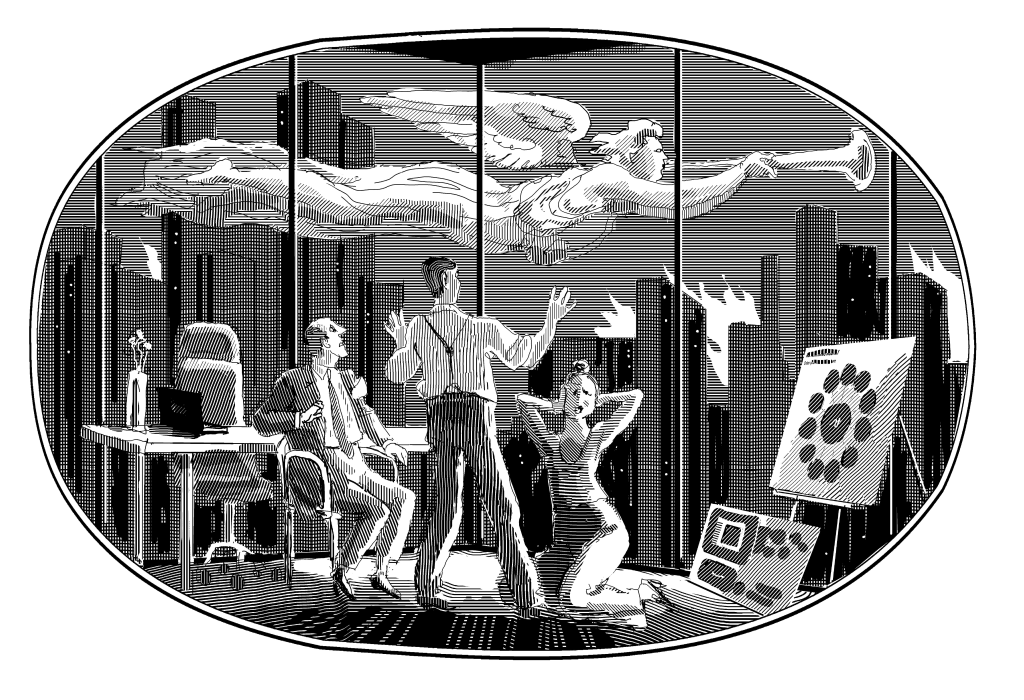
Where will you be when the Trumpet sounds?
by Kyle Smith – Winter 2024/25 – Claremont Review of Books
Barry McGuire – Eve of Destruction (written by P. F. Sloan)
The eastern world it is explodin’
Violence flarin’, bullets loadin’
You’re old enough to kill but not for votin’
You don’t believe in war, what’s that gun you’re totin’
And even the Jordan river has bodies floatin’
But you tell me over and over and over again my friend
Ah, you don’t believe we’re on the eve of destruction
(please see note below on the anti-American war movement of the 60s)
My cmnt: The most popular scenario in America today is the historic Premillennial interpretation of the Bible’s prophecies of the End Times. Baptist preacher William Miller, the progenitor of the Seventh Day Adventists founded by E.G. White, had his followers sit on the roof awaiting the Rapture he predicted would come in 1844. Their neighbors gathered to watch. It was embarrassing.
My cmnt: The Premillennial understanding goes roughly like this. There is an ongoing battle since Cain killed his brother Abel the first volley in the war between the Seed of the Serpent and the Seed of the Woman. The history of man is divided into seven dispensations. Each dispensation covers approximately one thousand years in the 7,000 year span of the redemptive history of man. (please see note below on Dispensationalism)
My cmnt: As an overview these dispensations or covenants cover the time of Adam to Noah, Noah to Abraham, Abraham to David, David to Christ, the rise of the Church to the Great Schism, and the Great Schism to Christ’s return in Glory to set up of His Millennial Reign on earth which will last for a thousand years.
My cmnt: One, the creation of man and his fall culminating in utter wickedness reigning (much like the democratic party) over men. Adam was told by God that in the day he ate of the Tree of Knowledge he would die. As Adam lived 930 years and “a day is unto the Lord as a thousand years” he did die in that day.
My cmnt: Two, Noah and the Ark with the Flood wiping out all but 8 individuals who restart the human race but also ends in paganism once again governing the lives of men. Three, the call of Abraham out of Ur to go to the Promised Land and start the race of Israel who would become as numerous as the stars of heaven. Four, Israel does indeed become a great nation while in bondage to Egypt, is delivered by Moses and culminates in King David and his son King Solomon ruling over all of the land promised to Abraham and foreshadowing the Millennial Reign of Christ over the earth. This dispensation of David ends with Israel back in bondage once again.
My cmnt: Five, the first advent of the Messiah who preaches the coming Kingdom of God. The Messiah finally arrives, dies on the cross for the sins of the world (i.e., the redeemed come from all the races, tongues and tribes of man including the Jews), rises to new life again and sits at the right hand of God ruling all things. Before He ascends into Heaven He establishes the Church through the Apostles. This is also called the age of the Holy Spirit. Six, the decline and fall of the Church culminating in the Seed of Satan (i.e., communism, Marxism, Islam, various dictators and the democratic party) ruling over the lives of men once again but also, against all odds and after the world attempted to wipe out the Jews, we have the mass return of the Jews and the recreation of the nation of Israel in their ancestorial home land.
My cmnt: Seven, Christ returns with His Holy Angels to save His Church and to end the war against the Jews culminating in their mass conversion to their Messiah and the binding of Satan for a thousand years. We who remain are caught up in the air to meet Him (i.e., the Rapture of the Church) and to reign with Him for a thousand years of peace, prosperity and righteousness. Then Satan is released for a little season before God permanently destroys the wicked and ushers in the New Heavens and the New Earth forever.
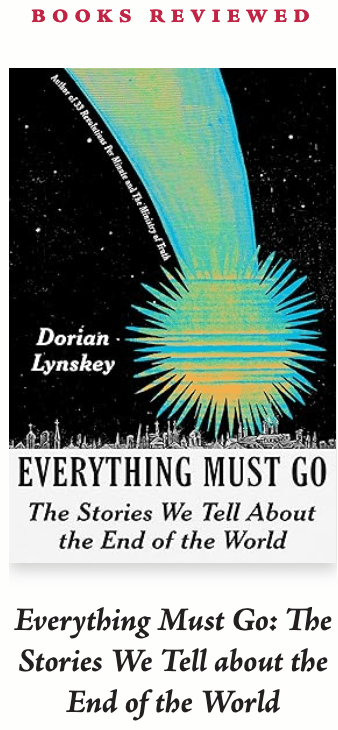
Dorian Lynskey’s Everything Must Go: The Stories We Tell about the End of the World is an exhaustive look at the enduring appeal of works about how civilization might end, from the Book of Revelation to 12 Monkeys, The Matrix, I Am Legend, and whatever extinction-level event Hollywood next brings to screens. (“Extinction-level event,” by the way, is a phrase popularized by the 1998 blockbuster Deep Impact, starring Robert Duvall and Téa Leoni, about what happens as Earth prepares to receive an asteroid the size of Texas.)
A writer and podcaster whose previous books include 33 Revolutions Per Minute: A History of Protest Songs (2011) and The Ministry of Truth: A Biography of George Orwell’s 1984 (2019), Lynskey seems to have pored over hundreds of books, many of them obscure, and watched nearly as many movies and TV shows to shape this definitive account. “There is always enough misery and mayhem in the world to support a claim that it is the end of days,” he writes. The seismologist Charles Francis Richter noted that when the Gospel records that “there shall be famines, and pestilences, and earthquakes, in divers places” (Luke 21:11), Jesus wasn’t exactly going out on a limb: “Assuredly, no safer forecast was ever made.”
Catastrophism is the obverse of utopianism, a fantasy with which human imagination can never part. The Bible neatly covers both obsessions: Armageddon and the Millennium—a thousand years of blissful rule by Christ. When the traveling Baptist preacher William Miller calculated, using Daniel 8:14 as a source, that the Second Coming would occur in “about 1843,” he became a sensation. The appearance of the Great Comet of 1843 in February seemed like a promising warm-up act, but the main attraction never appeared. October 22, 1844, became known as “the Great Disappointment” when the Millerites conceded error. It wasn’t the end of the world as they knew it—and they felt awful: “Our fondest hopes and expectations were blasted,” said one disillusioned Millerite.
***
Doomsday stories have always been with us, and always will be, though the method of destruction keeps changing according to fashion (the zombie emerged in the popular imagination when George A. Romero beckoned him forth in 1968’s Night of the Living Dead). There are so many disaster scenarios cycling in and out of vogue through history that the book divides them into acts of God plus seven other categories such as “The Bomb,” “Machines,” “Pandemic,” and “Climate.” There’s also a chapter on generalized social “Collapse,” one on “Impact” (which leads to a technical discussion of the differences between meteors, meteoroids, and asteroids), and one on “The Last Man,” which isn’t a sudden disaster but a reflection on what happens when the world population reaches one. (For dramatic purposes, such stories almost always feature more than one person, right on up to the 2010s Will Forte sitcom The Last Man on Earth, whose protagonist kept running into other humans.) Mary Shelley popularized the final-person scenario in her 1826 novel The Last Man, just as she is credited with giving birth to science fiction with Frankenstein; or, The Modern Prometheus in 1818.
Even talents as varied as Isaac Newton and Bob Dylan saw the end of the world as imminent. Newton worked for 50 years on a tract called Observations Upon the Prophecies of Daniel, and the Apocalypse of St. John that was published only after his death. As Lynskey points out, the world will end, so someone is going to be proven right, though the gloating will be limited when we all go up in flames, water, ice, or what have you. There are any number of ways it could happen. It could even happen all at once. This book is not for those with a fearful or gloomy disposition.
***
Except, however, those for whom gloom about extinction overlaps with giddiness. Lynskey shows how many of our most ardent catastrophists—J.G. Ballard, Kurt Vonnegut, Stephen King—have admitted attraction to the idea of planetary renewal via mass death. (You’d think the smell alone would be a persuasive argument against.) Vonnegut wrote in Timequake (1997), “Let us be perfectly frank for a change. For practically everybody, the end of the world can’t come soon enough.”
Much rarer is the sensibility of David Brin, author of the 1985 post-apocalyptic novel The Postman (made into a famously failed Kevin Costner movie in 1997), whose work was imbued with a sense of appreciation for the world we live in right now: we simply do not sufficiently appreciate how much of the miraculous lives in the ordinary, such as (back then) mail delivery. “Most post-holocaust novels are little-boy wish fantasies about running amok in a world without rules,” Brin later said.
Lynskey maintains a neutral to jocular tone throughout most of Everything Must Go, but as we get to the most recent forecasts of the end times, which tend to center on either overpopulation or the always-imminent “climate emergency,” he turns a bit more grave, and even defensive, suggesting we shouldn’t ignore the forecasts of these prophets, almost all of them on the political left. There is a taste question here, alluded to by Stanley Kubrick when, following Dr. Strangelove (1964), he considered making a movie about overpopulation. “Do you realize that in 2020 there will be no room on earth for all the people to stand?” he mused. “The really sophisticated worriers are worried about that.”
***
The most celebrated of this supposedly brilliant crew was the spectacularly erroneous neo-Malthusian Paul Ehrlich (“Sometime in the next 15 years, the end will come,” he promised in 1970), who boldly accepted a bet in 1980 by the techno-optimist economist Julian Simon about the future price of any five precious metals chosen by Ehrlich, which under his catastrophic-scarcity theory would necessarily become more expensive. Prices instead fell across the board. Lynskey sniffs, “Simon was lucky because commodity prices were unusually high in 1980 and Ehrlich had a weak grasp of economics.”
The most sophisticated of the sophisticated see climate change and overpopulation working in tandem to hasten our mass demise. For Lynskey, the 1973 Charlton Heston flick Soylent Green, which pictured a 2022 New York City (population 40,000,000) as a “smoggy, sweltering, desperate shanty town” is “a remarkably far-sighted movie about climate change.” Yet any long-time resident of New York City will tell you that the place is considerably cleaner and more pleasant than it was in 1973.
To Lynskey, no climate-change prophecy is ever wrong, merely premature; he occasionally sounds like a Millerite re-calculating the future arrival date of Armageddon. Why, after mocking so many doomsayers, does he include only two glancing mentions of the leading alarmist of our age, Al Gore, whose film An Inconvenient Truth (2006) won an Oscar for its sci-fi speculation, warning that the planet would be doomed in ten years unless a “drastic” reversal of course were taken? Lynskey seems entirely to have forgotten that Gore, a Nobel Prize winner, was taken far more seriously than nearly all of the dozens of (other) nuts and cranks whose wrong predictions get detailed, multi-page summaries. Reaching the end, one feels a bit worn out by the endless zombie-march of unearthed factoids. A greater effort to make sense of it all would have been welcome. But then again, it’s always a good time to panic.
Kyle Smith is the film critic of The Wall Street Journal and was a 2015 Lincoln Fellow of the Claremont Institute.
===========================================================
These dispensations are not to be confused with Dispensationalism which falsely teaches a secret Rapture of the Church just before the Tribulation and two, distinct people of God with God the Father married to Israel while Jesus the Son is married to the Church with the Church being a mystery unforeseen in prophecy and completely distinct from Israel.
The Great Schism irredeemably split the Church into East and West. After the Great Schism we then had the Reformation further splitting the Western Church and then communism destroying what was left of the Eastern Church. With all of this bringing about the eventual ineffectualness of the Church after a thousand years but amazingly and prophetically culminating in the reestablishment of the nation Israel,
The American Left has always been on the wrong side of everything. Funded today by the likes of billionaire and currency manipulator George Soros they were then funded directly by the Soviet communist apparatchiks as they waged a proxy war to keep Vietnam enslaved by communist dictators. But for our evil democrats trying to destroy then President Nixon, as they attempted to do in 2016 to the duly elected President Donald Trump, South Vietnam would now be a free and prosperous country just like South Korea whom we saved from the communists who now run North Korea and have turned it into a literal hellhole and who now run ALL of Vietnam and have predictably made it also into a hellhole.
People vote with their feet. NO one, absolutely NO one, immigrates to a communist country. They build walls to keep their people IN while we build walls to keep their people out.
 Lord Buckbeak: "Will you come into my parlor?," said the Spider to the Fly.
Thanks for writing this review.
LikeLike
My pleasure. LB
LikeLike