Henry J. Cordes – Omaha World-Herald – via LJS – 03/03/25
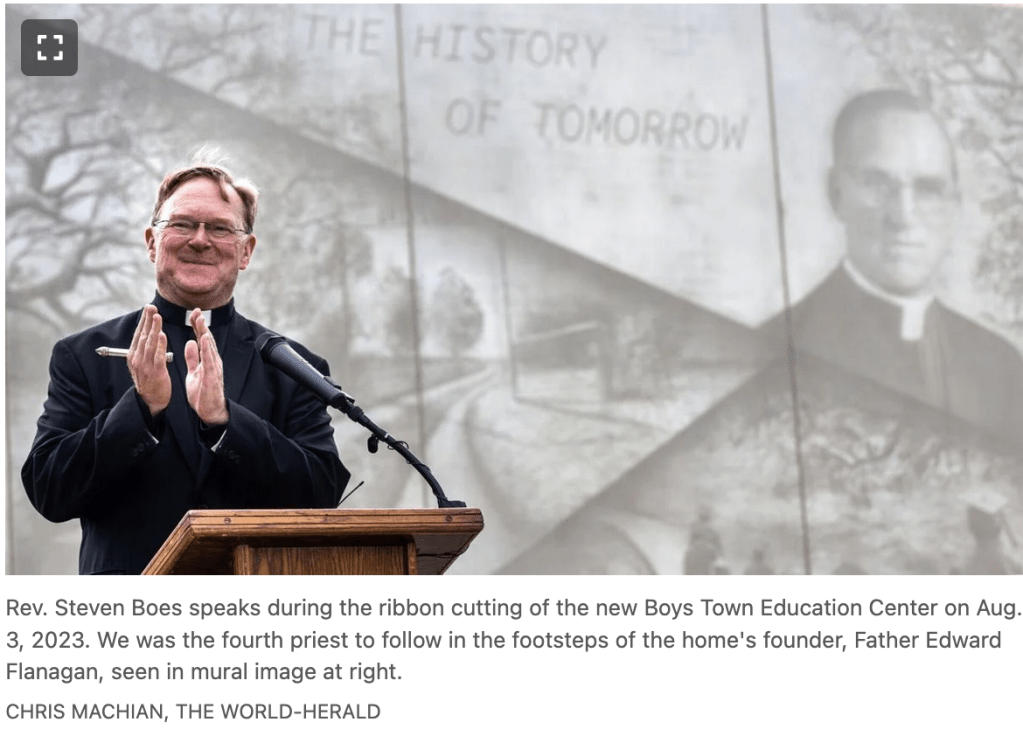
In September 2023, the Rev. Steven Boes retired as executive director and president of Boys Town, ending his tenure as the fourth Catholic priest to follow in the leadership footsteps of the celebrated institution’s founder, Father Edward Flanagan.
As he took a new pastoral position in the Archdiocese of Omaha, Boes left Boys Town with an 18-year legacy of helping to modernize and grow the child welfare nonprofit. He also departed with some substantial sums of money atypical for a priest.
Boes upon retirement received a lump-sum payment of $500,000, compensation Boys Town promised years earlier to account for his well below average salary and to give him incentive to stay.
Boes was also the beneficiary of a pair of retirement accounts into which Boys Town paid $1.8 million. With investment gains, the total lump sum coming to him could have been substantially higher than that.
Boys Town officials note that even including the contributions to his retirement, Boes’ total compensation averaged just over $200,000 a year during his tenure, well below market rate for anyone leading a national-scale nonprofit with annual revenues approaching half a billion dollars.
They also say Boes donated “a very generous amount” of the $500,000 payment back to Boys Town — apparently not the last donation he plans to make to the institution.
“Over the years, I have asked many people to donate to Boys Town, and I am an active donor myself,” Boes said in a statement to The World-Herald. “I will continue to support Boys Town and plan to leave almost everything in my will to them so that this life-saving work continues.”
Boes’ average compensation from Boys Town — revealed in the organization’s latest federal tax disclosure and in interviews with its leaders — indeed was not high for a person leading such a large nonprofit. But it was unusual for the men who choose to devote their lives to their faith as Catholic priests.
Contrary to common belief, ordained diocesan priests don’t take a vow of poverty — a pledge to renounce worldly possessions and emphasize spiritual wealth. But they are expected to lead a simple life, and their pay typically reflects that.
Even a senior priest in the Omaha Archdiocese is paid less than $40,000 annually, plus room and board. In retirement, they receive Social Security plus monthly pension checks of less than $2,000.
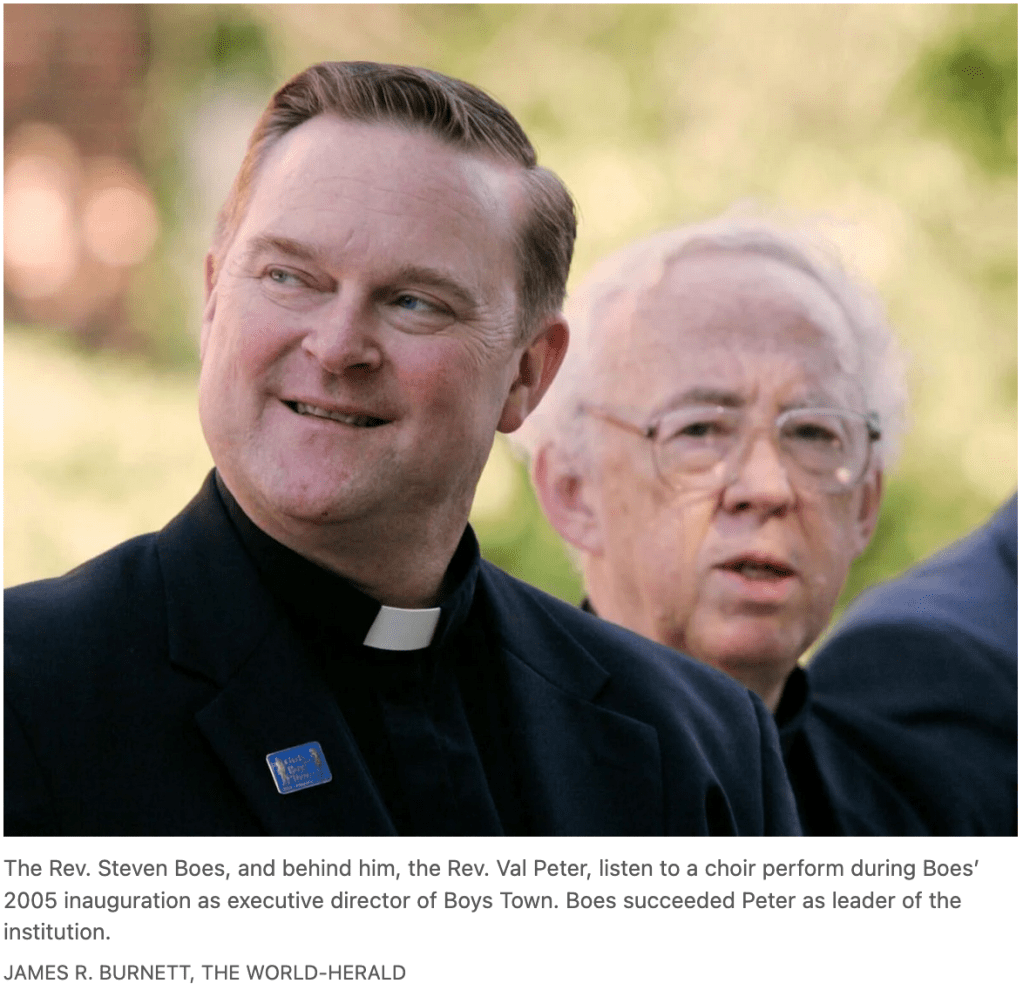
The World-Herald could find few cases of Catholic priests nationally with compensation quite like what Boys Town paid Boes. His pay also differed significantly from that of his predecessor, the Rev. Val Peter, whose compensation was akin to that of a typical priest.
But while Boes’ pay at Boys Town was uncommon, that does not mean it was out of line, said the Rev. Tom Gaunt, executive director of Georgetown University’s Center for Applied Research in the Apostolate, an organization that conducts social science research for the Catholic Church.
The trend in recent years has been for diocesan priests who take jobs outside the church to be paid more like a layperson performing the same role, he said. It’s just that today, he said, there are far fewer priests leading large church-related nonprofits, hospitals or universities.
Even among the nation’s more than 200 Catholic colleges and universities, some 80% over the years have turned to lay leadership.
“It’s a rarity because it’s rare to find a priest in that position,” Gaunt said of Boes’ pay.
Gaunt and others say two trends have driven the reduction of priests in such leadership positions: the increased and varied skill sets demanded to run a large organization, and the sharply shrinking pool of men going into the priesthood. The total number of priests in the United States has fallen from 58,000 in the early 1970s to about 34,000 today, creating a significant shortage.
Omaha’s Creighton University, led by the Rev. Daniel S. Hendrickson, is among the Catholic organizations still led by a priest. Hendrickson, however, is not compensated similar to a lay university leader because he’s a member of the Jesuits, a Catholic order whose members do take a vow of poverty.
In lieu of paying Hendrickson a salary, the school instead pays a comparable sum to support the campus Jesuit community, whose members fill a variety of teaching, administrative, service and spiritual roles at Creighton.
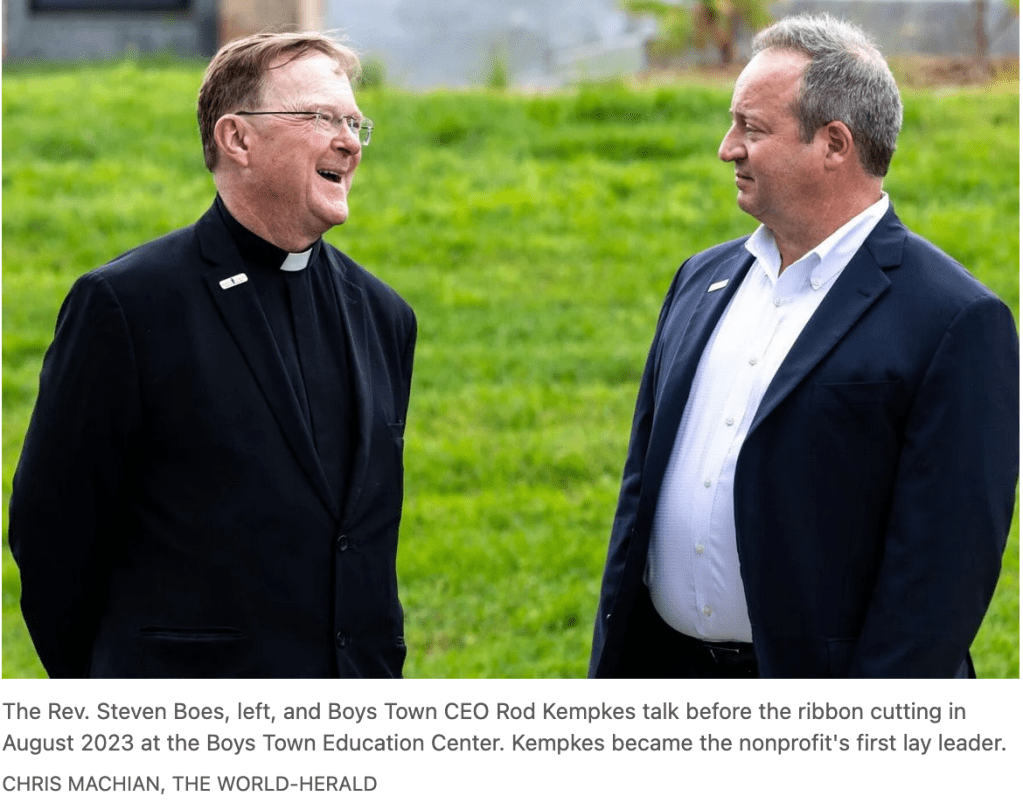
Boys Town itself can now be counted among the organizations that have turned to lay leadership. Rod Kempkes, who succeeded Boes as president of Boys Town, came from the corporate world.
Riley Johnson, a spokesman for the Archdiocese of Omaha, said while it is up to Boys Town to decide how it pays its leaders, he praised the Omaha nonprofit for the “countless young men and women” whose lives have been changed by its care.
He also praised the work of Omaha priests like Boes who devoted their lives to serving others.
“Wherever he is serving, each priest brings the Good News of Jesus Christ with him for the benefit of those around him,” he said.
Appointing a priest to lead Boys Town kept with tradition
In June 2005, the board of Boys Town tapped Boes as top leader of the iconic Omaha nonprofit.
Boys Town is not a Catholic institution nor is it operated by the church. Rather it’s a faith-based nonprofit that welcomes children of all faiths and backgrounds. Nonetheless, Boes’ appointment continued a tradition of priest leadership that started when Father Edward J. Flanagan founded the second-chance home for youths in Omaha in 1917.
Boes, a native of Carroll, Iowa, came to Boys Town after eight years directing St. Augustine Indian Mission, a K-8 school in Winnebago, Nebraska, under the supervision of the Omaha archdiocese. First ordained in 1985, Boes had also served the archdiocese as a parish priest and educator.
In addition to leading Boys Town, Boes served a spiritual role as minister of Immaculate Conception Church on the Boys Town campus.
While running a home for troubled youths remains a signature part of Boys Town, under Boes the organization followed national child welfare trends and put more emphasis on preventive services focused on keeping families together.
Its child care services now range from its traditional on-campus residential care to training for teachers and parents, behavioral health treatment and a national mental health hotline for kids.
The role of its Omaha-based pediatric hospital also grew significantly under Boes, with a particular research focus on neuroscience and behavioral health. Boys Town also opened Nebraska’s largest residential psychiatric treatment facility for children and launched a program serving youths aging out of the child welfare system.
In all, Boys Town said the number of children served grew 80% during Boes’ tenure, and total revenues nearly tripled.
“I have seen Boys Town continue to increase the scope and scale of its services, and Father Boes’ leadership was a vital part of these efforts,” said Kathleen Driscoll, chair of the Boys Town board of trustees. “His legacy will be long and lasting.”
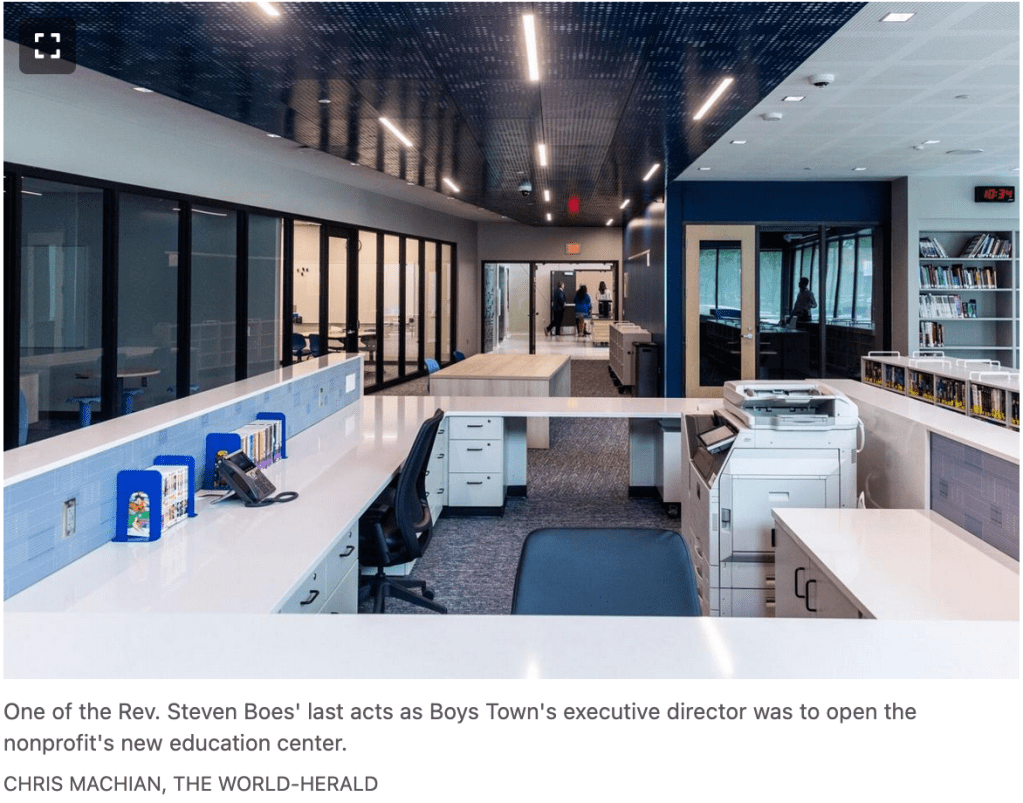
One of Boes’ last functions before he left in the fall of 2023 was to help open up a new school building serving the more than 300 youths who live in group homes on campus.
Boes then returned to the Omaha archdiocese, where today the 65-year-old priest now serves as the senior associate pastor in the family of parishes that includes Mary Our Queen and St. John Vianney.
His new role also came with a considerable cut in pay. The pay schedule for the diocese suggests he now makes roughly $39,000 annually, plus room and board.
Boys Town says pay vetted by consultants, survey data
Nonprofit disclosure forms show that almost from the beginning, Boys Town’s board compensated Boes differently than it did Peter, his predecessor.
Peter received a flat salary of $20,000, plus other benefits that raised his pay to $27,000. He also received room and board, living in a rectory on campus.
Boes’ base pay within two years of his hire was over $50,000, and it gradually rose from there, reaching $130,000 in his last full year on the job.
Like Peter, Boes also received free room and board from Boys Town that was not included in his pay figures. While Peter had lived in a campus rectory, Boys Town built a new home for Boes near the office of its national headquarters.
What most set Boes’ pay apart was his deferred retirement income.
Boes was the beneficiary of two retirement accounts into which the board by 2006 was putting substantial sums. The payments started at $30,000 a year, topped out at more than $200,000 annually, and totaled $1.8 million.
Those contributions did not require an employee match and were invested for his benefit. One of the funds provided him a lump sum upon retirement, the other giving an option of a lump sum or monthly payment.
It’s unclear how the funds were invested. But based on typical stock market returns, the $1.8 million Boys Town put in could have been worth more than $4 million by the time Boes retired.
At his retirement, Boes also received the $500,000 retention bonus that had been promised by the board years earlier
Kempkes and other Boys Town officials say the charity uses consultants and salary survey data to determine proper compensation for all of its top executives. Those consultant studies consistently found Boes’ compensation was low compared to peers at like-sized social service nonprofits, they said.
While his compensation uniquely included some items that were more generous than the market, his total compensation remained considerably below market rate. Not including room and board, Boes’ total compensation averaged just over $210,000 annually.
Boys Town in 2023 had an annual budget of $480 million, which included more than $270 million in earned revenues from its hospital and other services, more than $120 million in contributions and over $50 million in endowment income. Even at its highest, Boes’ annual pay amounted to less than one-tenth of 1% of Boys Town revenue.
There indeed are numerous Omaha social service nonprofits smaller than Boys Town who pay their leaders similar or higher pay than Boes received.
“The $200,000 a year does not seem crazy,” said Anne Hindery, CEO of the Nonprofit Association of the Midlands. “Their budget is huge.”
While the $1.8 million Boys Town paid toward Boes’ retirement was likely in lieu of base pay, “it still seems like a lot,” she said. And the sizable retention bonus is also not common among nonprofits.
Whether such pay is appropriate for a priest is more of a subjective question, with no clear answers.
Priests expected to lead ‘a life of simplicity’
While most priests don’t take a vow of poverty, they are expected to “lead a life of simplicity consonant with the people they serve,” according to the U.S. Conference of Catholic Bishops.
The Rev. Caleb La Rue, chancellor of the Lincoln Diocese, opined on compensation for priests in a 2023 online post.
Even though diocesan priests don’t take a vow of poverty, he wrote, “they are not to live lives of opulence.” Like all people, priests need to be mindful of their spending, give to charity, and be “careful that the good things of the world do not distract them from fulfilling their calling.”
But at the same time, he said, quoting 1 Timothy 5:17-18, “A worker deserves his pay.” Priests are free to use the money they make freely, which often means saving up for vacations, golfing, hunting or other hobbies.
The pay of diocesan priests in Omaha is typical of that of Catholic priests nationally. In Omaha, they receive base pay of $32,100 plus $180 for each year they serve after ordination. They also receive room and board from their parish, typically valued for tax purposes at around $7,000.
“It’s a very modest life,” said Georgetown’s Gaunt.
For years, priests and nuns who worked outside of ministry were paid less than laypeople performing the same job, Gaunt said. One informal study found that in the 1960s, the lower pay nuns teaching in schools received compared to lay teachers provided a $3 billion annual subsidy to U.S. Catholic schools.
He said that changed over time, as by the 1990s the trend was for priests and nuns who took teaching positions in K-12 schools or colleges or who served as administrators for church-related organizations to be paid more like laypeople performing the same role.
“They would get the regular compensation package that comes with that,” Gaunt said.
Still, it seems rare for priests working outside the church to command the kind of pay Boes received. Looking at the nonprofit disclosure forms of prominent universities and nonprofits with church ties, The World-Herald could find few similar examples, nor could Boys Town identify many.
The University of Notre Dame in its latest federal disclosure report indicates it paid its president, the Rev. John Jenkins, $1.6 million in 2023. But Jenkins also took a vow of poverty as a member of his religious order, the Congregation of Holy Cross. The school has said his pay is ultimately transferred to the order.
That appears to also be the arrangement at a number of universities headed by Jesuit priests, Creighton among them.
In 2016, DePaul University reported paying a priest who then led the school a package worth nearly $900,000. But it’s unclear if that went to the priest directly, as he also was part of an order that takes a vow of poverty. The university did not respond to a request for clarification. DePaul now has a lay leader.
St. Mary’s University in Winona, Minnesota reported in 2023 that it paid total compensation of over $400,000 to a priest from the Twin Cities diocese who serves as its top leader.
“There are very few priests or sisters in such roles,” Gaunt said.
If there is a difficulty in deciding how to pay a priest leading a large organization, that’s an issue Boys Town no longer faces.
In 2018, Boys Town decided its leadership structure needed more “business acumen,” Kempkes said. So the board hired him as a chief operating officer, and two years later he became CEO.
In those roles, Kempkes took over much of the day-to-day operations oversight from Boes, who as executive director focused on spiritual and religious guidance and fundraising.
For the first time in Boys Town history, the campus had lay leadership, a structure that has continued with Boes’ retirement. Kempkes as president and CEO in 2023 received total compensation of nearly $625,000.
Boes in a statement said he was thankful for the opportunity he had to lead Boys Town and expressed pride in what the team there was able to accomplish.
“I am grateful that I was able to help guide Boys Town for nearly two decades as it continued to change the way America cares for children and families,” he said.
And while he now is serving in a new role for the church, he said he remains “steadfast” in his support for Boys Town, intending to foster the charity’s future success with his financial support.
Gaunt said he’s not surprised to hear that Boes plans to give back to Boys Town. His substantial earnings there present opportunities that are not available to most priests.
“He has done this wonderful work over the years, he has received benefit from it, and he is returning it to that work,” he said. “It sets a good example for all of us.”


Leave a comment