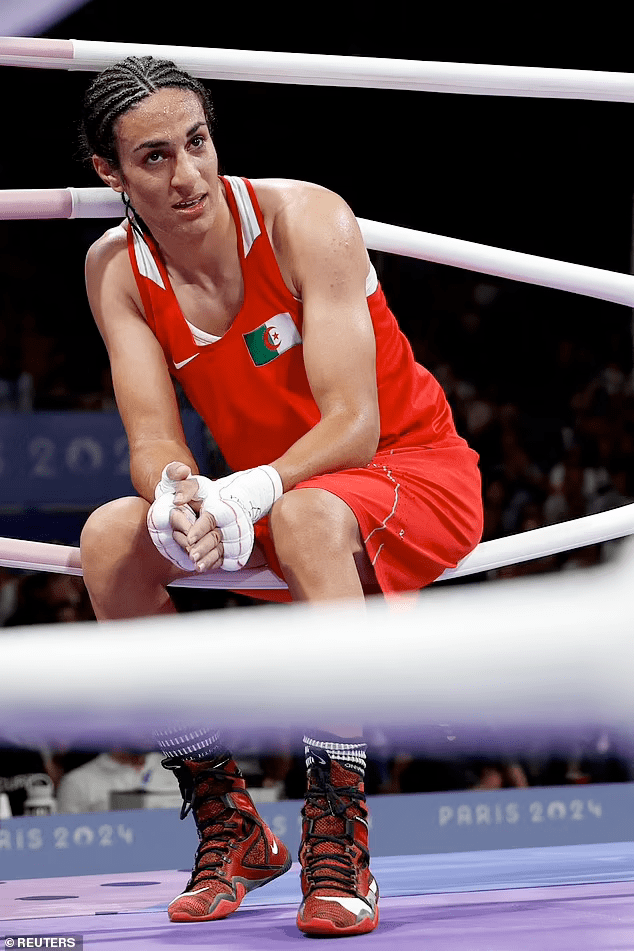
Imane Khelif of Algeria sits on the ropes after winning her fight against Anna Luca Hamori
Hermaphrodite, now called intersex, persons in sports include American basketballer Brittney Griner, boxer Lin Yu-ting of Taiwan, South African runner Caster Semenya, and boxer Imane Khelif of Algeria.
If the democrats and other evil Marxist-Leftists did not push everything to crazy and insane boundaries we would not be having this discussion and these people could quietly go about their lives. As it is we now have yet another democrat-media complex driven issue that won’t be allowed to be settled equitably.
It is cut and dried that no female athlete should have to compete against a born-male athlete who has gone thru male puberty no matter their current testosterone levels. It is admittedly more difficult to deal with the issues presented by hermaphrodites. Two of the athletes mentioned above, Griner and Semenya, have dominated normal, female athletes for years. Semenya has even been previously barred from competition as was Imane Khelif because of elevated testosterone levels and other tests, respectively.

Caster Semenya of Team South Africa reacts after the Women’s 5000m heats in 2022
The Algerian boxer was born female, was registered female, lived her life as a female, boxed as a female, has a female passport. Pretty much the same with Brittney Griner and Caster Semenya.
The axiom of law is that hard cases make for bad law is an adage or legal maxim meaning that an extreme case is a poor basis for a general law that would cover a wider range of less extreme cases. In other words, a general law is better drafted for the average circumstance as this will be more common.[1] – Wikipedia
Hayek, F. A. (2013). Studies on the Abuse and Decline of Reason: Text and Documents. Routledge. p. 63. ISBN 978-1-136-60437-9.
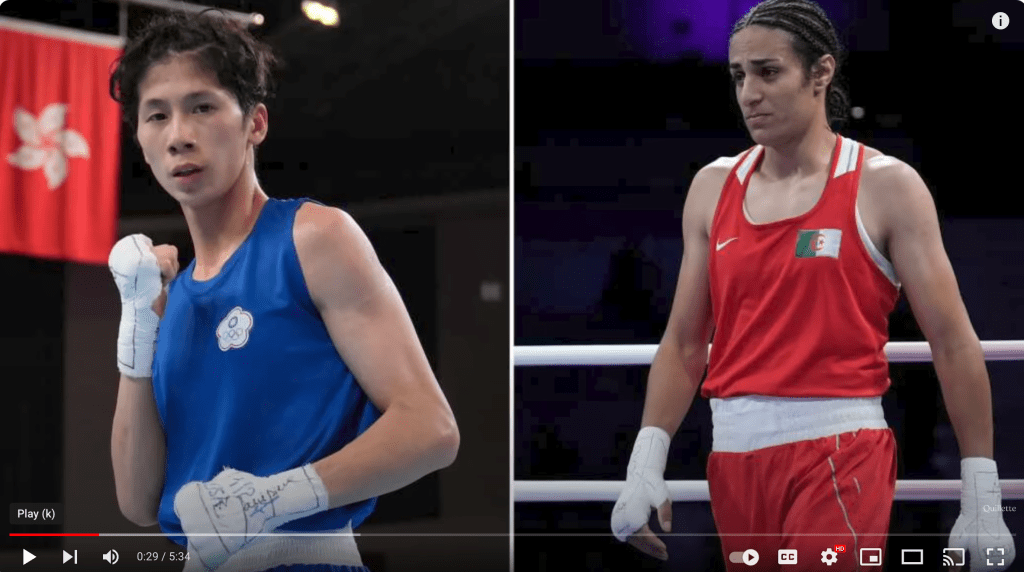
Watch YouTube video here or below explaining the XY female problem in sports.
No one wants to shame nor discriminate against anyone with an abnormal or rare genetic condition that separates them from the mass of humanity in a dehumanizing way. It could even be argued that most top male athletes are genetically rare or everyone would be like them. This would include most of the “gifted” boys, girls, men and women who stand out in any field or endeavor. However no one has ever been able to identify what makes one person, out of millions, a genius in his or her field. Whatever subtle genetic difference there is remains unknown and unknowable. Einstein’s children were unremarkable as is Bronny James.
Intersexuality can go the other way also. You can watch Bell Nuntita perform on YouTube for Thailand’s Got Talent. This born male person appears as a remarkably beautiful young woman in every way including having a beautiful female-sounding singing voice. And there is also the born male actress Jaye Davidson of The Crying Game movie fame who easily passes as female in every way – while still having a penis.
But sports is a whole other ball game so to speak. Historically the purpose of sports was to identify and honor the most masculine men, typically warriors or gladiators. For women to dominate other women in strength and speed oriented, contact type sports (i.e., basketball, football, soccer, boxing, MMA, wrestling, power lifting, etc.) they have to be trained to act more like men than women. They even call each other “guys” instead of “gals”. The reason the WNBA has no viewers (prior to Caitlin Clark – who looks and acts like a woman and has a boyfriend) is that not even other women, let alone men, want to watch a bunch of big, butch like, manish women playing a much lesser version of the NBA.
Boy athletes aspire to be like LeBron James or Tom Brady while girl athletes aspire to be like Fanny Stollár or Ronda Rousey. Girls want to be feminine while also being smart, creative, brave, mentally tough and hardworking. Boys want to be masculine while also being respectful and considerate, and defenders to the weak. Boys will settle for just for being the best athlete and a pretty girl for just being hot. But age kills both traits and so wise humans should strive to be well-rounded persons of integrity who put some effort into being useful, productive and good citizens – and if fame and fortune follow then they will be better equipped to handle it with grace and wisdom.
In the pop music or film genre female superheroes look even more feminine while they beat up on the villains while male superheroes look even more masculine than normal men. Male and female body ideals may be unrealistic but they are what sells.
We don’t congratulate men for taking steroids to win at sports and neither should we women who take steroids to help them pretend to be men. Anabolic steroids are dangerous and have longterm, negative health consequences. Giving them to men to elevate their testosterone levels is bad enough but giving them to women to turn them into men has to be disastrous to their health.
An intersex woman like Brittney Griner is not someone to congratulate for beating up on normal women on the basketball court because she has a Y chromosome and elevated testosterone levels. And no girl falls asleep at night wishing to become Brittney Griner.
Hermaphrodites are a hard case. They’re not man enough to win against men but too manish to compete fairly against women. It’s a dilemma. So far letting them compete seems to be the best solution but holding them up as paragons of womanly success isn’t fooling anybody.
Click here to read another take on the issue of intersex women.
Trans woman (born male) athlete Jessica Gill defends women’s (female only) sports against male interlopers
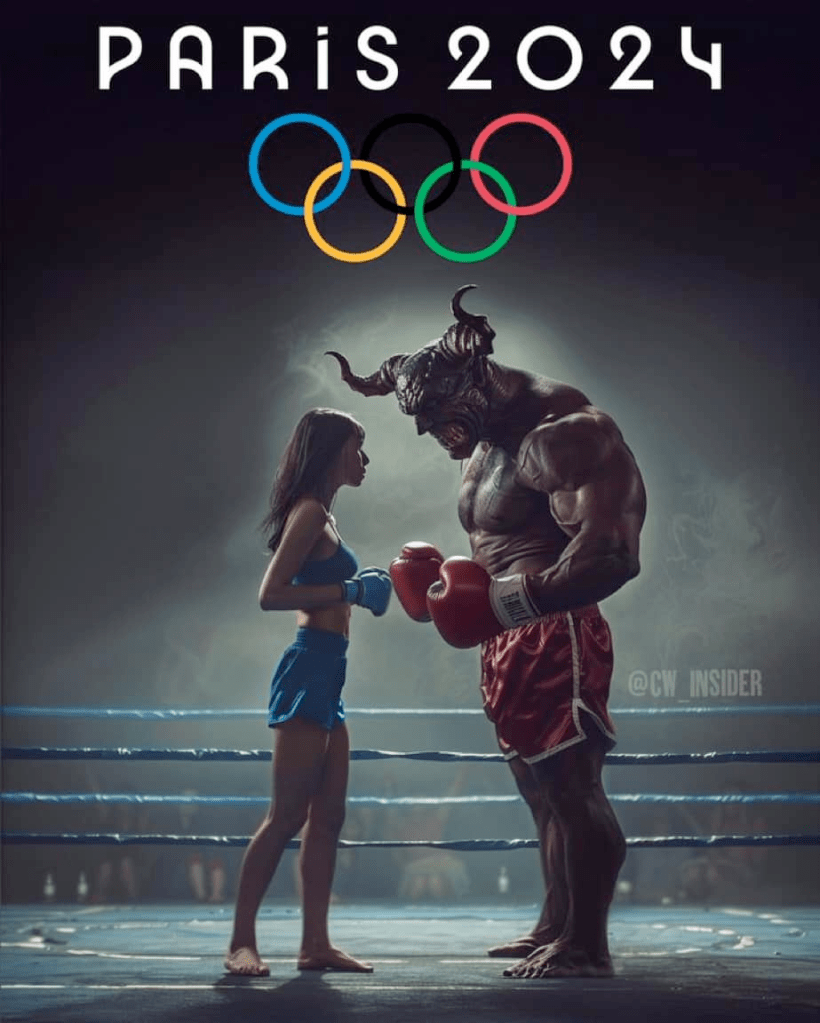
Click here to read about another female boxer who refused to fight a former male boxer.
Olympic boxer Angela Carini apologizes to Imane Khelif, is ‘sad’ about gender controversy

By Oskar Garcia and James Horncastle – Aug 2, 2024 – The New York Times
Angela Carini of Italy doesn’t like how the conversation about Olympic women’s boxing has turned.
She was knocked out of her opening fight Thursday in 46 seconds, but told the Italian publication Gazzetta dello Sport that she felt sorry for the winner, Imane Khelif of Algeria, who has faced uncomfortable questions and speculation about her gender and medical status as part of a wave of debate online.
Carini was sad that she lost, ending her Olympic competition. She said she didn’t feel Khelif did anything wrong by beating her.
“All this controversy certainly made me sad, and I also felt sorry for my opponent, she had nothing to do with it and like me was only here to fight,” Carini said.
She added that she was not making a statement about Khelif’s presence in the 66-kilogram (146-pound) tournament by not shaking her hand after choosing to quit, which was unusual and jarring in a format with headgear and fights slated for three rounds of 3 minutes each.
“It was not intentional, in fact I apologize to her and to everyone,” Carini said. “I was angry, because my Games had already gone up in smoke. I have nothing against Khelif and on the contrary if I happened to meet her again I would give her a hug.”
The finish, officially ruled as an abandonment, ratcheted up discussion about whether Khelif and Lin Yu-ting of Taiwan should be competing after they were disqualified near the end of the world championships in 2023, folding itself into more widespread and fractious arguments about gender in sport.
The International Boxing Association (IBA), which does not run Olympic boxing because of a bitter dispute with the International Olympic Committee (IOC), said this week that tests found that Khelif and Lin had advantages over other women. But it did not specify what tests were used beyond saying they were not testosterone tests.
That fervor led to “misleading information” being spread about the athletes, the IOC said, adding that Khelif and Lin were properly cleared to compete in Paris using passports and other medical clearances, the same methods used to clear them at the Tokyo Games in 2021 and in numerous other international competitions.
“The question you have to ask yourself is: ‘Are these athletes women?’ The answer is yes, according to eligibility, according to their passports, according to their history,” IOC spokesman Mark Adams told reporters Friday said when asked if Olympic organizers should have been better prepared for the Paris boxing tournaments. “If we start acting on every issue, every allegation that comes up, then we start having the kind of witch hunts that we’re having now.”
Carini, who said previously that she had not objected to facing Khelif going into the fight, told Gazzetta dello Sport that she tried to isolate herself from the controversy. But when asked if she felt manipulated by those using the bout to argue about gender issues, she said: “That’s a question I don’t want to answer. I imagine that many people supported me because like me they believed in my Olympic dream, in my desire to win a medal for Dad, who is no longer with us. That’s all.”
Lin, the top-seeded fighter in the 57-kilogram (125-pound) division, fought a much less memorable opener on Friday, outboxing Sitora Turdibekova of Uzbekistan for three mostly unremarkable rounds.
Little of the controversy was visible in the ring. They touched gloves before the fight. Lin mostly kept Turdibekova at a distance, using her longer limbs and occasional jabs to score points among the five judges, with only one judge awarding Turdibekova a single round. Turdibekova had some moments, especially in the second round as she tried to work inside to force scrappier exchanges with shorter punches. But she knew — and everyone knew because of the open scoring shared during Olympic bouts — that she was losing at each break.
Still, the fighters shook hands after removing their gloves. The decision was announced and the crowd cheered. Turdibekova wiped away tears. Lin celebrated like most boxers do, by holding a hand up in the air and acknowledging the spectators.
But little else about Olympic women’s boxing is straightforward right now. As Lin was in the ring and Khelif was preparing for her next opponent, Anna Luca Hamori of Hungary, Hamori was using the dispute like so many boxers do with controversies in the cutthroat game of promoting fights.
On Instagram, she shared numerous posts from users that cast her as the fighter to root for and that put down Khelif, positioning herself as a would-be hero for women’s sports.
(Photo: Richard Pelham / Getty Images)
How Olympic boxer Imane Khelif’s performance embroiled arguments about gender in sport

By Mark Puleo – Aug 1, 2024 – The New York Times
The contentious topic of gender in sport has made its way into a debate about how boxing is run at the Olympics, turning a murky administrative fight into the latest stage for combative arguments about how women should be allowed to compete.
Two boxers, Imane Khelif of Algeria and Lin Yu-ting of Taiwan, were approved to fight in women’s divisions at the Paris Games under guidance that relied in part on their passports and a medical clearance to determine they could compete.
However, they were disqualified from the 2023 World Championships because the governing body for the event, the International Boxing Association (IBA), said the women had failed a test given late in the tournament that it said showed the boxers had “competitive advantages over other female competitors.”
The International Olympic Committee said Thursday that the world championships were mishandled and that there was no doubt that the athletes, who also competed at the Tokyo Games, were women and should be allowed to compete.
But the issue was seized on quickly online around the start of the Games and magnified even more Thursday when Khelif brutally finished her first fight in 46 seconds, forcing her opponent to quit after being on the wrong end of a flurry of hard punches.
The discourse online and among sports commentators included widespread speculation about the gender classifications of the fighters, even though Olympic officials nationally and internationally have repeatedly identified Khelif and Lin as women and eligible to compete.
Lin, who competes under Chinese Taipei, won her first bout Friday with a relatively quiet unanimous decision. Khelif’s next fight is Saturday.
The dispute between the governing bodies is so fractured and bitter that boxing itself, one of the oldest sports on the Olympic program, is in danger of being removed unless the sport unites under a new global federation for the Los Angeles Games in 2028.
A swift, uncomfortable knockout
 Imane Khelif of Algeria won her first match Thursday when Italy’s Angela Carini abandoned it in the first round. (Photo: Mohd Rasfan / AFP via Getty Images)
Angela Carini of Italy and Khelif met in the round of 16 on Thursday in the 146-pound (66-kilogram) division, their first fight in the tournament. They briefly exchanged punches before Carini put her left hand in the air and walked to her corner just 46 seconds into the bout, an extremely unusual ending to a bout.
The bout was officially scored “Abandon R1.” An abandonment occurs anytime a boxer voluntarily stops fighting or when their corner throws in the towel. This has been the only bout to be finished by abandonment at the Olympics this year.
As the referee raised Khelif’s hand, Carini fell to the mat and cried into her knees. Afterward, Carini said she couldn’t continue boxing with the intense pain she endured from a few of Khelif’s punches.
“I couldn’t carry on,” she said. “I have a big pain in my nose and I said, ‘Stop.’ It’s better to avoid keeping going. My nose started dripping from the first hit.”
Carini added that she did not object to Khelif competing. “I did my job as a boxer, entering the ring and fighting. I didn’t manage to, but I am exiting (the competition) with my head held high and with a broken heart.”
Khelif spoke briefly after the bout, telling reporters: “Difficult for a first fight. Insh’allah for the second fight. I am very prepared because it’s been eight years of preparation.”
“It’s my second Olympic Games after fifth place at Tokyo. I need an Olympic medal here in Paris,” she said.
In comments published Friday by the Italian publication Gazzetta dello Sport, Carini said she felt sorry for Khelif and was not making a statement by not congratulating her after the fight.
“It was not intentional, in fact I apologize to her and to everyone,” Carini said. “I was angry, because my Games had already gone up in smoke. I have nothing against Khelif and on the contrary if I happened to meet her again I would give her a hug.”
Why Khelif and Lin were previously disqualified
Khelif and Lin had made it to the medal rounds of the 2023 World Championships in New Delhi when they were disqualified. Khelif had made a final and Lin had clinched a bronze medal.
Still, they were disqualified two days before the end of the meet, and on Wednesday the IBA said in a statement that they felt the decision was important for the integrity and fairness of the competition. The IBA also described its tests:
“The athletes did not undergo a testosterone examination but were subject to a separate and recognized test, whereby the specifics remain confidential,” the IBA said. “This test conclusively indicated that both athletes did not meet the required necessary eligibility criteria and were found to have competitive advantages over other female competitors.”
The IOC on Thursday criticized the IBA’s handling of the tournament and said Khelif and Lin were not given any due process.
“This decision was initially taken solely by the IBA Secretary General and CEO,” the IOC said, citing minutes of the meeting where the decision was made. “The IBA Board only ratified it afterwards and only subsequently requested that a procedure to follow in similar cases in the future be established and reflected in the IBA Regulations.”
How Khelif and Lin reached the Olympics
Khelif, 25, and Lin, 28, were cleared to compete at the Olympics on Monday. In a statement at the time, the IOC said it was following rules established by the Paris Boxing Unit, an ad-hoc unit used to organize the tournament for this Olympics.
The rules include medical regulations and guidelines for how boxers are identified. “As with previous Olympic boxing competitions, the gender and age of the athletes are based on their passport,” the IOC said in its statement on Thursday.
Algerian law does not allow people to change their gender on official documents or otherwise, according to Equaldex, a website that tracks LGBTQ laws by country for travelers. Taiwan has more protections for LGBTQ people, including anti-discrimination laws, Equaldex said.
Cho Kuan-ting, a city council member in New Taipei, told the Taipei Times that Lin was registered as female on her birth certificate.
Lin qualified for Paris after winning the Asian Games title in October, and Khelif qualified by winning an African qualifying tournament in September.
At the Tokyo Games, Khelif finished in fifth place in the 132-pound (60-kg) division, and Lin finished in ninth place in the 126-pound (57-kg) division.
Khelif entered Paris with a 9-5 career professional record, with notable losses to two Irish boxers, Kellie Harrington in the 2021 Olympic quarterfinals and Amy Broadhurst in the 2022 world championship finals.
Lin has a pro record of 19-5 and is a three-time world championship medalist and a two-time Asian champion.
What the IOC and others have said
On Tuesday, IOC spokesperson Mark Adams told reporters no personal information about the boxers’ medical histories would be disclosed.
“They’ve been competing in boxing for a very long time,” he said. “They’ve achieved all the eligibility requirements in terms of sex and age. We’re following the rules in place in Tokyo.”
“They are eligible by the rules of the federation which was set in 2016, and which worked for Tokyo too. To compete as women, which is what they are. And we fully support that.”
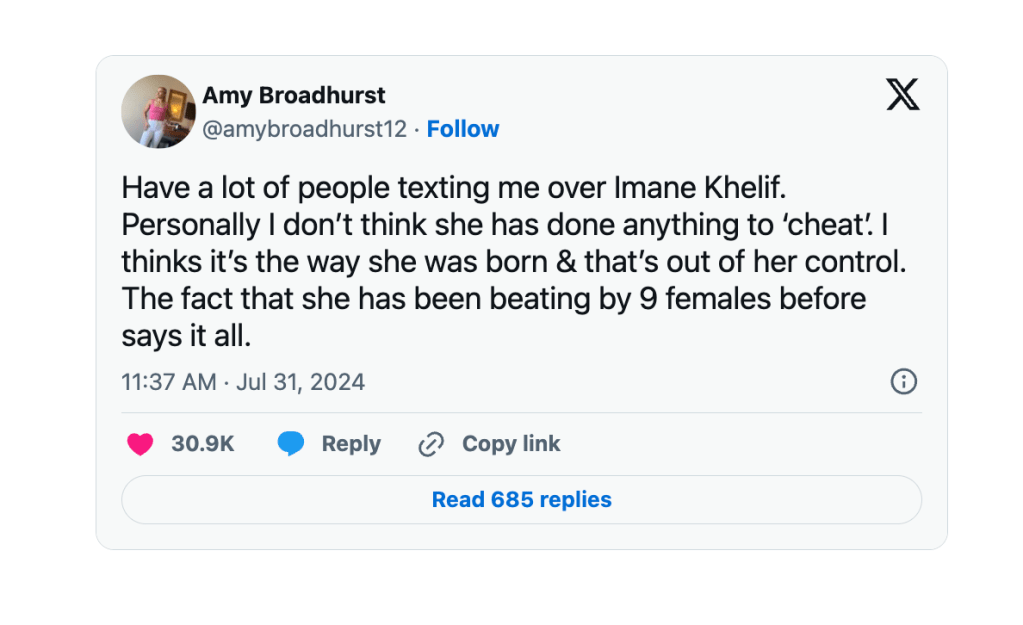
Broadhurst, the last competitor to defeat Khelif, said Thursday she doesn’t think Khelif “has done anything to ‘cheat.’”
On Wednesday, the Algerian Olympic Committee condemned the commentary around Khelif’s gender as “lies” in a statement to The Associated Press. The committee also called it “unethical targeting and maligning of our esteemed athlete” with “baseless propaganda from certain foreign media outlets,” per the AP.
A governance mess risks Olympic boxing
The IOC has repeatedly said that the IBA no longer has any involvement with the Olympics in part because of a lack of financial transparency from the IBA, about prize money and other support.
Other disputes are tied to the IBA’s governance, its reliance on official Russian support, and the integrity of judging at past events, including the 2016 Olympics.
The IBA, which is financially backed by the Russian state-owned energy company Gazprom, promised to hand out more than $3 million in prize money to fighters and teams in Paris. That led the IOC to issue an ultimatum: Countries who stayed loyal to the IBA could be barred from competing in boxing at the 2028 Olympics in Los Angeles.
“This total lack of financial transparency was exactly one of the reasons why the IOC withdrew its recognition of the IBA,” the IOC said in May.
In response to the ultimatum, the IBA called the IOC’s position “an absolute travesty and disgrace.”
“An important reminder to note is that the IBA has never restricted our athletes from any event, we actively support to the fullest, and we continue to do so at all costs,” the IBA said on the same May day. “It appears that the IOC fail to recognize the very same values that we at IBA hold dearly… a clear measure and lack of selfless commitment and integrity that they pontificate.”
The Court of Arbitration for Sport ruled in June that the IOC’s move was justified, and said that the IBA had not met the requirements of Olympic leaders.
The IOC said Thursday that national boxing organizations need to line up under another worldwide federation.
“The IOC has made it clear that it needs National Boxing Federations to reach a consensus around a new International Federation in order for boxing to be included on the sports programme of the Olympic Games LA28,” the IOC said.
(Photo: David Fitzgerald / Sportsfile via Getty Images)

Mark Puleo is a News Staff Editor at The Athletic. Before joining The Athletic, Mark covered breaking weather news as a digital journalist and front page digital editor with AccuWeather. He is a graduate of Penn State University and its John Curley Center for Sports Journalism. Follow Mark on Twitter @ByMarkPuleo

 Lord Buckbeak: "Will you come into my parlor?," said the Spider to the Fly.
Leave a comment