By Sawyer Belair – June 26th, 2023 – Lincoln Journal Star
My cmnt: Any denomination with the word “United” in its name (i.e., United Methodist, United Presbyterian, United Lutheran, United Church of Christ, et al.) is a compromised church. While these churches may still use historic creeds and statements of faith (and most of them do) they do not interpret them the way the original church meant them. Most (if not all) of these churches have either removed the miraculous from their thinking or spiritualized (i.e., made unreal) all of the great foundational doctrines of historic Christianity. Whatever supernatural elements there may be in the Bible (i.e., the masculine nature of God in the Trinity – Father, Son and Holy Ghost, actual creation by God of the entire universe, actual creation by God of life and especially man (created male and female), actual miraculous birth of the nation Israel by God through the prophet Moses, actual space-time incarnation of God into the person of Jesus of Nazareth, born of the actual Jewish virgin Mary, actual physical resurrection of Jesus from death and the tomb, actual final Judgement by God of all people based upon their confession of faith in the risen Christ, etc.) have all or mostly been expunged from their belief systems and replaced with a humanistic, naturalistic counterfeits.
My cmnt: It has been multiple decades now that these churches have ceased proclaiming the Gospel of salvation offered in scripture of trust and faith in the bodily resurrection of Jesus Christ to the right hand of God the Father through the ministry of the Holy Spirit. All of these churches ordain women to the positions of priest or elder against the express prohibition of Holy Scripture, accept homosexuality as a good and normal state of men and women, have faith in the doctrine of Darwinian evolution, despise Zionism, more or less worship nature through radical environmentalism, consider abortion a natural right and a neutral moral action, and tend towards a belief in the goodness of communism and the evil of America.
My cmnt: So it is slightly ironic and certainly revealing what it takes now-a-days to upset a Lib church. And apparently the surgical and chemical mutilation of children in the name of LGBTQwerty has become a bridge too far.

Living Faith Methodist Church in Omaha voted earlier this month to disaffiliate from the United Methodist, joining the newly formed Global Methodist Church on the same day. Courtesy photo
OMAHA — Less than a week after voting to leave the United Methodist Church, the mood among the congregation of Omaha’s Living Faith Methodist Church seemed like business-as-usual on the morning of June 4.
That all changed when Pastor Jaime Farias gave the official news 10 minutes into the service: the congregation, along with 155 others across Kansas and Nebraska, had been approved for disaffiliation from the United Methodist Church during a regional conference held over Zoom on May 31. The crowd of 20-some churchgoers erupted into enthusiastic applause.
Despite his congregation’s enthusiasm, Farias has mixed emotions about the breakup, which has centered around disagreements over the denomination’s enforcement of sexuality laws.
“I’m not happy, to be honest,” said Farias, who has been involved with the church since he was a 15-year-old living in Mexico. “God doesn’t want this to happen … the division, the discord, the disagreements.”
Along with several other Nebraska congregations, none of which are based in Lincoln, Living Faith is part of a broader disaffiliation movement in the Methodist Church that has resulted in clashes across the country.
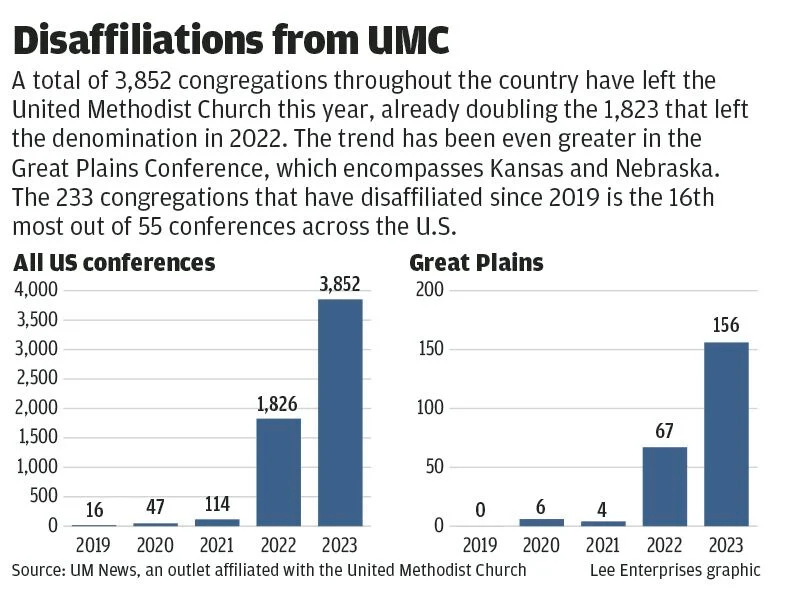
According to data from UM News, an outlet directly affiliated with the United Methodist Church, a total of 3,852 congregations have left the denomination in 2023, more than doubling the 1,826 who left in 2022 and nearly 13 times more than the 308 that left in 2021.
The trend has been even stronger in the Great Plains Conference that encompasses Kansas and Nebraska, which has lost 156 congregations thus far in 2023, 67 in 2022 and four in 2021. The conference’s 233 lost congregations since 2019 are the 16th most among the 55 conferences across the country.
Sexuality at center stage
The crux of the issue centers around sections pertaining to sexuality within the United Methodist Church’s code of conduct, known as the Book of Discipline. While the text mandates that the church not “reject or condemn lesbian and gay members and friends,” it also asserts an incompatibility between Christian practices and homosexuality, effectively outlawing LGBTQ members from joining the clergy or marrying someone of the same sex.
The specific edict has been subject to vigorous debate in the decades since it was first introduced in 1972 during the church’s first General Conference meeting, where congregations across the world gather every four years to vote on amendments to the Book of Discipline and establish other general guidelines.
Multiple attempts have been made to amend the church’s laws, but every effort has fallen short, according to Great Plains Bishop David Wilson, the church’s first-ever Native American bishop who was elected in 2022.
“Every four years since the ’70s, there’s been legislation to change this,” Wilson said.
The conflict came to a head in 2019, when a special session of the General Conference was held to address it directly.
Two factions emerged from that meeting, according to the Rev. David Livingston, a four-time delegate to the General Conference and board member of Kansas-based Mainstream UMC, a unity-focused advocacy group within the church.
There were those in favor of reconciliation between the differing ideologies, known as the “One Church” plan, and those advocating for stricter enforcement and punishments for violations of the church’s laws.
“The ‘One Church’ plan was an attempt to say, ‘Can we agree to disagree?’” Livingston said. “The traditionalists said, ‘No, this is what you have to believe, this is how you must behave.’”
While the meeting resulted in strengthened restrictions on ordination, it left much to be desired from both sides, according to Wilson. A subsequent discussion of a split within the United Methodist Church led to the introduction of an exemption to the Book of Discipline known as Paragraph 2553, which allowed congregations to leave without forfeiting their assets to the UMC and paved the way for the current exodus.
Wilson said the exemption was meant to serve as a short-term compromise before the General Conference reconvened in 2020, prior to the COVID-19 pandemic throwing a wrench in the process of further in-person discussions and hastening the schism within the church.
Many congregations were exasperated over the reluctance of the United Methodist Church’s American leadership to punish congregations in violation of the Book of Discipline while the dispute remained under mediation.
“Most folks got impatient and just said, ‘We’ve got to move on this,’” Wilson said. “(But) it was inevitable; we all knew it was going to come.”
Competing interpretations
For Living Faith, the issue has been front-and-center since its inception in the late ’90s. Many of its founding members fled from another Omaha congregation, First United Methodist Church, following a scandal involving a same-sex union performed by the church’s Rev. Jimmy Creech in 1997 that resulted in a trial and acquittal for the minister.
Diane West is one such member at Living Faith. She said she believed she was leaving the issue of same-sex ordination and marriage behind when she joined Living Faith in 1998, but said the United Methodist Church’s unwillingness to enforce its rules at other churches has been a drain on her and others at Living Faith.
“There’s no accountability in the denomination, and that wears on people over time,” she said.
Living Faith is one of many departing congregations that have joined with the Global Methodist Church, a denomination officially founded in May 2022 that has placed an increased emphasis on the doctrine of Methodism.
A representative from the Global Methodist Church could not be reached for comment.
While many who disagreed with the “One Church” plan have left already, some still remain. John Lomperis is a UMC General Conference delegate based out of Oregon and a contributor to the Institute for Religion and Democracy, an American Christian conservative think tank.
An outspoken critic of his denomination’s leadership, Lomperis claims the United Methodist Church has been “hijacked by a liberal faction,” citing a litmus test the church employed during last fall’s elections that required bishops to accept the ordination LGBTQ+ ministers as decided by the Board of Ordained Ministry, which is responsible for deciding ordinations.
In doing so, Lomperis said United Methodist Church leadership is in direct opposition to the doctrine it is officially bound by.
Livingston disagreed with Lomperis’ characterization of the situation as a matter of abiding by religious law. He said Lomperis and other traditionalists’ reservations towards LGBTQ+ ordination and marriage hypocritically ignore other violations of the church’s doctrine, such as the case of many congregations refusing to practice infant baptism.
“Infant baptism is about as foundational to our specific theology methods as you can get,” Livingston said. “(Traditionalists) are not going to bring them up on charges because the issue for them is about sexuality.”
A self-described “centrist” in the debate that is seen by some as a battle between progressives and traditionalists, Livingston said he personally agrees with “about 95%” of the GMC’s stances. Nonetheless, he said their adherence to the doctrine hinders their ability to fulfill the spirit of Methodism, which he said requires an inquisitive and inclusive approach, pointing to his own shifting beliefs.
“If I had been at the 2004 General Conference, I would probably not have voted the way that I’m voting now, but my faith journey has continued to move,” Livingston said.
Such a view isn’t compatible with everyone. Farias, the pastor at Living Faith, said that although he “doesn’t judge” LGBTQ people, he disagrees with their way of life, and sees acquiescence to them in the denomination as an afront to the fundamental identity of Christianity.
“Christ and all followers of Jesus Christ in all times, from the beginning until today, we are counterculture,” Farias said. “You can’t compromise your beliefs trying to fit in with the rest of the people.”
For Livingston, he believes that Methodism itself, which he said is heavily focused on the concept of God’s grace, requires a different orientation.
“If I’m gonna get in trouble with God, I would rather get in trouble for who I include instead of who I exclude,” he said. “I’m convinced that God would prefer that we get it wrong in favor of love and grace, instead of rule and judgment.”
Peace on the Prairie
While the disaffiliation process has been messy in some parts of the country, according to both Lomperis and Livingston, the breakup has been much less so in the Great Plains conference, which allowed 156 congregations to leave in a 655-to-29 vote at the May 31 virtual meeting.
Phil Fisher, the chairman of Living Faith’s church council, said his church’s situation was no exception.
“Any time I had a question over email, (UMC director of administration) Scott Brewer would fire right back to me. He made it as easy as he could,” Fisher said. “We had a lot of help; all we had to do was just ask for it.”
Livingston attributed the ease of the process in the Great Plains to factors both cultural and pragmatic.
“It probably has something to do with just some of our Midwest sensibilities; we’ve always known that we have to work together and get along,” he said. “And by allowing churches to leave in an amicable way, I’m hopeful that they also would be able to come back in an amicable way.”
Nonetheless, congregations in the Great Plains on both sides of the disaffiliation vote find themselves on diverging paths. For the United Methodist Church Great Plains conference, Bishop Wilson said that while he has no ill will toward those who have decided to leave, the greater sense of solidarity within the conference will allow it to fully turn its energy toward the issues that matter most to them.
“There’s a great feeling in the conference,” Wilson said. “We believe in our work of inclusion … working towards social justice, and working around building our community in our local churches.”
Farias, who is retiring from the United Methodist Church after two decades of service and starting anew as a pastor in the Global Methodist Church, said he’s embracing the bittersweet moment as a chance to reaffirm his life’s purpose.
“I’m here to do whatever the Lord wants me to do,” he said. “I hope this church keeps following and learning and doing what is in the scriptures for them to do, and I just hope that I can be a good pastor for them.”
Zion Congregational Church

From 1914 to 1954, the Zion Congregational Church served its congregation from the corner of Ninth and D streets in Lincoln. Journal Star file photo


Leave a Reply