Or: From goo to you by way of the zoo
By Stephen Meyer – Discovery Institute – for Prager U
=========================================
Ai Overview
This famous quote is by British astronomer Sir Fred Hoyle (1915–2001), expressing that the precise tuning of physical laws for life suggests a “super intellect” intervened in physics, chemistry, and biology. Despite being an atheist, Hoyle concluded that the “overwhelming” numerical facts made this manipulation seem intentional, dismissing “blind forces”.
HyperPhysics +3
Key Context of the Quote:
- Context: Hoyle made this remark (often quoted as “…monkeyed with physics, as well as with chemistry and biology…”) after calculating the extreme improbability of carbon-12 forming in stellar nucleosynthesis.
- The “Hoyle State”: He discovered that for carbon-12 and oxygen to exist in the universe in balanced amounts, the nuclear resonance levels had to be precisely tuned.
- Atheist Perspective: While commonly cited by intelligent design advocates, Hoyle (a staunch atheist) was not necessarily suggesting a supernatural God, but rather that the universe’s structure implies a “super-calculating” entity.
- The Junk-yard Tornado: Hoyle famously argued against the random emergence of life by comparing it to a tornado sweeping through a junkyard and assembling a Boeing 747.
Hoyle coined the term “Big Bang” but rejected the theory, favoring a steady-state model. In this he was proven incorrect by Einstein, Hubble and others. The discovery of the CMB pretty much drove a stake into the last faint beating of the heart of the steady-state theory.
The Cosmic Microwave Background (CMB) is the oldest, faintest light in the universe, representing residual radiation from the Big Bang. It is a 2.7-degree Kelvin microwave “glow” filling all space, dating back to 380,000 years after the universe began, providing crucial evidence for the Big Bang theory and the origin of cosmic structures.
Key Facts About the CMB:
- Origin: It formed when the early universe cooled enough for electrons and protons to form neutral hydrogen (recombination), allowing photons to travel freely.
- Discovery: Discovered by Arno Penzias and Robert Wilson in 1965, who registered a consistent signal from all directions, winning a Nobel Prize.
- Temperature: It is nearly uniform at roughly
2.7-degree Kelvin, indicating a remnant “fireball” from the early, hot universe.
- Anisotropies: Small fluctuations in temperature (less than 0.001K) show where matter was slightly denser, seeding the formation of galaxies.
- Function: It serves as a “baby picture” of the universe, allowing scientists to study the composition of dark matter, dark energy, and test the Big Bang model.
The CMB is polarized, which provides further information regarding the early moments of the universe.
==============================================
Evolution.
You learned about it in high school.
It goes like this: Life started out with very simple forms and then gradually, over hundreds of millions of years, morphed into all the forms we see today. Bacteria to Beethoven. Not a straight line, of course…but that’s roughly how it went.
This was the theory proposed by Charles Darwin in 1859, and, with some modification, it has been embraced as unassailable by the science community over the last century. As evolutionary biologist Richard Dawkins says, “If you meet somebody who claims not to believe in evolution, that person is either ignorant, stupid or insane.”
But is that right? Are there no scientific reasons to doubt the evolutionary account of life’s origins?
In November 2016, I attended a conference in London convened by some of the world’s leading evolutionary biologists. The purpose: to address growing doubts about the modern version of Darwin’s theory.
Let’s look at just two scientific reasons to doubt this theory.
First, the Cambrian Explosion. A weird and wonderful thing happened 530 million years ago: A whole bunch of major groups of animals—what scientists call the “phyla”—appeared abruptly within a geologically short window of time—about ten million years.
These novel animal forms—exhibiting proto-types of most animal body designs we see today—emerged in the fossil record without evidence of earlier ancestors.
Did you catch that? A huge number of diverse animals appeared, with no discernible antecedents.
So where did they come from?
This question really bothered Darwin. And he acknowledged that he could give it “no satisfactory answer.” Nor can scientists today.
The renowned biologist Eugene Koonin, of the National Center for Biotechnology Information, describes the abrupt appearance of the Cambrian animals and other organisms such as dinosaurs, birds, flowering plants and mammals as a pattern of “biological Big Bangs.”
So what caused all these new forms of life to arise? That question leads to a second big doubt: the DNA enigma.
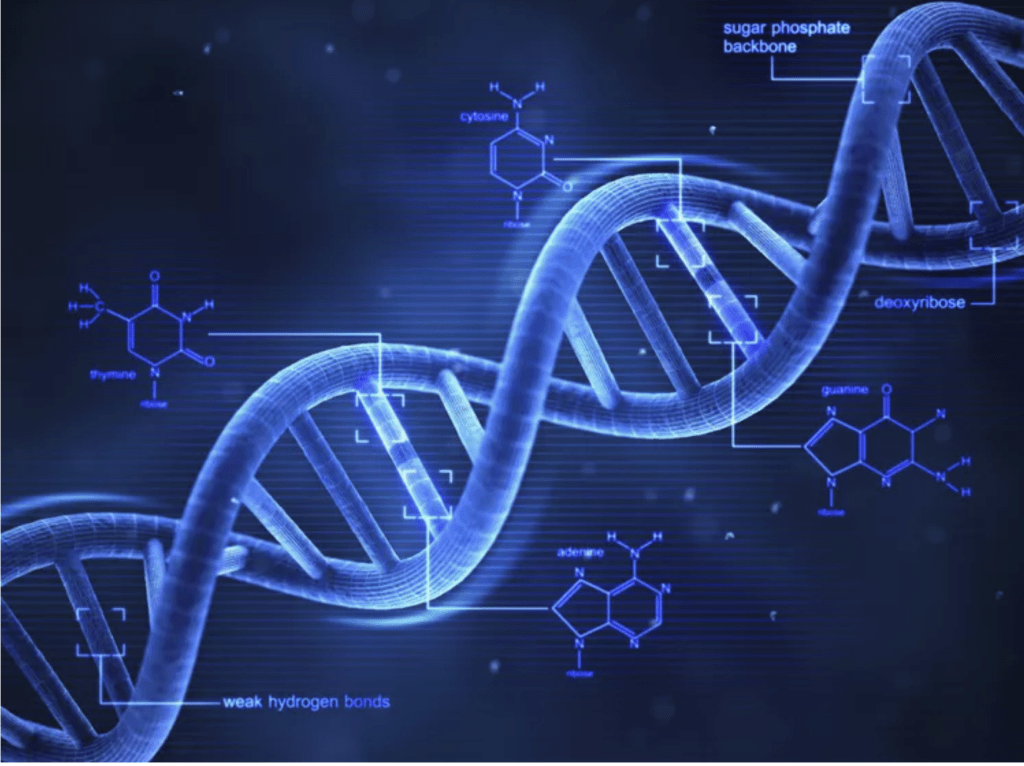
In the 1950s, James Watson and Francis Crick made a startling discovery: The DNA molecule stores information as a four-character digital code. Strings of precisely sequenced chemicals inside the DNA helix store the instructions—the information—for building the crucial proteins that cells need to survive. Unless the chemical “letters” in the DNA text are sequenced properly, a protein molecule will not form. No proteins; no cells. No cells; no living organisms.
Bill Gates has said, “DNA is like a software program.” Let’s think about that for a second. For computers to run faster and perform more functions, they require new code. Well, the same is true for life: To build new forms of life, the evolutionary process would need to produce new genetic information—new code.
But this raises questions about the creative power of natural selection and mutation. Natural selection is a simple sorting process. Species keep favorable mutations that allow them to survive but eliminate bad mutations that cause their members to die out. No one doubts that natural selection is a real process and that it produces minor variations, but many biologists now doubt that it produces major innovations in biological form.
To see why, think again about software. What happens if you introduce a few random changes into computer code? You’ll likely mess it up, right? Though it might still work—if you don’t make too many changes. But if you make enough random changes, your program will stop functioning altogether. You certainly can’t keep doing this and expect some cool, new program to pop out. There’s a mathematical reason for this. In all codes and languages, there are vastly more ways of arranging characters that will generate gibberish than there are arrangements that will generate meaningful sequences.
And this applies to DNA.
Remember, natural selection only “selects” sequences that random mutations generate. Yet experiments have established that DNA sequences capable of making stable proteins are extremely rare—and, thus, really hard to stumble on randomly.
How rare? While working at Cambridge University, molecular biologist Douglas Axe showed that, for every DNA sequence that generates a relatively short functional protein, there are 10 to the 77th power nonfunctional sequences.
Now consider that there are only 10 to the 65th power atoms in our galaxy. So finding a new DNA sequence capable of building a functional protein is like searching blindfolded for a single marked atom among a trillion Milky Way galaxies. Talk about a needle in a haystack!
As I show in my book Darwin’s Doubt, even 4 billion years of life’s history is not enough time to overcome a search problem this big.
So, two serious doubts about modern Darwinian theory: The Cambrian Explosion—the sudden appearance of new animals, which evolutionary theory has failed to explain; and the DNA enigma—the implausibility of random mutations producing the information needed to build new forms of animal life.
Scientists who know about these problems are not “ignorant, stupid, or insane;” they are just appropriately skeptical.
I’m Stephen Meyer, senior fellow at the Discovery Institute, for Prager University.
My cmnt: As a systems analyst and computer programmer for a large manufacturing company for over 30 years I would from time-to-time attempt to debug an extremely complex pgm by, as my Perfect Score on the SATs coworker would say, using ‘beads and rattles’ – that is blind luck. Needless to say it never worked. Random changes to the code NEVER fixed an error nor made the pgm better – only worse. Only super hard, tedious, time consuming intelligent design and effort EVER made a pgm run properly or better.
My cmnt: For multiple decades I have also played computer chess. The chess pgms are so good now it is hard for a Grand Master to beat them. In all my years of playing chess (over 50 now) I have never beaten a good player or chess pgm by random moves. Again, intellegent design proves out over and over again.
 Lord Buckbeak: "Will you come into my parlor?," said the Spider to the Fly.
Leave a comment