By Billy W – Sunday Aug. 07, 2016 – Bible Brodown
Introduction
In this section, we will discuss the following:
- Who was John the Baptist
- What was John’s purpose
- Why did Jesus get baptized by John
- What righteousness did Christ need to fulfill?
- The ordination of Christ as High Priest by letter and Spirit
- What righteousness did Christ need to fulfill?
Who is John the Baptist?
John the Baptist was from the tribe of Levi (Luke 1:5-7)
- His father was Zacharias, from the priestly division of Abijah (a Levitical Priest)
- His mother was a daughter of Aaron, from the tribe of Levi
John was, by birth, able to serve as a priest in the temple of God, for he was a Levite. Instead of serving as a priest, however, he was instead called to be a prophet and a messenger.
Luke 1:76-77
“And you, child, will be called the prophet of the Most High; for you will go on before the Lord to prepare His ways; to give to His people the knowledge of salvation, by the forgiveness of their sins
John also followed the Nazirite vow (Luke 1:15). To take the Nazirite vow was to dedicate one’s self to the Lord for certain periods of time, but John did it for his entire life. The scripture records the Nazarite vow and service in Numbers 6:1-21.
What was John’s purpose?
As stated above, John the Baptist was a Nazarene. By definition, the Hebrew word nazir, simply means “to be separated or consecrated”. John had been separated in order to prepare and proclaim that the Messiah was coming, and to preach repentance and faith to receive the forgiveness of sins (Mark 1:4; Luke 3:3) This is the gospel and this is what John was said to preach (Luke 1:77; Luke 3:18).
This is the same exact gospel that has always been preached – repent and trust in God, and receive the forgiveness of sins. See our study, The gospel preached by John the Baptist, Jesus, and the Disciples.
John was the fulfillment of a prophecy from Isaiah.
John 1:22-23
Then they said to him, “Who are you? Tell us so that we can give an answer to those who sent us. What do you say about yourself?” John said, “I am the voice of one shouting in the wilderness, ‘Make straight the way for the Lord,’ as Isaiah the prophet said.”
John quoted directly from Isaiah 40:3. Any Hebrew familiar with his Old Testament would have expected the ministry of John as a preliminary measure in the divine plan, paving the way for the appearance of the Messiah. Seven centuries before the birth of Jesus, the prophet Isaiah spoke about the voice crying in the wilderness preparing the way of the Messiah. Furthermore John is referenced in Malachi:
Malachi 3:1
“Behold, I send My messenger, and he will prepare the way before Me. And the Lord, whom you seek, will suddenly come to His temple, even the Messenger of the covenant, in whom you delight. Behold, He is coming,” Says the Lord of hosts.
Note the distinction between the “messenger” who prepares the way, and the “Messenger of the Covenant,” for whom the way is prepared. The former is a reference to John, the latter is an reference to Christ.
John’s sole purpose was to be the sign to Israel that the Messiah had come.
John 1:6-9
A man came, sent from God, whose name was John. He came as a witness to testify about the light, so that everyone might believe through Him. He himself was not the light, but he came to testify about the light. The true light, who gives light to everyone, was coming into the world.
John was a sign to the Jews that the Messiah was coming. His purpose was to preach the gospel, and prepare the hearts of those looking for the Messiah, the one who would cover their sins. John was preaching the gospel–repentance and faith in God and His Word for forgiveness of sins. By baptizing in water, John was providing a shadow of the future baptism of the Holy Spirit to all those who believe
(Matt.3:11; Mark 1:8-9; Luke 3:16; John 1:33; Acts 1:5).
John wanted the Jews to turn from their ways of following the Pharisees, whom he called offspring of vipers (Matt.3:6-8), and produce works of genuine repentance and faith.
John was to be the messenger of the Messenger. He was to proclaim to Israel to turn from their sin and self-righteousness in order to receive salvation, and to prepare the way of the Messiah.
Why did Jesus get baptized by John?
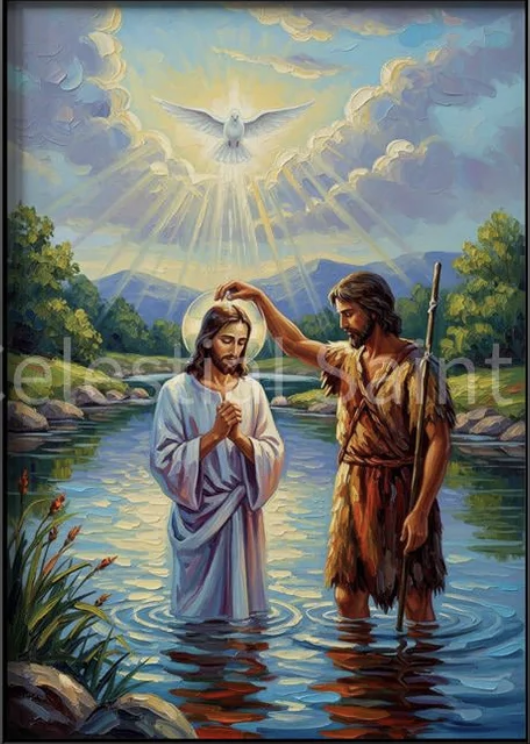
Matthew 3:13-17
Then Jesus arrived from Galilee at the Jordan coming to John, to be baptized by him. But John tried to prevent Him, saying, “I have need to be baptized by You, and do You come to me?” But Jesus answering said to him, “Permit it at this time; for in this way it is fitting for us to fulfill all righteousness.” Then he permitted Him. After being baptized, Jesus came up immediately from the water; and behold, the heavens were opened, and he saw the Spirit of God descending as a dove and lighting on Him, and behold, a voice out of the heavens said, “This is My beloved Son, in whom I am well-pleased.”
John was preaching the gospel, and asking people to repent and receive the forgiveness of sins. Jesus was sinless, and did not need to be forgiven. He was already faithful. So how was Christ fulfilling all righteousness by being water baptized by John?
“Permit it at this time; for in this way it is fitting for us to fulfill all righteousness.“
“At this time” means at this very moment and “in this way” means in this manner. Christ was telling John to yield at this moment and in this manner (with John water baptizing Him).
“Fitting” is the verb “prepo” and means “to tower up (be conspicuous), i.e. to stand out so as to be clearly visible (the meaning of conspicuous). Figuratively or by implication it shows what is suitable or proper.
Notice also that Jesus says it was for ‘us’. This was done specifically with John for a purpose. In this instance, Christ’s water baptism by John was done to stand out and to be clearly visible to “fulfill all righteousness.” This word for “fitting” is used only 6 more times, and we need to take special note of one of them:
Hebrews 7:26
For it is indeed fitting for us to have such a high priest: holy, innocent, undefiled, separate from sinners, and exalted above the heavens.
Christ was to stand out so as to be clearly visible as our High Priest.
In summary thus far, Christ said to “yield at this moment” and “in this manner” in order “to stand out so as to be clearly visible” for “us” to “fulfill all righteousness.” The verb, “to fulfill” means to make full, or to make complete, to render perfect or to satisfy.
Christ stated that by doing this now, and in this manner, and with John, was to standout and be visible to satisfy all righteousness. What does He mean by that?
What righteousness did Christ need to fulfill?
Christ was righteous; He was sinless (2 Cor.5:21). He did not need to repent or be made ritually clean, for He was already with God, for He was God.
In Matthew 5:17-20, Christ says He came to fulfill the Law and the Prophets. Christ had to keep the Law, and He did perfectly, both in Spirit and the true letter. Christ fulfilled the demands of the Mosaic Law (not the ordinances the Pharisees created that distorted the true letter of the Law), which called for perfect obedience. He was circumcised after eight days, and even was purified as a baby according to the Law, and a sacrifice was made according to the Law (Luke 2:21-24).
Christ also provided the true meaning of the letter of the law, by expounding on the spiritual meaning (Matt 5:21-48). We also see this through the Holy Spirit baptism that occurred after His water baptism. This is to indicate that the true spiritual understanding of water baptism is to be baptized by the Holy Spirit (which occurs at our faith).
So what righteousness of the Law, whether by the letter of the Law or the spirit of the Law, did Christ satisfy through His water baptism?
Ordination as High Priest by letter and Spirit
Hebrews 2:16-17
For surely His concern is not for angels, but He is concerned for Abraham’s descendants. Therefore He had to be made like His brothers and sisters in every respect, so that He could become a merciful and faithful high priest in things relating to God, to make atonement for the sins of the people.
Hebrews 5:1-3
For every high priest is taken from among the people and appointed to represent them before God, to offer both gifts and sacrifices for sins. He is able to deal compassionately with those who are ignorant and erring, since he also is subject to weakness, and for this reason he is obligated to make sin offerings for himself as well as for the people.
Christ came to be our High Priest, so that He could atone for the sins of the people. Through the confessions of our sins (our repentance), He provides the atonement. When the high priest entered the temple annually, he sacrificed for all people. There were not certain people he made sacrifices for. You didn’t have to know the high priest personally to be included. The high priest did it for all people (Lev.16:15,24), even for those in ignorance (Heb.9:7), or better translated, for ‘the ignorance of the people”. It wasn’t based on what they knew, it was based on God’s grace. Christ did it once and for all. His sacrifice first applies to all people (which is why God currently passes over our sin and does not destroy us. God is patient, and does not desire any to perish. Because of the work of the Son, God passes over, and is patient, wanting all to come to repentance. Those of faith will truly reap the full benefit of the atonement, and be completely forgiven, washed clean, and raised to eternal life.
Christ needed to fulfill the righteousness of the letter of the Law, as commanded by God for all priests.
When Aaron was ordinated as a priest along with his sons, they were first washed by water (Lev. 8:6). And then they were anointed with oil (Lev. 8:12). The last thing to occur was the sacrificial offerings, in which the priests were anointed with blood on the altar (Lev. 8:30). Whenever a priest entered the tent of meeting for service, it was commanded that they ritually cleanse themselves first by water (Ex. 40:30-32).
Moses was a Levite and prophet that performed the washing ordination of Aaron (the High Priest). John the Baptist was a Levite and prophet who washed and ordained Christ as a High Priest. But in order to be a High Priest, you had to be called by God.
Hebrews 5:4
And no one assumes this honor [as High Priest] on his own initiative, but only when called to it by God, as in fact Aaron was.
The Lord Jesus Christ is to be the final and authoritative High Priest of God and He needed to be ordained, per the Law, just as other priests. John had been called and set aside by God to fulfill this commandment of the Law for all priests (and he could, being both a Levite and a prophet). Christ was ritually cleansed as part of His ordination.
Immediately after fulfilling the letter of the Law for ordination as a priest, we see Christ’s calling by the Father as High Priest:
Matthew 3:16-17
After being baptized, Jesus came up immediately from the water; and behold, the heavens were opened, and he saw the Spirit of God descending as a dove and lighting on Him, and behold, a voice out of the heavens said, “This is My beloved Son, in whom I am well-pleased.”
The Father anointed the Son as High Priest through the Spirit falling upon Him. The Spirit was and is the true anointing (as the oil represented) that was required to ordain all priests.
Acts 10:37-38
you know what happened throughout Judea, beginning from Galilee after the baptism that John announced: with respect to Jesus from Nazareth, that God anointed him with the Holy Spirit and with power. He went around doing good and healing all who were oppressed by the devil, because God was with him.
Hebrews 5:5-6
So also Christ did not glorify himself in becoming high priest, but the one who glorified him was God, who said to him, “You are my Son! Today I have fathered you,” as also in another place God says, “You are a priest forever in the order of Melchizedek.”
The Lord Jesus Christ was washed with water, fulfilling the righteous requirement of the [letter] of the Law. It was done through John because he was both a Levite and a prophet, and was the messenger to proclaim the coming of the one who would baptize us with the Holy Spirit.
Christ then fulfilled the righteous requirement of the [Spirit] of the Law when God the Father called out His Son to be the High Priest, and anointed Him with the Holy Spirit. Christ then began His ministry as High Priest, and is able to sympathize with our weakness and temptation (Heb. 4:15), and offer both gifts and sacrifices for sins (Heb.5:1).
Christ is the High Priest of a new order, and a new tribe, and of a new covenant (Heb.7:11-22). By His atoning sacrifice and covering of His own blood, He entered once and for all the heavenly Holy of Holies and secured eternal redemption to all those who trust in God (Heb.9:11-12).
Our Lord and High Priest is now able to save completely those who come to God through the His work, because the Son always lives to intercede for them (Heb. 7:25).
Summary
John was called to preach the gospel, proclaim the coming of the Messiah, and provided a shadow of how the Father would use the Son’s work to truly cleanse us of sin (by baptizing us with the Holy Spirit).
John, a Levite and prophet, baptized Christ with water in order to fulfill the righteous requirement of the Law to ordain Christ as our High Priest.
In our next section on baptism, we will go over baptized with water, baptized by fire, and baptized into Moses.
Billy W.
Baptism – The purpose of John the Baptist and Christ’s water baptism

 Lord Buckbeak: "Will you come into my parlor?," said the Spider to the Fly.
Leave a comment