The regime never stopped seeking a weapon, and Obama’s deal didn’t end its pursuit.
By The Editorial Board – March 15, 2026 3:52 pm ET – Wall Street Journal
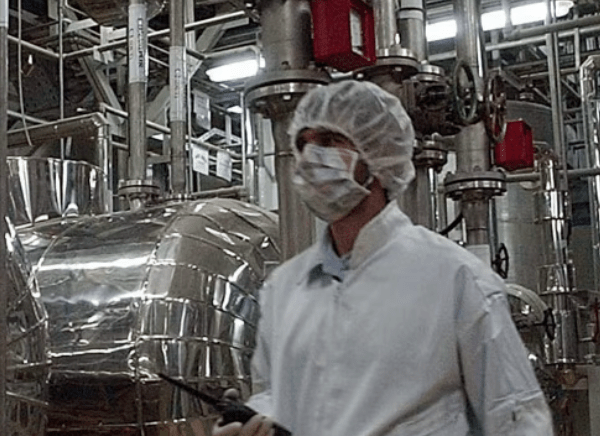
FILE – An Iranian security official walks through part of the Uranium Conversion Facility outside the Iranian city of Isfahan, March 30, 2005. Vahid Salemi/Associated Press
So much of today’s media framing of the Iran war relies on a mythology of what came before. The gist is that Iran was contained by Barack Obama until Donald Trump mucked it up, and now the regime will really pursue nuclear weapons.
Naive is too kind a word for this deceptive, partisan history. The real history is worth rehearsing because it shows that Iran’s regime has been relentless for decades in its quest for the bomb, which is why President Trump is weakening it by force.
***
A good date to start is 2002, when Israel helped expose Iran’s secret nuclear sites at Natanz and Arak. These are where the regime was pursuing a bomb via uranium and plutonium. That same year Iran tested its design for a nuclear implosion device, all in violation of its Nuclear Non-Proliferation Treaty obligations.
Iran denied wanting a bomb, and in 2007 a U.S. national intelligence estimate reported, with high confidence, that Iran had ceased its organized effort to develop nuclear bombs in 2003 after the U.S. invasion of Iraq. The worry in Tehran in 2003 was that it could be next. Iran’s President called the report a “gift from God.” Others saw it as a politicization of intelligence to block George W. Bush from confronting Iran. That was the effect, even as Iran helped kill 600 U.S. soldiers and foment chaos in Iraq.
Only later did we learn how misleading that intelligence finding was. The most conclusive evidence came in 2018 when Israel whisked Iran’s secret nuclear archives out of Tehran. The records proved that, far from ending its nuclear-weapons program, after 2003 Iran decentralized and dispersed but continued its activities. Weaponization was concealed or pursued at universities when dual-use civilian cover was plausible.
In 2009 the U.S. learned Iran had been building a facility deep under a mountain near Qom, designed to enrich uranium to weapons-grade. Again Iran claimed its purpose was peaceful, but then why bury it and not tell inspectors until the U.S. was on to it? This became the Fordow facility that the U.S. bombed in June with special earth-penetrating bombs.
***
Enter Mr. Obama, who made a nuclear deal with Iran a top priority. The talks dragged on for years, as Iran pressed forward with enrichment, repression at home and terror abroad while Mr. Obama did little in response. The regime’s negotiating goal was to win economic relief from sanctions while preserving and legitimizing its nuclear program. Iran finally agreed to a deal in late 2015 after a series of U.S. concessions.
The Obama team allowed enrichment and let Iran keep the infrastructure that could be used to reach weapons-grade when Iran felt the time was right. Mr. Obama backtracked to let Iran operate at Fordow and Arak and keep 5,000 centrifuges at Natanz. He gave up on “anytime, anywhere” inspections. Iran didn’t even have to detail all of its past nuclear activities.
The deal’s restrictions would sunset after five, eight, nine or 15 years, depending on the provision, and it weakened restraints on Iran’s missiles. In the deal’s first week, Iran received $30 billion in sanctions relief. Qassem Soleimani, the Quds Force chief, immediately flew to Moscow and secured Russia’s military intervention in Syria.
Then the Islamic Revolutionary Guard Corps (IRGC) arrested four Americans and held them for a trade. The deal didn’t change the regime’s hostile behavior, and Iran kept building its proxy network.
Mr. Trump quit the deal in 2018 and escalated sanctions. If he hadn’t, Iran and its proxies would be more dangerous now. The regime would be legally advancing its nuclear program from a position of strength.
President Biden made it his goal to redo the Obama deal and stopped enforcing oil sanctions. Iran pretended to negotiate but accelerated its uranium enrichment to the doorstep of weapons-grade. It also hid nuclear material and repeatedly lied to inspectors, as the International Atomic Energy Agency finally concluded in 2025. In October 2023 Iran’s proxies started a regional war by massacring Israelis, taking hostages, raining down rockets, and attacking global shipping.
Israel fought back, and Iran for the first time attacked Israel directly with missiles. The U.S. first joined in defense, and then under Mr. Trump joined to attack the nuclear facilities last June. The months since have been the first time in 20 years Iran hasn’t enriched uranium.
Before and after the June attack, Mr. Trump gave Iran every chance to dismantle its nuclear program and reach a new deal. But even with a U.S. armada in the region, Ayatollah Ali Khamenei insisted on keeping the capabilities to pursue a bomb. He put that above everything. He had done the same with Mr. Obama, and perhaps he thought Mr. Trump would also settle for a bad deal. He was wrong, fatally so for himself and maybe yet for the regime.
***
Critics of Mr. Trump’s bombing campaign now say it will motivate Iran to pursue nuclear weapons in earnest. But that’s what it has been doing for years. Critics also say the IRGC will now steer the ship of state, but it’s been doing that since the days of Mahmoud Ahmadinejad. The IRGC’s humiliation of Iran’s President in recent days only lifts that veil.
No one knows how this war will evolve. But one certainty since June is that the nuclear designs of a fanatical, anti-American regime have been set back years. A “race” to a bomb would now be more difficult, with Israel and the U.S. poised to intervene. Iran’s regime also faces serious economic, domestic and international problems that will last well beyond the war.
Bill Clinton faced a similar moment of truth with North Korea in the 1990s before it had the bomb, and he chose to trust Pyongyang’s diplomatic promises. North Korea lied and cheated and built a bomb anyway. Now it is building missiles that could reach the U.S. Mr. Trump chose to act instead, after his predecessors didn’t, and that is a service to the world.
 Lord Buckbeak: "Will you come into my parlor?," said the Spider to the Fly.
Leave a comment