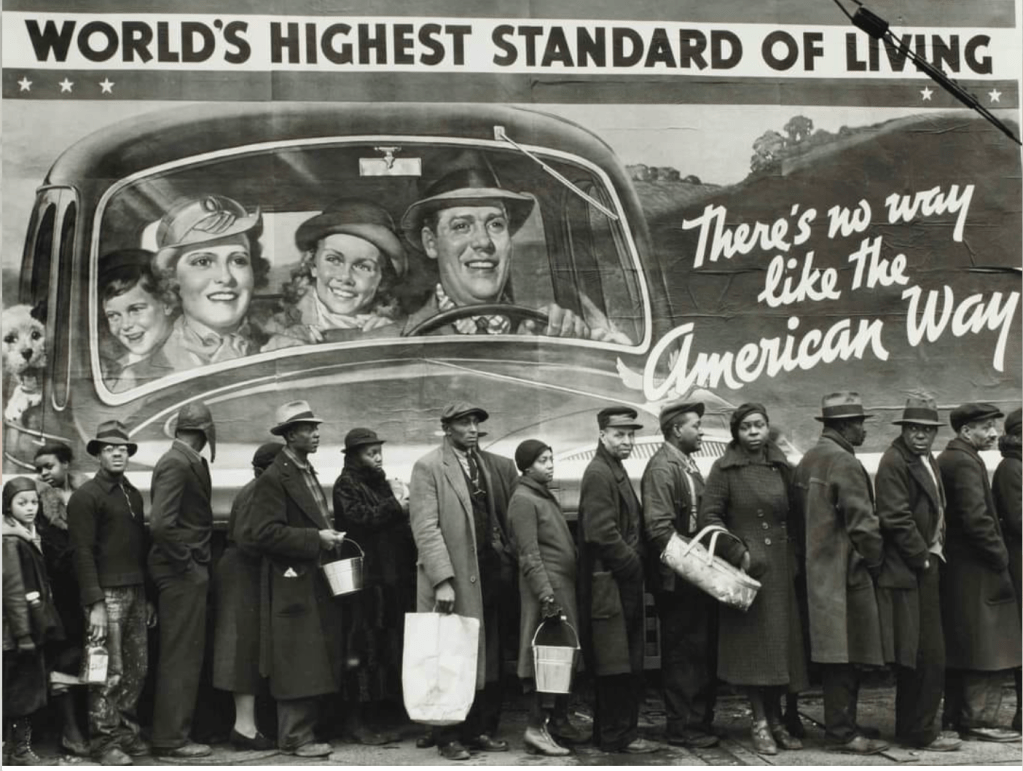
The question of whether Franklin D. Roosevelt’s New Deal (1933–1939 roughly) was a success or failure remains one of the most debated topics in American economic and political history. There’s no simple yes/no answer—it was both, depending on the criteria you use. Click here to read more on the New Deal.
Successes: Relief, Reform, and Stabilization
The New Deal provided immediate relief to millions suffering from the Great Depression, introduced lasting reforms, and helped stabilize key parts of the economy.
- Banking system stabilization — The Emergency Banking Act and creation of the FDIC (Federal Deposit Insurance Corporation) restored confidence after widespread bank failures. Bank runs essentially ended, and deposit insurance remains a cornerstone of U.S. finance today.
- Relief for the unemployed and poor — Programs like the Civilian Conservation Corps (CCC), Works Progress Administration (WPA), and Federal Emergency Relief Administration employed millions in public works (building roads, schools, parks, dams, etc.) and provided direct aid. This alleviated widespread hunger, homelessness, and despair.
- Long-term reforms — Social Security (1935) created a safety net for the elderly and disabled. The Securities and Exchange Commission (SEC) regulated Wall Street. Labor rights advanced through the Wagner Act (supporting unions) and the Fair Labor Standards Act (minimum wage, overtime, child labor restrictions). Infrastructure from the Tennessee Valley Authority (TVA) and other projects modernized rural areas and provided electricity.
- Economic rebound in the 1930s — After the 1929–1933 collapse (GDP down ~30%, unemployment peaking near 25%), real GDP grew robustly in several years (e.g., 1934–1936). Microeconomic studies show that relief and public works spending often had positive local effects on income and employment even as we know that public works are always only temporary bandaids on larger economic failures.
These achievements pulled the U.S. back from the brink of deeper collapse, restored hope, and reshaped the role of the federal government in providing economic security—effects that endure in programs like Social Security and FDIC insurance.
Failures and Criticisms: Incomplete Recovery and Economic Drag
The New Deal did not come close to ending the Great Depression. Unemployment remained high throughout the 1930s.
- Unemployment trajectory:
- 1933 (FDR takes office): ~25%
- Mid-1930s: Dropped to around 14–17%
- 1937–1938: Spiked back up (recession partly due to premature tightening of fiscal/monetary policy)
- 1939–1940: Still ~14–17%
- Full employment (~2–4%) only arrived with massive WWII mobilization (1941–1945), when defense spending exploded.
- Policy shortcomings — Some programs (e.g., National Recovery Administration, struck down in 1935) were criticized as cartel-like, raising prices and hindering recovery. Agricultural policies (e.g., AAA) paid farmers to reduce output, which helped prices but drew criticism for destroying food amid hunger. Certain regulations and taxes certainly slowed private investment.
- Unequal benefits — African Americans, women, and many Southern workers often received fewer benefits due to exclusions or local discrimination. The New Deal did nothing to directly address racial discrimination. Democrats still despised black people as they did during slavery, Jim Crow, the Woodrow Wilson (D) presidency and up to and including President Johnson’s (D) Great Society failures that continue to haunt us to this day.
- No full macroeconomic cure — Without a fully developed Keynesian framework (Keynes’s major work appeared in 1936), the New Deal mixed contradictory approaches and never achieved sustained, high-growth recovery on its own. Of course democrats always say their failures are not because of their misbegotten policies but rather because they were never “fully implemented”.
Overall Assessment from Historians and Economists
- Mainstream view (most historians, FDR Library, many economists): Partial success. It provided relief, reformed institutions, prevented worse outcomes, and laid foundations for modern social welfare and financial stability—but did not end the Depression (WWII did).
- Left/progressive view: Major success in human terms (saved capitalism from itself, empowered labor, built infrastructure) despite limitations.
- Conservative/libertarian critique (e.g., some Heritage Foundation, Cato analyses): Largely a failure or even counterproductive economically—prolonged the Depression through intervention, while political successes built a bigger government.
Modern scholarly reviews (e.g., microeconomic analyses by economists like Price Fishback) find many individual programs effective at the local level for employment and output, but the overall recovery never happened until war spending.
In short: The New Deal was a qualified success—extremely effective at relief, reform, and preventing catastrophe, but a failure at restoring prosperity in the 1930s. Its legacy is overwhelmingly positive in terms of America’s social safety net and infrastructure, even as the economy needed World War II’s demand surge for true escape from FDR’s mismanagement of the Great Depression.
Was FDR’s AAA in 1933 a horrible case of government mismanagement?
The Agricultural Adjustment Act (AAA) of 1933, a key part of Franklin D. Roosevelt’s New Deal, aimed to address severe farm distress during the Great Depression. Farm prices had collapsed due to massive overproduction (exacerbated by post-WWI policies and the Dust Bowl era), leaving many farmers bankrupt or in poverty. The AAA sought to restore “parity” — raising prices to levels comparable to 1909–1914 — by reducing surpluses.
The main mechanism involved paying farmers subsidies (funded by a tax on food processors) to take land out of production or limit acreage for key commodities like cotton, wheat, corn, tobacco, rice, and others. In extreme early cases, this included plowing under about 10 million acres of cotton and slaughtering roughly 6 million pigs (many young ones) to shrink supply quickly. The idea was that less supply would drive up prices, boosting farmers’ income and purchasing power, which in turn could stimulate the broader economy.
Short-Term Outcomes and Criticisms
The program did achieve some of its core goals fairly quickly:
- Farm prices rose significantly (e.g., by around 50% in some measures by 1935 compared to 1932 lows).
- It provided direct payments that helped many farmers avoid foreclosure and stabilized rural incomes in the short term.
However, it faced intense criticism and visible flaws that led many contemporaries (and later observers) to call aspects of it mismanagement or worse:
- Destruction amid hunger — Slaughtering livestock and destroying crops while millions were unemployed, underfed, and in breadlines struck many as absurd and morally outrageous. Critics (including some within the administration) highlighted the irony given FDR’s own phrase about Americans being “ill-fed, ill-clothed, and ill-housed.”
- Higher food prices for consumers — By design, the act raised costs for bread, meat, clothing (cotton), etc., during a depression when purchasing power was already low. This burdened urban workers and the poor.
- Unequal benefits — Large landowners and commercial farmers received the bulk of subsidies and often used payments to mechanize or evict tenants/sharecroppers (especially affecting Black farmers in the South, accelerating land loss and migration). Small farmers, tenants, and laborers gained far less or were harmed.
- Economic logic questioned — Some economists and libertarians (then and now) viewed paying people not to produce as a perverse incentive that distorted markets, created artificial scarcity, and set a precedent for ongoing farm subsidies seen as cronyism.
Legal Fate and Legacy
The original 1933 AAA was struck down as unconstitutional by the Supreme Court in United States v. Butler (1936, 6–3 decision). The Court ruled the processing tax was a coercive tool to regulate production (a state power) rather than a legitimate use of federal taxing/spending authority under the Tenth Amendment.
Congress responded with revised versions (e.g., the 1936 Soil Conservation and Domestic Allotment Act and the 1938 AAA), shifting to soil conservation justifications and avoiding the direct tax mechanism. Elements of production controls and subsidies persisted in U.S. farm policy for decades.
Was It “Horrible Government Mismanagement”?
It depends heavily on perspective:
- From a free-market or libertarian viewpoint — Yes, often seen as a textbook case of harmful intervention: destroying goods amid scarcity, raising prices on the needy, favoring big interests, and unconstitutionally expanding federal power.
- From a pragmatic New Deal/historical viewpoint — No, or at least not entirely. It was an emergency response to a genuine crisis of overproduction and farm collapse. It met key objectives (higher prices, stabilized incomes for many), prevented worse rural collapse, and reflected the limited tools available at the time. Many farmers supported it, and it laid groundwork for later agricultural stability.
Overall, the AAA was controversial, flawed (especially in equity and optics), and not fully successful — but calling it outright “horrible mismanagement” is more a value judgment than a consensus historical verdict. It was one of the more polarizing New Deal programs, with valid critiques on both efficiency and ethics, yet it did deliver measurable relief to the farm sector in a desperate period.
 Lord Buckbeak: "Will you come into my parlor?," said the Spider to the Fly.
Leave a comment