My cmnt: This same type of lunacy is ruining New York City by democrat-socialist mayor Zohran Mamdani today. Liberals never learn from the past.
From Living History Farm:
During the early years of the Depression, livestock prices dropped disastrously. Officials with the New Deal believed prices were down because farmers were still producing too many commodities like hogs and cotton. The solution proposed in the Agricultural Adjustment Act of 1933 was to reduce the supply.
So, in the late spring of 1933, the federal government carried out “emergency livestock reductions.” In Nebraska, the government bought about 470,000 cattle and 438,000 pigs. Nationwide, six million hogs were purchased from desperate farmers. In the South, one million farmers were paid to plow under 10.4 million acres of cotton.
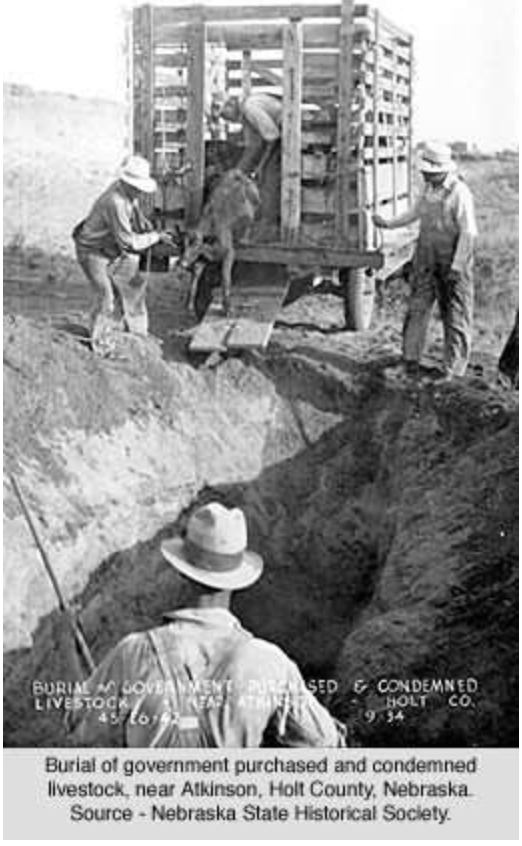
The hogs and cattle were simply killed. In Nebraska, thousands were shot and buried in deep pits. Farmers hated to sell their herds, but they had no choice. The federal buy-out saved many farmers from bankruptcy, and AAA payments became the chief source of income for many that year.
It was a bitter pill for farmers to swallow. They had worked hard to raise those crops and livestock, and they absolutely hated to see them killed and the meat go to waste. Critics charged that the AAA was pushing a “policy of scarcity,” killing little pigs simply to increase prices when many people were going hungry.
From Google Ai:
The 1933 Agricultural Adjustment Act (AAA) slaughter of 6.4 million pigs and destruction of crops to raise prices during the Depression is widely considered one of the federal government’s most controversial and callous economic policies. It aimed to boost farm incomes by reducing supply, which was morally condemned while many Americans starved.
Key details about this action:
- Scale: The government killed 6.4 million pigs/sows and paid farmers to destroy 10.4 million acres of cotton.
- Intent: The goal was to combat massive deflation by limiting supply, as farmers were overproducing.
- Controversy: Critics viewed it as a “porcine slaughter of the innocents”. While it achieved its economic goal, it heavily favored large landowners over sharecroppers.
- Context: It was a desperate, albeit misguided, attempt by the New Deal to rescue the agricultural economy from collapse.
While some critics argue it was one of the most unethical policies, many historians compare it to other actions in US history by FDR such as the internment of Japanese Americans, which is generally considered more “heinous” by historical standards. However, the AAA destruction is a frequently cited example of profound governmental ineptitude and moral conflict regarding food policy.
========================================
How extensive was the purposeful destruction of foodstuffs during the Great Depression? Steinbeck paints a very severe picture.
“The works of the roots of the vines, of the trees, must be destroyed to keep up the price, and this is the saddest, bitterest thing of all. Carloads of oranges dumped on the ground. The people came for miles to take the fruit, but this could not be. How would they buy oranges at twenty cents a dozen if they could drive out and pick them up? And men with hoses squirt kerosene on the oranges, and they are angry at the crime, angry at the people who have come to take the fruit. A million people hungry, needing the fruit- and kerosene sprayed over the golden mountains. And the smell of rot fills the country. Burn coffee for fuel in the ships. Burn corn to keep warm, it makes a hot fire. Dump potatoes in the rivers and place guards along the banks to keep the hungry people from fishing them out. Slaughter the pigs and bury them, and let the putrescence drip down into the earth.
There is a crime here that goes beyond denunciation. There is a sorrow here that weeping cannot symbolize. There is a failure here that topples all our success. The fertile earth, the straight tree rows, the sturdy trunks, and the ripe fruit. And children dying of pellagra must die because a profit cannot be taken from an orange. And coroners must fill in the certificate- died of malnutrition- because the food must rot, must be forced to rot. The people come with nets to fish for potatoes in the river, and the guards hold them back; they come in rattling cars to get the dumped oranges, but the kerosene is sprayed. And they stand still and watch the potatoes float by, listen to the screaming pigs being killed in a ditch and covered with quick-lime, watch the mountains of oranges slop down to a putrefying ooze; and in the eyes of the people there is the failure; and in the eyes of the hungry there is a growing wrath. In the souls of the people the grapes of wrath are filling and growing heavy, growing heavy for the vintage.”
In The Grapes of Wrath, John Steinbeck describes the “slaughter of the innocents” in Chapter 25 (often cited alongside the thematic, interchapter reflections in Chapter 21). This scene depicts the intentional destruction of food—specifically oranges, potatoes, and pigs—by corporate farmers in California to maintain high prices, while thousands of American migrant workers and their children are starving.
================================================
Lotterman (1999, p. 1) writes:
Participation in the program was voluntary, and farmers were paid for pigs that were killed. Some of the hogs killed were sent to packing plants that contracted with the government. Some 5 million light hogs, averaging 53 pounds, were simply “tanked” or processed into inedible meat and bone meal. Sows, which were required to be visibly pregnant for acceptance into the program, were processed into meat that was donated to various local food relief programs [Note; The Red Cross distributed a good bit of the processed meat).
Historical records show that some 6.4 million pigs and sows were killed at an expenditure of $31 million.
According to the Oklahoma Historical Society (Fite):
Under the corn-hog program Oklahoma farmers received $4,058,000 in 1934 in return for reducing hog numbers. This program, which involved killing brood sows and little pigs, brought cries of protest from many critics. However, the useable meat was distributed through the Federal Emergency Relief Administration. A similar cattle-purchasing program was also important to Oklahoma farmers.
In addition to killing pigs, cattle were also killed. Reinhardt and Ganzel (2003) write:
In Nebraska, the government bought about 470,000 cattle and 438,000 pigs. In the South, one million farmers were paid to plow under 10.4 million acres of cotton.
The hogs and cattle were simply killed. In Nebraska, thousands were shot and buried in deep pits. Farmers hated to sell their herds, but they had no choice. The federal buy-out saved many farmers from bankruptcy, and AAA payments became the chief source of income for many that year.
It was a bitter pill for farmers to swallow. They had worked hard to raise those crops and livestock, and they absolutely hated to see them killed and the meat go to waste.
===============================================
Further from Google Ai:
The 1933 pig slaughter was a controversial part of Franklin D. Roosevelt’s New Deal, specifically the Agricultural Adjustment Act (AAA), designed to reduce supply and stabilize plummeting hog prices during the Great Depression. Over 6 million pigs were slaughtered in the summer and autumn of 1933, with many being processed for relief, while others were turned into fertilizer.
Archival photographs and documents from this period often depict:
- Massive livestock reduction scenes: Photos show large herds of young pigs (shoats) being collected at stockyards, such as in Chicago.
- Butchering scenes: Images from 1933 show agricultural workers and inspectors in stockyards and farms, including documentation of the “emergency livestock reduction”.
- The “killed” photo controversy: Many photographs of the era were “killed” (hole-punched) by administrators to control public perception of the destruction.
- Relief efforts: Some photos show the distribution of the meat to the needy, as a portion of the pigs were processed for food relief.
Archival resources that hold images related to this event include the Franklin D. Roosevelt Library & Museum, the Wisconsin Historical Society, and the Library of Congress.
Note: Due to the nature of the 1933 pig slaughter (1.2.1, 1.3.1), many of the images may be graphic.
===============================================
FDR’s administration, heavily influenced by Marxist ideology, paid out tens of millions of dollars to producers and farmers to plow under their crops and slaughter millions of livestock. This, like everything in communism, makes no sense. He could just as well have kept the food and still paid the money to the farmers allowing millions of Americans to have full stomachs, the farmers and producers to stay afloat and American children to thrive.
 Lord Buckbeak: "Will you come into my parlor?," said the Spider to the Fly.
Leave a comment