
by Paul Kengor – Summer 2024 – Claremont Review of Books
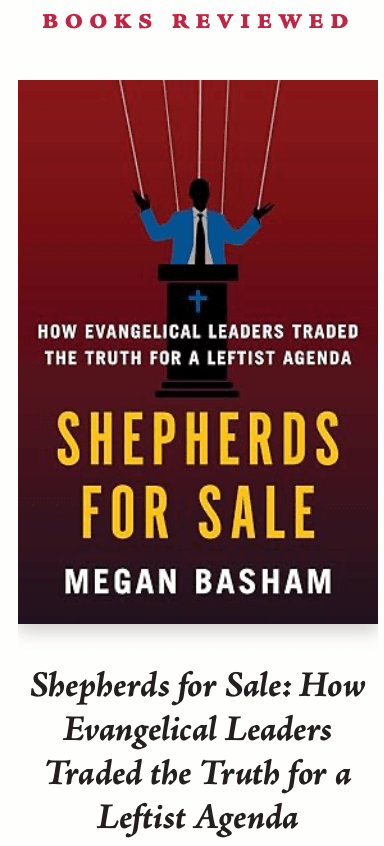
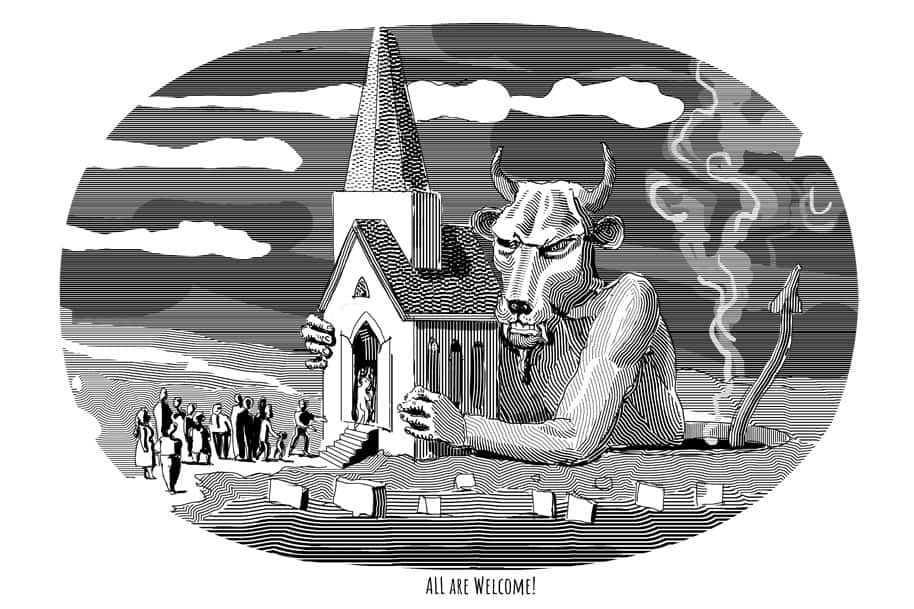
Megan Basham’s Shepherds for Sale is an engaging, revealing, often depressing exposé of evangelical ministers who have sold out themselves and their flocks to the agenda of the secular Left. What makes Basham’s tale so sad is that many of the ministers she covers began as conservatives—or at least not as left-wingers. But in due course, they capitulated to the progressive Left, especially on issues like race, sex, and gender. These morally and intellectually compromised pastors have ladled up the whole alphabet soup, from CRT (Critical Race Theory) and DEI (Diversity, Equity, and Inclusion), to LGBTQIA2S+ (the latest embellishment on an ever more ornate sexual panoply).
Basham is a reporter, most notably for The Daily Wire. Her main beat is the evangelical movement, a subject she has covered at The Wall Street Journal, First Things, National Review, WORLD Magazine, and The American Spectator, among many other venues. She does real and often courageous digging to come up with firsthand sources. The chapters of this book typically open with anecdotes from her own reporting on topics ranging from climate change to illegal immigration, abortion to COVID, CRT to #MeToo and the LGBTQ movement. In each area, she highlights examples of actual people she has met who have been severely hurt by their wayward pastors.
In so many cases, what these struggling Christians need in a minister is a man who can look them in the eye with compassion and tell them firmly what Jesus told the woman taken in adultery: “Now go, and sin no more.” Many of these clergy, however, seem reluctant to utter those words of true mercy. They lack the moral courage to call sin “sin” in the face of a pervasive left-wing narrative that encourages or even praises what Scripture calls evil.
***
As Basham notes, these pastors have succumbed to forces alien to their churches and hostile to their Bibles. They have allowed ideas entirely unrelated to the Christian tradition to infect their congregations and metastasize there. Basham begins by citing some of my own books and articles on how the far Left in the early 20th century—particularly the Marxist Left—carefully and deliberately set out to infiltrate churches. Marxist and socialist front organizations cynically invoked slogans like “social justice” and “peace” as cover for a hardline political takeover. This decades-long effort was monitored by the U.S. Congress, FBI, and other government bodies. It was spearheaded by devious operatives and Communist Party beneficiaries like the Methodist minister and early American Civil Liberties Union co-founder Reverend Harry Ward.
For most of the early to mid-1900s, the worst dupes of this enterprise were from mainline Protestant denominations: the United Methodist Church, the Episcopal Church, and the Presbyterian Church USA. Many of those churches lurched so far leftward that by the end of the century they suffered a mass exodus of parishioners who switched to non-denominational, independent evangelical churches. Nowadays, those evangelical churches have become the new mission field for leftists seeking to redefine Christianity in their own image. That’s where Basham, herself an Evangelical, looks to cast some light: “Satan’s wolves in sheep’s clothing secretly slip into the church for one reason,” she warns, “to prevent it from snatching more souls out of the fire.”
Unfortunately, many shepherds today have let themselves be carried away with the Zeitgeist, tossed to and fro by every wind of doctrine. Some pastors have fully bought in to the Left’s new brand of cultural Marxism. Others appear simply gutless—men without chests afraid to resist as the latest liberal lobby attacks them, their church, and their flock. Sometimes these activists go straight for tried-and-true forms of emotional manipulation, tarring dissenters as hateful bigots. Other times they use subtler rhetorical tactics; progressives are masters of sloganeering. When they wanted to bless same-sex marriage, they labeled it “marriage equality.” When they wanted to justify abortion on demand, it was repackaged as “women’s reproductive health.” And any time they want socialism, it’s tagged as “social justice,” a phrase which has an otherwise noble tradition in Christianity.
***
Basham calls attention to a particularly noxious form of verbal manipulation that has gained currency in the last several years. The injunction to “Love thy neighbor” has been used in bad faith to back believers into partisan corners. She explains how any extremist policy can be given the force of Christian doctrine when disingenuously represented as a simple matter of love:
Why should the United States reward tens of millions of illegal immigrants with citizenship despite the fact they broke our laws and it drives down wages for blue-collar workers? Love your neighbor. Why should I take an experimental COVID-19 vaccine I don’t want when I’m statistically extremely unlikely to experience anything more than mild symptoms? Love your neighbor.
The examples go on. Why not “affirm” your niece’s gender-mutilation surgery? Don’t you love your neighbor? Basham notes that after Roe v. Wade (1973) was overturned, California Governor Gavin Newsom put up billboards in Texas offering easy abortions next door in his state: “California Is Ready to Help. Love Your Neighbor as Yourself.”
The effort to identify far-Left policy with Christian love was particularly relentless during COVID. Basham cites as exhibit A the “Love Your Neighbor, Get the Shot” movement, led by National Institutes of Health director Francis Collins. For many evangelical leaders this became a righteous crusade—e.g., Reverend Russell Moore, who left the Southern Baptist Convention to become the editor of Christianity Today; Christianity Today’s president and CEO Timothy Dalrymple; bestselling author Philip Yancey; Phil Vischer, creator of the Christian animated series VeggieTales; columnist David French, and many others. When not pandering to those they selectively defined as “neighbors,” they were judging others who disagreed, and shaming the great unwashed. They released a high-and-mighty statement, loaded up with Scripture verses and dripping with sanctimony. In the name of “faith in Jesus Christ,” signatories pledged they would “Wear Masks” because “mask rules are not experts taking away our freedom, but an opportunity to follow Jesus’ command to love our neighbors as ourselves (Luke 6:31).” They would “get vaccinated,” because “vaccination is a provision from God.” And they would “correct misinformation and conspiracy theories when we encounter them in our social media and communities,” because “Christians are called to love the truth; we should not be swayed by falsehoods (1 Corinthians 13:6).”
Over 8,000 people ultimately affixed their names to the statement, including countless ministry leaders. Those who did not subscribe were accused of violating sacred commandments. Rick Warren, megachurch founder and author of The Purpose Driven Life (2022), proclaimed that “[w]earing a mask is the great commandment: love your neighbor as yourself.” “One of the responsibilities of faith leaders is to tell people to…trust the science,” Warren solemnly intoned. “They’re not going to put out a vaccine that’s going to hurt people.”
***
Basham’s chapter on this COVID campaign is the best in her book. But she also gives damning scrutiny to the “Critical Race Prophets” among modern evangelicals and to those who have indulged the LGBTQ lobby. Basham concludes that chapter, entitled “None Dare Call It Sin,” with a choice quote from Presbyterian Church in America pastor Todd Pruitt. Pruitt sums up how once-faithful Christian institutions succumbed to LGBTQ heresies: “This does not happen overnight; it happens day-by-day, over a period of years, one compromise at a time.”
It has indeed been a long march through these once-faithful institutions. Is there any hope for them? In my mind, not really. I’m firmly committed to a hell-in-a-handbasket assessment of these churches and the culture. One might think that Megan Basham would be as well. But not necessarily: though her report is discouraging, she concludes on a note of hope. Hope, after all, is a Christian virtue, no less needful than charity or faith. It’s easy to lose hope when these men and women of Protestant pulpits have gone so foolishly and cravenly woke. But it was G.K. Chesterton who said that “hope means hoping when things are hopeless, or it is no virtue at all.” Basham’s book ends in this spirit, with an inspiring story of redemption: her own.
***
Reading Basham in recent years, one might get the impression of a sharp young evangelical woman who has always had things together. But in the final chapter of Shepherds for Sale, she reveals that she arrived at this point in her journey after a long and dreadful series of traumas: alcohol and drug use, sexual assault, car crashes, emergency room visits. She takes readers with her onto the floor of a jail cell, where she found herself sleeping one summer morning, vaguely remembering a fight with her roommate from the night before. She left the party that night after washing down two Vicodin, two Xanax, and two Somas with several vodka tonics, all to “take the edge off an amphetamine comedown.”
She is grateful she ended up in a jail cell and not a morgue. Basham takes her recovery as evidence of God’s great mercy for her. She was her Christian parents’ “prodigal” daughter, and these were her “wasteland years.” Yet she found that “Our God is still a God who brings dead girls to life.” Even so, the sinner has to choose to walk out of the tomb. What brought Basham out was Jesus’ scriptural instruction to go and sin no more. To just stop it: enough.
It did her no good to have enablers accommodate and “affirm” her in her sin. That is what so many shepherds are doing when they sell out their flocks. In turn, Basham now exhorts Christians to stay away from those preachers and stop “reward[ing] them by remaining in their churches or buying their books.” Those ministers who contort their message in a bid for worldly approval, “belittling their sheep and defaming the Church for the applause of the important and influential,” do their followers no favors.
Centuries ago, John Milton wrote of parishioners in corrupt churches that “the hungry sheep look up, and are not fed.” Megan Basham’s heart is with the hungry sheep.
Paul Kengor is professor of political science at Grove City College, director of the college’s Institute for Faith & Freedom, bestselling author of over 20 books, and editor of The… read more
Next in the summer 2024 Issue

 Lord Buckbeak: "Will you come into my parlor?," said the Spider to the Fly.
Leave a comment