July 01, 2010 – Obama Whitehouse archives
American University School of International Service, Washington, D.C.
My cmnt: I’ve edited out of this speech purely political statements of dubious accuracy. Also note that Obama lauds past immigrants who came here to build things and contribute to the country, who were grateful and thankful to be here and were not criminals, illegal immigrants, non-assimilaters nor future welfare recipients.
THE PRESIDENT: Thank you very much. Thank you. Thank you. (Applause.) Everyone please have a seat. Thank you very much. Let me thank Pastor Hybels from near my hometown in Chicago, who took time off his vacation to be here today. We are blessed to have him.
So, despite the forces of the status quo, despite the polarization and the frequent pettiness of our politics, we are confronting the great challenges of our times. And while this work isn’t easy, and the changes we seek won’t always happen overnight, what we’ve made clear is that this administration will not just kick the can down the road.
Immigration reform is no exception. In recent days, the issue of immigration has become once more a source of fresh contention in our country, with the passage of a controversial law in Arizona and the heated reactions we’ve seen across America. Some have rallied behind this new policy. Others have protested and launched boycotts of the state. And everywhere, people have expressed frustration with a system that seems fundamentally broken.
Of course, the tensions around immigration are not new. On the one hand, we’ve always defined ourselves as a nation of immigrants — a nation that welcomes those willing to embrace America’s precepts. Indeed, it is this constant flow of immigrants that helped to make America what it is. The scientific breakthroughs of Albert Einstein, the inventions of Nikola Tesla, the great ventures of Andrew Carnegie’s U.S. Steel and Sergey Brin’s Google, Inc. -– all this was possible because of immigrants.
And then there are the countless names and the quiet acts that never made the history books but were no less consequential in building this country — the generations who braved hardship and great risk to reach our shores in search of a better life for themselves and their families; the millions of people, ancestors to most of us, who believed that there was a place where they could be, at long last, free to work and worship and live their lives in peace.
So this steady stream of hardworking and talented people has made America the engine of the global economy and a beacon of hope around the world. And it’s allowed us to adapt and thrive in the face of technological and societal change. To this day, America reaps incredible economic rewards because we remain a magnet for the best and brightest from across the globe. Folks travel here in the hopes of being a part of a culture of entrepreneurship and ingenuity, and by doing so they strengthen and enrich that culture. Immigration also means we have a younger workforce -– and a faster-growing economy — than many of our competitors. And in an increasingly interconnected world, the diversity of our country is a powerful advantage in global competition.
Just a few weeks ago, we had an event of small business owners at the White House. And one business owner was a woman named Prachee Devadas who came to this country, became a citizen, and opened up a successful technology services company. When she started, she had just one employee. Today, she employs more than a hundred people. This past April, we held a naturalization ceremony at the White House for members of our armed forces. Even though they were not yet citizens, they had enlisted. One of them was a woman named Perla Ramos — born and raised in Mexico, came to the United States shortly after 9/11, and she eventually joined the Navy. And she said, “I take pride in our flag and the history that forged this great nation and the history we write day by day.”
These women, and men and women across this country like them, remind us that immigrants have always helped to build and defend this country -– and that being an American is not a matter of blood or birth. It’s a matter of faith. It’s a matter of fidelity to the shared values that we all hold so dear. That’s what makes us unique. That’s what makes us strong. Anybody can help us write the next great chapter in our history.
Now, we can’t forget that this process of immigration and eventual inclusion has often been painful. Each new wave of immigrants has generated fear and resentments towards newcomers, particularly in times of economic upheaval. Our founding was rooted in the notion that America was unique as a place of refuge and freedom for, in Thomas Jefferson’s words, “oppressed humanity.” But the ink on our Constitution was barely dry when, amidst conflict, Congress passed the Alien and Sedition Acts, which placed harsh restrictions of those suspected of having foreign allegiances. A century ago, immigrants from Ireland, Italy, Poland, other European countries were routinely subjected to rank discrimination and ugly stereotypes. Chinese immigrants were held in detention and deported from Angel Island in the San Francisco Bay. They didn’t even get to come in.
So the politics of who is and who is not allowed to enter this country, and on what terms, has always been contentious. And that remains true today. And it’s made worse by a failure of those of us in Washington to fix a broken immigration system.
My cmnt: Our immigration system wasn’t broken until the guilt-ridden Sen. Ted Kennedy (D) pushed thru legislation to give priority to immigrants based upon race, lack of education and third world status.
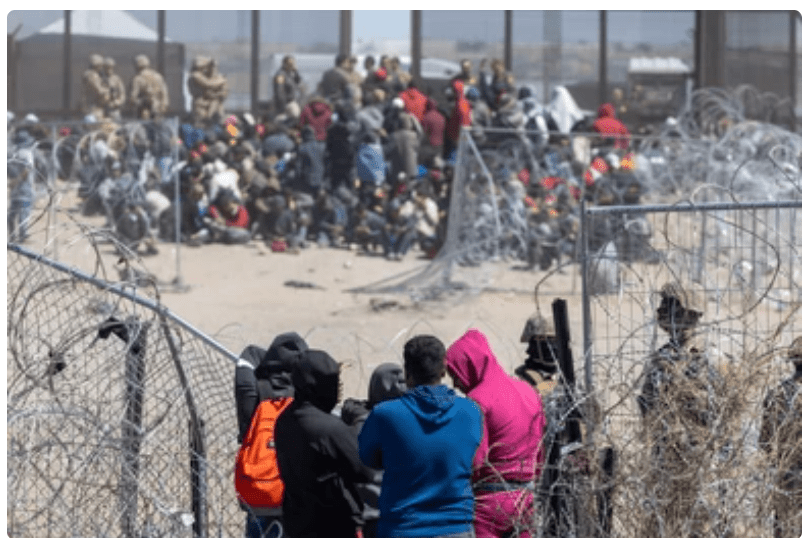
To begin with, our borders have been porous for decades. Obviously, the problem is greatest along our Southern border, but it’s not restricted to that part of the country. In fact, because we don’t do a very good job of tracking who comes in and out of the country as visitors, large numbers avoid immigration laws simply by overstaying their visas.
The result is an estimated 11 million undocumented immigrants in the United States. The overwhelming majority of these men and women are simply seeking a better life for themselves and their children. Many settle in low-wage sectors of the economy; they work hard, they save, they stay out of trouble. But because they live in the shadows, they’re vulnerable to unscrupulous businesses who pay them less than the minimum wage or violate worker safety rules -– thereby putting companies who follow those rules, and Americans who rightly demand the minimum wage or overtime, at an unfair [dis]advantage. Crimes go unreported as victims and witnesses fear coming forward. And this makes it harder for the police to catch violent criminals and keep neighborhoods safe. And billions in tax revenue are lost each year because many undocumented workers are paid under the table.
More fundamentally, the presence of so many illegal immigrants makes a mockery of all those who are going through the process of immigrating legally. Indeed, after years of patchwork fixes and ill-conceived revisions, the legal immigration system is as broken as the borders. Backlogs and bureaucracy means the process can take years. While an applicant waits for approval, he or she is often forbidden from visiting the United States –- which means even husbands and wives may be forced to spend many years apart. High fees and the need for lawyers may exclude worthy applicants. And while we provide students from around the world visas to get engineering and computer science degrees at our top universities, our laws discourage them from using those skills to start a business or power a new industry right here in the United States. Instead of training entrepreneurs to create jobs on our shores, we train our competition.
In sum, the system is broken. And everybody knows it. Unfortunately, reform has been held hostage to political posturing and special-interest wrangling -– and to the pervasive sentiment in Washington that tackling such a thorny and emotional issue is inherently bad politics.
Just a few years ago, when I was a senator, we forged a bipartisan coalition in favor of comprehensive reform. Under the leadership of Senator Kennedy, who had been a longtime champion of immigration reform, and Senator John McCain, we worked across the aisle to help pass a bipartisan bill through the Senate. But that effort eventually came apart. And now, under the pressures of partisanship and election-year politics, many of the 11 Republican senators who voted for reform in the past have now backed away from their previous support.
Into this breach, states like Arizona have decided to take matters into their own hands. Given the levels of frustration across the country, this is understandable. But it is also ill conceived. And it’s not just that the law Arizona passed is divisive -– although it has fanned the flames of an already contentious debate. Laws like Arizona’s put huge pressures on local law enforcement to enforce rules that ultimately are unenforceable. It puts pressure on already hard-strapped state and local budgets. It makes it difficult for people here illegally to report crimes -– driving a wedge between communities and law enforcement, making our streets more dangerous and the jobs of our police officers more difficult.
And you don’t have to take my word for this. You can speak to the police chiefs and others from law enforcement here today who will tell you the same thing.
These laws also have the potential of violating the rights of innocent American citizens and legal residents, making them subject to possible stops or questioning because of what they look like or how they sound. And as other states and localities go their own ways, we face the prospect that different rules for immigration will apply in different parts of the country -– a patchwork of local immigration rules where we all know one clear national standard is needed.
Our task then is to make our national laws actually work -– to shape a system that reflects our values as a nation of laws and a nation of immigrants. And that means being honest about the problem, and getting past the false debates that divide the country rather than bring it together.
For example, there are those in the immigrants’ rights community who have argued passionately that we should simply provide those who are [here] illegally with legal status, or at least ignore the laws on the books and put an end to deportation until we have better laws. And often this argument is framed in moral terms: Why should we punish people who are just trying to earn a living?
I recognize the sense of compassion that drives this argument, but I believe such an indiscriminate approach would be both unwise and unfair. It would suggest to those thinking about coming here illegally that there will be no repercussions for such a decision. And this could lead to a surge in more illegal immigration. And it would also ignore the millions of people around the world who are waiting in line to come here legally.
Ultimately, our nation, like all nations, has the right and obligation to control its borders and set laws for residency and citizenship. And no matter how decent they are, no matter their reasons, the 11 million who broke these laws should be held accountable.
My cmnt: And remember this was in 2010. If the low-ball number of 11 million is close to accurate then after four years of the Biden regime of rampant illegal immigration the figure in 2024 has to be 22+ million!
Now, if the majority of Americans are skeptical of a blanket amnesty, they are also skeptical that it is possible to round up and deport 11 million people. They know it’s not possible. Such an effort would be logistically impossible and wildly expensive. Moreover, it would tear at the very fabric of this nation -– because immigrants who are here illegally are now intricately woven into that fabric. Many have children who are American citizens. Some are children themselves, brought here by their parents at a very young age, growing up as American kids, only to discover their illegal status when they apply for college or a job. Migrant workers -– mostly here illegally -– have been the labor force of our farmers and agricultural producers for generations. So even if it was possible, a program of mass deportations would disrupt our economy and communities in ways that most Americans would find intolerable.
My cmnt: The entire above paragraph is the big, democrat lie. It is of course possible to deport millions of the 11 million illegals. But what we have seen is that because most of them are undocumented democrats illegally allowed to vote in blue cities, counties and states there is no way that the democrats are going to uphold the law and cooperate with their deportation.
Now, once we get past the two poles of this debate, it becomes possible to shape a practical, common-sense approach that reflects our heritage and our values. Such an approach demands accountability from everybody -– from government, from businesses and from individuals.
Government has a threshold responsibility to secure our borders. That’s why I directed my Secretary of Homeland Security, Janet Napolitano — a former border governor — to improve our enforcement policy without having to wait for a new law.
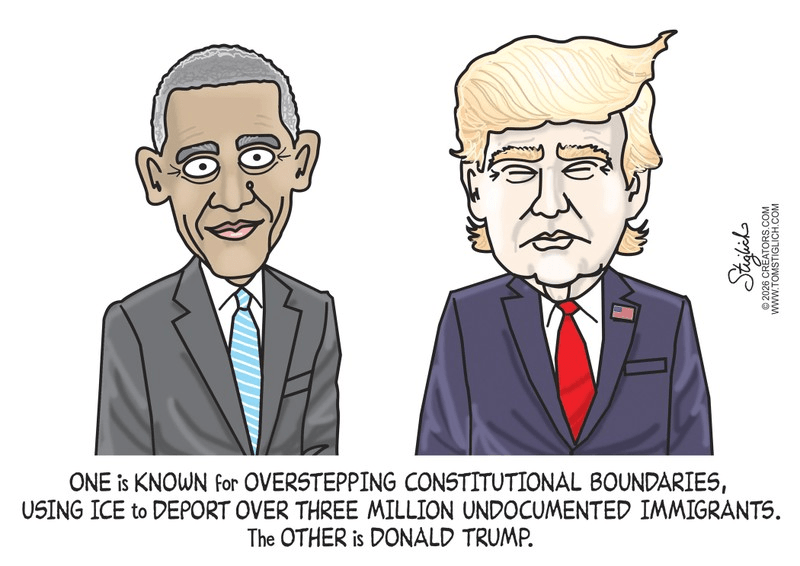
My cmnt: Obama did actually deport 3 million illegals during his two terms in office. And there was never even a squawk, a squeak or a twittle out of any democrat legislator, educator, pundit nor influencer.
Today, we have more boots on the ground near the Southwest border than at any time in our history. Let me repeat that: We have more boots on the ground on the Southwest border than at any time in our history. We doubled the personnel assigned to Border Enforcement Security Task Forces. We tripled the number of intelligence analysts along the border. For the first time, we’ve begun screening 100 percent of southbound rail shipments. And as a result, we’re seizing more illegal guns, cash and drugs than in years past. Contrary to some of the reports that you see, crime along the border is down. And statistics collected by Customs and Border Protection reflect a significant reduction in the number of people trying to cross the border illegally.
So the bottom line is this: The southern border is more secure today than at any time in the past 20 years. That doesn’t mean we don’t have more work to do. We have to do that work, but it’s important that we acknowledge the facts. Even as we are committed to doing what’s necessary to secure our borders, even without passage of the new law, there are those who argue that we should not move forward with any other elements of reform until we have fully sealed our borders. But our borders are just too vast for us to be able to solve the problem only with fences and border patrols. It won’t work. Our borders will not be secure as long as our limited resources are devoted to not only stopping gangs and potential terrorists, but also the hundreds of thousands who attempt to cross each year simply to find work.
My cmnt: President Trump showed this is just another democrat talking point and completely untrue. We did NOT need new legislation to completely and thoroughly close the southern border. Trump did it in a matter of months!
That’s why businesses must be held accountable if they break the law by deliberately hiring and exploiting undocumented workers. We’ve already begun to step up enforcement against the worst workplace offenders. And we’re implementing and improving a system to give employers a reliable way to verify that their employees are here legally. But we need to do more. We cannot continue just to look the other way as a significant portion of our economy operates outside the law. It breeds abuse and bad practices. It punishes employers who act responsibly and undercuts American workers. And ultimately, if the demand for undocumented workers falls, the incentive for people to come here illegally will decline as well.
Finally, we have to demand responsibility from people living here illegally. They must be required to admit that they broke the law. They should be required to register, pay their taxes, pay a fine, and learn English. They must get right with the law before they can get in line and earn their citizenship — not just because it is fair, not just because it will make clear to those who might wish to come to America they must do so inside the bounds of the law, but because this is how we demonstrate that being — what being an American means. Being a citizen of this country comes not only with rights but also with certain fundamental responsibilities. We can create a pathway for legal status that is fair, reflective of our values, and works.
And, yes, this is an emotional question, and one that lends itself to demagoguery. Time and again, this issue has been used to divide and inflame -– and to demonize people. And so the understandable, the natural impulse among those who run for office is to turn away and defer this question for another day, or another year, or another administration. Despite the courageous leadership in the past shown by some Republicans — including, by the way, my predecessor, President Bush -– this has been the custom. That is why a broken and dangerous system that offends our most basic American values is still in place.
My cmnt: We do NOT have a broken and dangerous system of immigration law. We DO have illegal so-called sanctuary democrat strongholds that refuse to either obey or enforce existing law and are the main source of immigration trouble – both legal and illegal.
But I believe we can put politics aside and finally have an immigration system that’s accountable. I believe we can appeal not to people’s fears but to their hopes, to their highest ideals, because that’s who we are as Americans. It’s been inscribed on our nation’s seal since we declared our independence. “E pluribus unum.” Out of many, one. That is what has drawn the persecuted and impoverished to our shores. That’s what led the innovators and risk-takers from around the world to take a chance here in the land of opportunity. That’s what has led people to endure untold hardships to reach this place called America.
One of the largest waves of immigration in our history took place little more than a century ago. At the time, Jewish people were being driven out of Eastern Europe, often escaping to the sounds of gunfire and the light from their villages burning to the ground. The journey could take months, as families crossed rivers in the dead of night, traveled miles by foot, endured a rough and dangerous passage over the North Atlantic. Once here, many made their homes in a teeming and bustling Lower Manhattan.
It was at this time that a young woman named Emma Lazarus, whose own family fled persecution from Europe generations earlier, took up the cause of these new immigrants. Although she was a poet, she spent much of her time advocating for better health care and housing for the newcomers. And inspired by what she saw and heard, she wrote down her thoughts and donated a piece of work to help pay for the construction of a new statue — the Statue of Liberty — which actually was funded in part by small donations from people across America.
Years before the statue was built — years before it would be seen by throngs of immigrants craning their necks skyward at the end of long and brutal voyage, years before it would come to symbolize everything that we cherish — she imagined what it could mean. She imagined the sight of a giant statue at the entry point of a great nation -– but unlike the great monuments of the past, this would not signal an empire. Instead, it would signal one’s arrival to a place of opportunity and refuge and freedom.
“Here at our sea-washed, sunset gates shall stand,” she wrote,
A mighty woman with a torch…
From her beacon-hand
Glows world-wide welcome…
“Keep, ancient lands, your storied pomp!”…
“Give me your tired, and your poor,
Your huddled masses yearning to be free…
Send these, the homeless, tempest-tossed to me,
I lift my lamp beside the golden door!”
Let us remember these words. For it falls on each generation to ensure that that lamp -– that beacon -– continues to shine as a source of hope around the world, and a source of our prosperity here at home.
Thank you. God bless you. And may God bless the United States of America. Thank you. (Applause.)
END
11:47 A.M. EDT
 Lord Buckbeak: "Will you come into my parlor?," said the Spider to the Fly.
Leave a comment