From Jackson’s portico to Trump’s ballroom, presidents have always renovated
By Mallory Wilson – The Washington Times – Tuesday, December 30, 2025
President Trump’s razing of the East Wing to build a grand ballroom has raised eyebrows as an extreme transformation of the iconic White House contours, but other presidents have given the executive mansion makeovers, big and small, over the past two centuries.
The White House ballroom, which remains nameless, will be a whopping 90,000 square feet and seat 650, the administration said. The White House itself, excluding the West Wing, is about 55,000 square feet.
Official plans have not yet been presented to the National Capital Planning Commission. The White House said it will present plans at the commission’s meeting next month.
The president has since said the ballroom could accommodate closer to 1,000 people.
The East Room, the largest of the State Rooms, seats 200. Mr. Trump says a larger permanent space is needed to host foreign dignitaries and throw large dinner parties, rather than erecting and dismantling a tent on the South Lawn as needed.
Critics say the ballroom is too big for the White House and that the changes feel more like the “Trump House” than the colloquial “People’s House.” Others praise the president for adding a real ballroom and not using taxpayer money to do it, and attribute the criticism to “Trump derangement syndrome.”
The White House says the project is necessary.
“In the latest instance of manufactured outrage, unhinged leftists and their Fake News allies are clutching their pearls over President Donald J. Trump’s visionary addition of a grand, privately funded ballroom to the White House — a bold, necessary addition that echoes the storied history of improvements and additions from commanders-in-chief to keep the executive residence as a beacon of American excellence,” the White House said in a release.
Mr. Trump has had his eye on a ballroom since before he campaigned for president and even offered to pay for a ballroom renovation during the Obama administration.
Despite the outcry over the renovations, the White House has undergone many changes over the years.
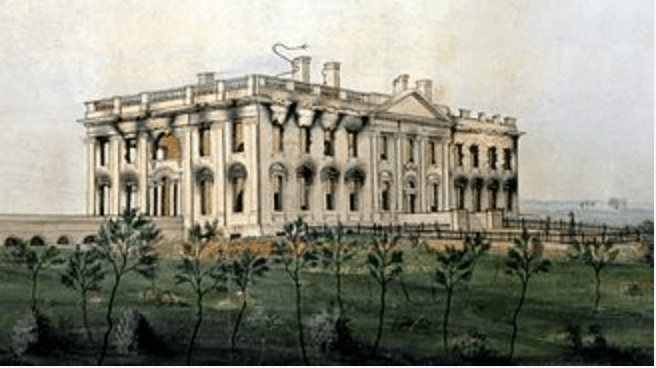
Built from 1792 to 1800, the executive mansion at 1600 Pennsylvania Ave. was only 14 years old when the British army burned it down while invading Washington during the War of 1812. The destruction forced President Madison and first lady Dolley Madison to move temporarily to the nearby Octagon House in Foggy Bottom.
The White House was rebuilt and officially reopened in 1817, and James Monroe was the next president to live in it.
Monroe added the South Portico in 1824, and President Jackson built the North Portico in 1830.
Stewart McLaurin, president of the White House Historical Association, wrote that the North Portico’s construction was controversial at the time because the country was facing an economic downturn, a sentiment similar to the criticism Mr. Trump is receiving for prioritizing the ballroom during a government shutdown and amid persistent economic anxiety.
During the Chester A. Arthur administration in the early 1880s, the White House interior underwent renovation. Although the changes were praised, the price tag was not. Arthur added an elevator and a new plumbing system. He hired Louis Comfort Tiffany to create designs for the Red Room, Blue Room, State Dining Room, East Room and Cross Hall, according to the historical association.
In total, $110,000 was spent on the White House during Arthur’s administration. The government’s inflation calculator doesn’t go back to the 1880s to provide a modern equivalent, but $100,000 in the era just before World War I translates to more than $3 million in today’s currency.
Mr. Trump faces similar criticism over the ballroom’s size and increasing cost. The White House initially estimated that the ballroom would cost $200 million, but that has since increased to $300 million. The president recently said that the price could now be $400 million.
Mr. Trump’s wealthy friends, not taxpayers, are footing the construction bill.
Priya Jain, architecture professor and the chair of the Society of Architectural Historians’ Heritage Conservation Committee, said the committee raised concerns about the ballroom’s impact on the White House grounds.
“The extension of just the addition does seem to jut out significantly into the grounds. That was the kind of the symmetry of the landscape, the kind of effects to the landscape, trees … other things that could be affected,” she said. “And yes, we also raised concerns about the size and the scale, and finally, about the significance of the East Wing as well.”
She said that even though the construction isn’t being funded by taxpayers, “the money for the upkeep and stewardship of this ballroom, once done, will still be borne by the taxpayers.”
“The building, once built, would have yearly, annual needs for heating, cooling, running it, keeping it up and running, which will all still come from the federal government,” she said.
The National Trust for Historic Preservation has filed a lawsuit to halt the construction of the ballroom until it undergoes proper review processes and receives approval from Congress.
“No president is legally allowed to tear down portions of the White House without any review whatsoever — not President Trump, not President Biden, and not anyone else,” the lawsuit states. “And no president is legally allowed to construct a ballroom on public property without giving the public the opportunity to weigh in.”
A federal judge in Washington denied the trust’s request, saying it didn’t demonstrate sufficient evidence to prove that irreparable harm had been caused by work that had already begun underground.
The White House acquired much of its current appearance during the Theodore Roosevelt administration, including the creation of what is now known as the West Wing in 1902. Critics of the change argued that it made the White House appear too modern.
The Oval Office was established by President Taft in 1909 after the expansion of the West Wing. It underwent remodeling after a 1929 fire and expansion in 1934, when President Franklin Delano Roosevelt moved the Oval Office to its current location.
In 1942, the East Wing was added by Roosevelt and was highly controversial, according to the WHHA.
“Congressional Republicans labeled the expenditure as wasteful, with some accusing Roosevelt of using the project to bolster his presidency’s image. The secretive nature of the construction, tied to military purposes, further fueled suspicions,” Mr. McLaurin wrote. “However, the East Wing’s utility in supporting the modern presidency eventually quieted critics.”
The next major White House renovation came under the Truman administration from 1948 to 1952, when the interior was gutted because of structural deficiencies. It was a nearly $6 million project, close to $60 million today, authorized and funded by Congress.
During the renovations, Truman and his family moved across the street to Blair House, where they lived for roughly four years.
Truman also added a balcony, now known as the Truman Balcony, on the second floor of the South Portico. The balcony is considered one of the most contentious additions to the White House, according to the WHHA. Truman paid for the balcony out of his household account.
The White House Rose Garden was redesigned by first lady Jacqueline Kennedy in 1962. The space had always been a garden, but Kennedy transformed it into a space that could host events as well.
Mr. Trump refurbished the garden this year, paving over the grass and setting up tables and chairs with umbrellas. He often said the grass caused issues when it got wet, with women’s high heels sinking into the ground.
The press got its own space during the Nixon administration in 1970, when Richard Nixon converted the indoor swimming pool into the James S. Brady Press Briefing Room. The pool was built in 1933 to aid Franklin D. Roosevelt in his polio therapy.
Presidents are known to make some design changes throughout the White House to fit their taste, as they will be calling it home for the next four to eight years. The Oval Office, especially, is known to undergo changes in decor.
“The White House is a work in progress,” said Craig Shirley, presidential historian and Reagan biographer. “And each time it’s built to reflect, the interior or the exterior, the tastes of the time.”
Mr. Trump has decked out the Oval Office with gold detailing. He’s also added a Presidential Walk of Fame on the wall of the colonnade between the West Wing and the executive residence.
“People are wary of change. People get settled in their ways. The media gets settled in their ways,” Mr. Shirley said. “And, let’s face it, politics enters into it.”
To make room for the ballroom, Mr. Trump has demolished the East Wing, which has sparked mixed reactions, especially after Mr. Trump said the White House facade wouldn’t be touched.
White House press secretary Karoline Leavitt told reporters that the president had made it clear that the East Wing would need to be “modernized.”
Mr. Shirley said the ballroom will be available to the public, beyond the current short tours of the White House.
“When it’s done, it’s going to be in constant use for charities, for fundraising purposes. It’s going to be in constant use for dinners, for state dinners and the like, for major meetings, things like that,” he said.
The White House has said the ballroom continues a “proud presidential legacy” of making changes to the White House.
Ms. Jain said, “We totally understand that buildings need to change, even have big additions made to them.”
“We’re not saying just freeze the building in time,” she said. “We’re not clutching pearls, I believe, but we’re saying that there’s a better way of doing this.”
Mr. Shirley said it’s Mr. Trump’s prerogative.
“We call it the people’s house, and it is, but it’s also the president’s house,” he said.
• Mallory Wilson can be reached at mwilson@washingtontimes.com.
 Lord Buckbeak: "Will you come into my parlor?," said the Spider to the Fly.
Leave a comment