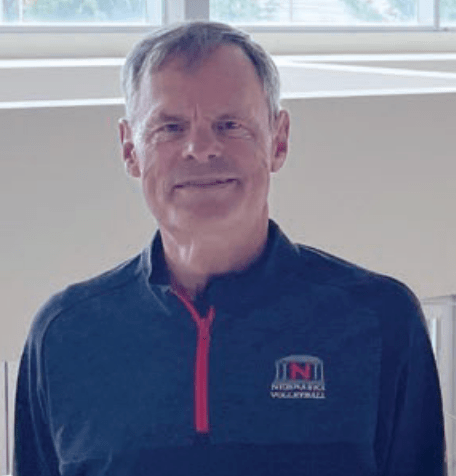
Published in “Living Well” magazine Fall 2025
I wasn’t born here, but I really feel like I’m a Nebraskan, and it was by choice.”
– Coach John Cook
It’s safe to say former Nebraska volleyball coach John Cook left a lasting legacy, inspiring generations
of young girls to dream of wearing Husker red. The California native fully embraced Nebraska’s culture and values, becoming one of the most iconic and recognizable figures in the state while cementing his place not just in the record books, but in the hearts of fans across Husker Nation.
“Dr. Jeff Gold said it best: I’m a Nebraskan by choice,” Cook said. “I wasn’t born here, but I really feel like I’m
a Nebraskan, and it was by choice.
Cook grew up in Chula Vista, a community near San Diego, California. After earning his degree from the
University of San Diego, he returned to teach at his high school alma mater, Francis Parker School. The position included coaching responsibilities, including junior high boys’ basketball and girls’ basketball, softball and volleyball.
With little knowledge of volleyball, Cook studied books to learn the fundamentals. His rapid success led
to a role as head assistant coach at the University of California San Diego from 1983 to 1984; and in 1987, he
co-founded the San Diego Volleyball Club. A year later, Cook met legendary Nebraska volleyball coach Terry Pettit in San Diego.
Cook made a strong impression; and a few months later, Pettit called with an offer for him to join Nebraska
as an assistant coach. The timing was right, and Cook and his wife, Wendy, took the leap that would ultimately change everything.
The Cooks set off for Nebraska in a Toyota pickup and U-Haul, arriving first in Ogallala to face 105-degree August heat, thick humidity and a south wind carrying the scent of nearby feedlots.
“We were questioning if we made the right decision,” he laughed.
Cook spent three years as Nebraska’s assistant coach before returning to San Diego to coach the U.S. Men’s National Volleyball Team. Following the 1992 Olympics in Barcelona, Spain, he was named the University of Wisconsin head coach. In the 1998 NCAA Division I women’s volleyball tournament, Nebraska defeated Cook’s Wisconsin team in the Elite Eight, advancing to the Final Four and ultimately winning the national
championship. At dinner after the match, Pettit told Cook he planned to retire and wanted him back at Nebraska.
The Cooks took their time with the decision. With two young children in elementary school and a home on a quiet cul-de-sac, they had every reason to stay. In the end, it was the people of Nebraska who drew Cook back.
“They are friendly and will do anything for you,” he said. “Lincoln is a great community with good schools,
an ideal place to raise kids. Everyone across the state bleeds Husker red. I tell recruit families, if you’re going to work hard, why not be somewhere where they care? This is the pinnacle place to coach because everyone loves Nebraska sports.”
Cook emphasized Nebraska’s unique culture that fuels athletic success.
“There’s a level of respect and a great work ethic in this state,” Cook said. “Those are some reasons volleyball is successful not only at Nebraska, but other colleges and high schools across the state. There are great
coaches, a love for sports and a strong sense of pride in the community.”
Building Upon Husker Volleyball Legacy
Cook became Nebraska volleyball’s head coach in 2000 and quickly found himself facing what he describes as the toughest challenge of his career — sustaining success amid high expectations. The team in his first year went undefeated and won the national championship.
“It was only the second time ever in college volleyball that happened,” he said. “Then, everyone expects you to do that again. The expectations and pressure on the athletes and myself to be great every year can bring out the best, but it can also wear you down.”
Cook persevered, drawing on lessons he learned from watching Coach Tom Osborne work with the football team during his first time at Nebraska. “He’d have four stations and 150 athletes training,” Cook said. “I was
blown away, but that helped me be a better coach by knowing how to train and maximize time to make sure
everyone’s moving.”
The approach resulted in Cook having a very disciplined team — both on and off the court.
“Our culture was based on very few rules, but we wanted player-led teams in the locker rooms,” he said. “That doesn’t just happen because you say it. I learned you have to work hard at developing leaders. Our team and coaching staff will outwork anyone.”
Another key aspect of the culture was having an attitude of gratitude.
“Nebraska volleyball can change people’s lives, including the student-athletes,” he said. “They should be
grateful and thankful for what they’re given here. We have the best facilities, athletic training and coaches. A lot of athletes think it’s like this everywhere, but transfers come in from other top programs and note the differences.”
Cook retired in January 2025 with an overall record of 883-176, making him the fifth-winningest Division I volleyball coach of all time; and a Nebraska record of 722-103, making him the winningest Division I coach of this century. He led the Huskers to four national championships in 2000, 2006, 2015, 2017; 12 Final Four appearances and 14 conference titles. Cook’s leadership contributed to the longest sellout streak in NCAA women’s athletics history, with more than 339 consecutive home matches sold out; and record-breaking
attendance at matches in Ord, Nebraska, and in Memorial Stadium for Volleyball Day, drawing a historic crowd of 92,003.
Cook received the AVCA National Coach of the Year in 2000, 2005 and 2023, as well as Big Ten Coach of the
Year eight times. He’s also had some remarkable experiences — riding on the USS Nebraska submarine, flying with the Blue Angels, and taking a Blackhawk helicopter ride with the National Guard.
“Not every volleyball coach is able to do those things, but I’ve fully embraced what it means to live and coach
in Nebraska,” he said. “Everyone calls me ‘Coach,’ and that’s a sign of respect you don’t find everywhere. We had the opportunity to take Nebraska volleyball up another level, and we’ve done incredible things with the program,” he said. “Thanks to all the fans who have supported us.”
Cook looks forward to watching the program move forward under his successor Dani Busboom Kelly, former
2006 Nebraska national champion player.
Coaching Transformation
Cook intends to eventually detail the evolution of his coaching throughout his 25 years at Nebraska in a book. Starting with an intense, “in your face” approach, his style transformed over time.
“I made several adjustments to the full spectrum to where I call it ‘coaching with love,’” he said. “I tried to come in with an attitude of coaching with love and support each day.”
Cook has several theories about why those changes were necessary. He notes today’s athletes are substantially different from those he coached in 2000.
“They’re wired differently, brought up differently — social media has changed them,” he said. “You have to
make adjustments as a coach to stay successful as the athletes change.”
Cook believes his 2008 team came closest to reaching its full potential during his 25-year tenure. However,
from 2009 to 2014, Nebraska failed to reach the Final Four, leading fans to question what had gone wrong and whether the program was meeting its high expectations.
Reflecting on his career, Cook considers 2015 to 2024 his most successful stretch.
“We went to seven Final Fours, played for five national championships and won the Big 10 four times. That is
hard to do,” he said. “To accomplish that, I had to make some changes — and it started with me.”
Some of those changes came from embracing a different lifestyle.
Embracing the Cowboy Life
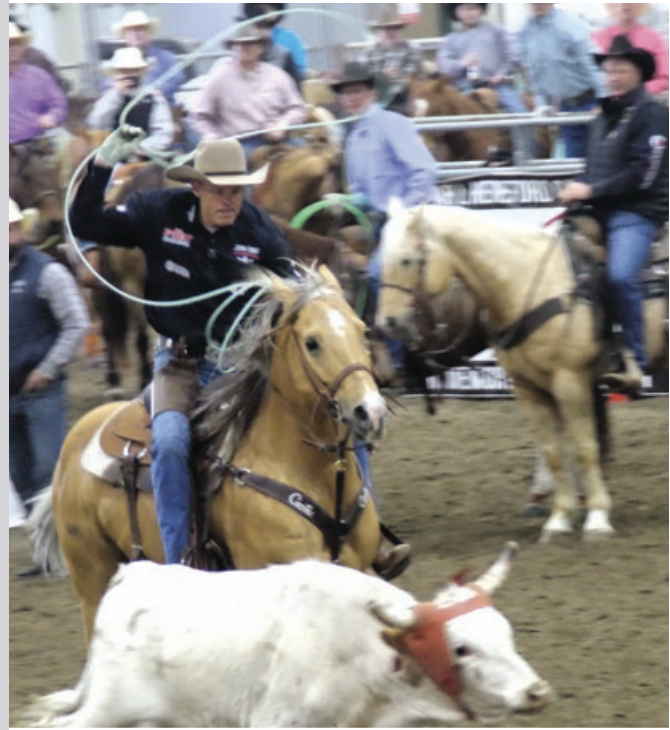
Although Cook experienced the ranch life during a college summer in Wyoming, it was in Nebraska where
he truly immersed himself in the agricultural world of western Nebraska — horses, cattle and rural living.
“I have tremendous respect for that lifestyle,” he said. “In today’s technology-driven world, people are craving getting in the dirt, working outside with animals and horses. This country was built on horses, and I’ve fallen back in love with that. Ranchers work hard, love America and say prayers before they rope or brand cattle. It’s humbling. They respect their world and everyone helps everyone.”
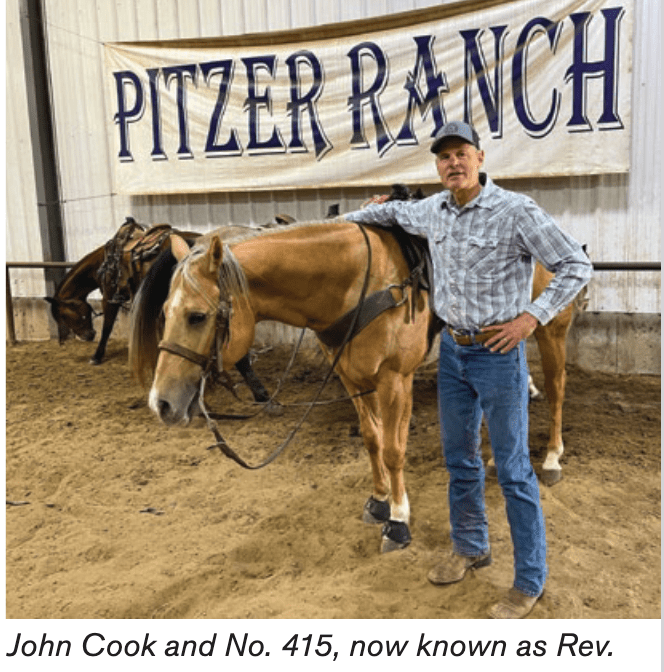
In 2021, while looking for a horse for his son, Cook purchased Bud — a trail horse — with the help of Nebraska Volleyball Director of Operations Lindsay Peterson, who was searching for a horse for her four young sons. Bud proved too spirited for young children, so Cook purchased him instead.
Bud was playfully named the team’s volunteer assistant coach, attracting attention from recruits and fans on social media. Knowing horses are social animals, Cook added Reba, a trained a trained roping horse, to his stable the following year, which spurred his interest in roping.
Shortly after, Cook discovered a love for roping dummies through the UNL Rodeo Team. In his downtime, he often could be found practicing roping in the Bob Devaney Sports Center or out on the ranch.
Cook found a strong correlation between roping and coaching: Both require trust and leadership. Just as a
horse must trust its rider, a team must trust its coach. It’s about earning trust and working together toward a common goal.
In 2024, Cook began looking for a new roping horse, so he made a trip out to Ord, Nebraska, to visit the ranch of Mark Wray, a seasoned cowboy and rancher with decades of experience working with performance
horses. There, Cook rode Bobs, who he purchased at the Pitzer Ranch sale. But there was another horse that left a lasting impression.
During the visit, Wray offered Cook the chance to ride No. 415, just to experience what a great horse felt like.
The moment Cook got in the saddle, everything clicked. “That horse taught me more than I could ever teach him,” he said. “He seemed to know exactly what to do.”
With an impeccable pedigree, No. 415 was expected to fetch a high price at auction. But when the day came, Wray did something he’d never done in the more than 30 years selling horses: he no-saled him. He wanted No. 415 to go to the right home.
Cook, meanwhile, couldn’t stop thinking about the horse. He returned to Ord a few more times to ride him.
Around that time, he received a text from Nebraska Athletic Director Troy Dannen, informing him about
his five-year contract extension. Traditionally, coaching contracts at Nebraska include a stair-stepped salary
increase over time, but Cook had something else in mind — that horse.
The two sides worked it out, and the extension included an annual salary and a $70,000 retention bonus. Cook called Wray with an offer, and No. 415 had a new home.
The situation captured national attention, the Wall Street Journal ran a front-page story, “This Legendary Coach Didn’t Want A Raise. He Wanted a Horse.”
“Everyone west of Lincoln involved in ag knows about it and thinks it’s the greatest thing ever to put a horse in the contract,” Cook laughed.
But for Cook, it was about being welcomed into a world he hadn’t grown up in – earning trust in a new
community and rooting himself in the values of hard work, humility and connection to the land, shaping the
identity of so many Nebraskans.
No. 415 later became Rev, short for Revival, after inviting name suggestions on social media. There were more than 10,000 entries, with Cook narrowing them down to four finalists to put to vote.
To support youth interested in roping, Cook partnered with the UNL Club Rodeo Team to host the inaugural John Cook Team Roping Classic in April 2025 — a youth roping clinic and auction aimed at raising
scholarships for the Nebraska College Rodeo Program.
Living the Life
Cook has fully adopted the rancher lifestyle, now owning five horses, five head of cattle and two rescue dogs on his 5-acre mini ranch in Wyoming. He lives near both his son, Taylor, and daughter, Lauren, who does
analyst work for the Big 10 Network.
He continues to be involved with Nebraska working as a mentor but makes the most of his time with his two
grandchildren — Madden and Griffin — as well as riding and roping. “Madden loves to help with the horses,” he said. “She’s a real mountain girl.”
Even though he no longer resides in Husker country, it will continue to follow him. A recent trip to Cooke City,
Montana, was proof.
“It’s isolated up there, but someone recognized me,” Cook said. “Everywhere I go all over the world, even when I took teams to China, we met people who knew Nebraska volleyball or were from Nebraska.”
At 69, Cook shares two pieces of advice for aging well: keep moving and stay involved. “The older you get, the harder you gotta go,” he said.
Staying involved also is important, as research shows people in retirement are at risk for depression, may lose their sense of purpose and physical well-being. Cook focuses on starting something new.
“For me, the horse and roping world are a new hobby I’m starting, and I’m going against people who have
roped their whole lives,” he said. “It’s a challenge. Physically you need to be in really good shape, and it keeps you on your toes because it happens so fast. So, what’s your new beginning? What’s something new you are starting?”
Cook remains active in Nebraska volleyball. Earlier this year, he was announced as the part-owner and
general manager of the Omaha Supernovas, a professional volleyball franchise. He has also backed a
partnership between the City of Lincoln and Nebraska for Volleyball (N4VB) to develop a new volleyball
facility in Lincoln, aimed at expanding recreational opportunities. In addition, Cook made his debut as a volleyball analyst on the Big Ten Network this fall.
Another lesson Cook is learning in retirement is the importance of staying socially connected. He’s found a group of recently retired neighbors to bike and ski with, or meet for coffee.
“I’ve met some fascinating people, all because of the path I’m on in retirement,” he said. “I’ve got a whole
new network now. I used to network with 18- to 22-year-olds and their parents — this is completely different.”
The growth mindset that fueled Cook’s coaching success still drives him today.
“I used to ask: How can I get better? How are we going to rebuild next year’s team?,” he said. “Now, I get up at 7 a.m. to do chores — feeding, training, cleaning stalls. That’s how I start every morning, and I love it.”
 Lord Buckbeak: "Will you come into my parlor?," said the Spider to the Fly.
Leave a comment