
Opened September 18, 1968 – Barbra Fan website
My cmnt: This website has it all for Funny Girl fans. Check it out by clicking link above. This is my wife’s favorite singalong album. And she sounds every bit as good as Barbra when singing it.
My cmnt: The first time (over 50 years ago) I was over to her house to eat Sunday dinner with her and her parents she put this LP on and sang with it. So beautiful, I fell in love right there.
Synopsis:
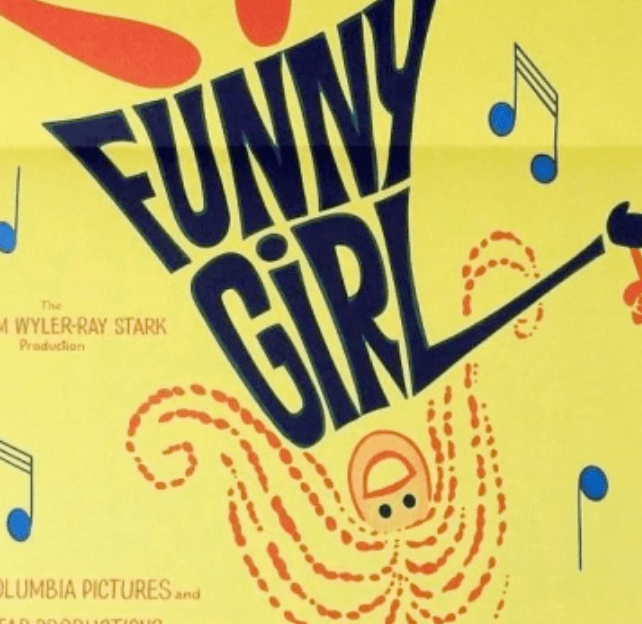
“Funny Girl” follows the career of Jewish comedienne Fanny Brice in the early 1900s in New York. Only her mother believes Fanny can make it in show business until she gets her first break at Keeney’s Music Hall. Later, Fanny is hired by the great Florenz Ziegfeld and becomes a star.
However, Fanny’s marriage to the dashing gambler Nick Arnstein is tested as her career soars and Nick’s debts mount.
“You think beautiful girls are going to stay in style forever? I should say not! Any minute now they’re going to be out! Finished! Then it’ll be my turn!”
… Fanny Brice
Although Barbra Streisand originated the role of Fanny Brice in Funny Girl on Broadway and in London from 1964 to 1966, there is a history of Broadway actresses who were passed over when it came time to make the movie version of their shows. Julie Andrews played Eliza Doolittle on Broadway in My Fair Lady but Audrey Hepburn won the movie role; Gwen Verdon was passed over for Sweet Charity in favor of Shirley MacLaine; and even Carol Channing lost the movie version of Hello, Dolly! to Barbra Streisand.
Producer Ray Stark was a shrewd bargainer when the Funny Girl movie was announced. It was Edward Feldman – he handled advertising and publicity for the Broadway production of Funny Girl – who admitted in his memoir that Stark asked him to plant rumors with gossip columnist Dorothy Kilgallen in June 1965. Kilgallen wrote, “Shirley MacLaine thinks she and Frank Sinatra would make a great combination for the film version of Funny Girl.”
Barbra Streisand’s movie agent, David Begelman, warned her not to believe the ‘exclusives’ that Ray Stark planted in the newspapers. Streisand explained to Playboy in 1977 that “I only wanted to do Funny Girl and Ray refused to give it to me unless I signed a four-picture deal,” she said. “I remember my agent saying to me, ‘Look, if you’re prepared to lose it, then we can say, sorry, we’ll sign only one picture at a time.’ I was not prepared to lose it.”
It was December 25, 1965 that Columbia Pictures’ vice president for world production, M.J. Frankovich, announced that Barbra Streisand would make her screen debut in Funny Girl, released by Columbia. Her contract terms, not published in the press, were impressive for a first-timer: $200,000 for seventeen weeks’ work (compared to Omar Sharif’s $50,000 payday for the film); the ability to have her personal representatives on the set; and, for foreign versions of the film, the guarantee that her speaking voice could be dubbed but her singing voice could not. In his column, Army Archerd revealed that a contract clause called for Barbra to record the Funny Girl songs in French, German and Italian – “at her option.”
Meanwhile, Streisand moved to London March 1966 to star in the West End debut of Funny Girl. It’s said that Streisand agreed to perform in London as part of the deal to appear in the film.
——————————————————————————–
Ray Stark wanted to film the story of Fanny Brice since her death in 1951. He also happened to be married to Fanny Brice’s only daughter, Frances.
Prompted by questions from her friend, Goddard Lieberson (head of Columbia Records), Fanny Brice recorded her memoirs into a tape recorder before she died. The family commissioned an authorized biography based on those tapes (“The Fabulous Fanny”) but Ray Stark said, “it captured none of her warmth or vitality.” When he discovered he did not have the legal right to cancel the publication of the book, he bought the plates back from the publisher for $50,000.
Then Stark hired Ben Hecht to write a screenplay about Fanny Brice. Henry and Phoebe Ephron wrote a revised draft in 1951.
Not happy with those scripts, Stark hired Isobel Lennart to write one titled “My Man” in 1960. “Vincent Donehue, the director, read some pages at my home in Malibu one day and went wild about them,” Lennart told writer Philip Scheuer in 1964. “He called Mary Martin and later Ray Stark, and the thing just snowballed. Ray wanted me to do it as a play and I agreed just to please him.”
“Books are the most personal form,” Stark said at the time, “plays open up more, and films are worlds unto themselves. It seemed wise to open it halfway as a trial before going the whole way with a film and also to be able to view a ‘dry run’ for a film.”
In 1965, with Funny Girl a proven success on Broadway with a book written by Lennart, Ray Stark decided to commence with the film version. He approached Sidney Buchman (Mr. Smith Goes to Washington) to write the first Funny Girl screenplay. Anne Edwards revealed in her book, Streisand: A Biography, that she was hired as an uncredited co-writer of that script. Buchman and Edwards wrote their screenplay using several sources: the play script; Isobel Lennart’s very first screenplay (My Man); and the tapes that Fanny Brice recorded for her unreleased memoir. “Fanny’s honesty about her own missteps in the marriage – and the intonation of her voice – added much to her character and more depth to the story; especially to a better understanding of her love affair and marriage to Nicky Arnstein … [who, in the play] was no more than a plot device or lead-in to a song,” wrote Ann Edwards in her memoir.
Edwards also revealed that, because Stark was married to Fanny Brice’s daughter, “certain true incidents must not appear in the script” — that included anything too derogatory about Nick Arnstein (who was still alive), or Fran’s actual birth date (she was born before Brice and Arnstein were married.)
Buchman turned in a draft screenplay dated September 25, 1966, and then another revised draft dated November 7, 1966. These scripts would have been for the Sidney Lumet-directed version of the film. According to the William Wyler papers, which has collected both drafts, these scripts eliminate the framing device used by Lennart in the final film. The September version opened with Fanny asking Eddie Ryan, “You think beautiful girls are going to stay in style forever?” and ends with her singing: “Nicky Arnstein, Nicky Arnstein … I’ll never see him again.” Buchman’s November draft screenplay opened with Mrs. Strakosh singing “If A Girl Isn’t Pretty.”
Buchman and Edwards were the first to include the Georgia James character and the roller-skate number. They also wrote a scene showing racism with Bert Williams, the black Follies performer.
Then, Buchman and Edwards were off the picture. According to Edwards, Buchman was fed up with the Stark’s requests to sanitize Fanny Brice, and Streisand was not happy with Arnstein’s enlarged role in their drafts.
Stark brought the Broadway librettist in, Isobel Lennart, around March 1967 to write the Funny Girl film. Lennart adapted many of Buchman and Edwards’ concepts, including Fanny’s scenes with the “best friend” character, Georgia James — a character she had already written then cut from her Broadway libretto. Lennart’s April 1967 draft included the Broadway song “The Music That Makes Me Dance” in the place where the new “Funny Girl” song now resides.
Meanwhile, Jule Styne was nervous about his songs. Even after principle photography began, Styne sent a secretive telegram to Streisand, hoping her power and pull would help retain some of his songs. His September 14th telegram read: “Dear Barbra, Please consider Who Are You Now for Music That Makes Me Dance before you settle on reprise of You Are Woman for that spot. Do not say I said so.” [Unfortunately, neither “Who Are You Now” nor “Music” were used in the movie version. A reprise of “You Are Woman” is an interesting musical idea; it was not used either.]
When he was producing the Broadway play, Stark was not able to secure the rights for the Fanny Brice standard, “My Man.” Also, Jule Styne was adamant his stage score not be spoiled by another composer’s songs. But Stark wanted the song that Fanny Brice made famous sung in the film. He also toyed with adding “Rose of Washington Square,” another song identified with Brice which she sang in Ziegfeld’s 1920 show, Midnight Frolic. Incidentally, Jule Styne told the New York Times in 1987, “‘My Man’ ruined the movie.”
=====================================================
Funny Girl Debunked: The Truth About Fanny Brice
by John Kenrick – Barbra Streisand Archives website
Although the stage and screen hit Funny Girl is based on the life of singer-actress Fanny Brice, it is mostly delicious fiction with an occasional stray fact thrown in. Both the play and movie were produced by Fanny Brice’s son in law, Ray Stark. So it is no surprise that he was happy when librettist Isobel Lennart took creative liberties with history.
The release of the digitally restored film on DVD makes this the perfect time to debunk some of the inaccuracies Funny Girl perpetrates in the name of providing good entertainment…
- Fanny’s family name was Borach. After her career took off in burlesque, she changed it to Brice.
- Fanny’s parents owned a chain of profitable saloons in Newark, New Jersey. They lived comfortably, with household servants and and frequent trips to visit relatives in Europe. Fanny’s mother Rosie spent years managing the bars while her husband played cards and drank his days away. When that got to be more than she could bear, Rosie got a legal separation and took the kids to New York. Rosie made a good living buying and selling real estate. While Fanny struggled, her family lived in a series of handsome apartments and townhouses, including one on swanky Beekman Place — nowhere near the folksy poverty of Henry Street.
- Fanny made her amateur debut at Frank Keeney’s popular Brooklyn vaudeville theatre as a solo singer. She was never part of the chorus, on roller skates or otherwise.
- Fanny was eventually fired from a chorus, but not by Keeney. No less than Broadway legend George M. Cohan dropped her from the Broadway cast of Talk of the Town because she could not dance. To cover her disappointment, Fanny always claimed she was dumped because of her “skinny legs.”
- In her teens, Fanny was married to (and quickly divorced from) Frank White, a barber with a taste for young actresses. So she lost her sexual innocence years before meeting Nick Arnstein.
- Funny Girl makes no mention of Fanny’s long friendship with Irving Berlin. He wrote several special numbers for her, including “Sadie Salome,” a song which helped Fanny break into big-time show business.
- Fanny made her Broadway debut in a Shubert Brothers production, so she was not in burlesque when Ziegfeld sent for her.
- Fanny performed material her own way, but the pregnant bride routine depicted in Funny Girl never happened. If it had, Ziegfeld would have fired her on the spot, no matter what the audience thought of her! When Fanny debuted in the 1910 Follies, she stopped the show singing “Lovey Joe.”
- Fannny and Ziegfeld had few (if any) disputes, and always treated each other with professional and personal respect.
- The Ziegfeld Follies did not move to the New Amsterdam Theater until 1913. When Fanny made her Follies debut, it was at The Jardin de Paris, an open air summer theater atop the now-gone New York Theater.
- Nick Arnstein “gorgeous”? Oy vey! Compared to who — William Howard Taft? He may have been sophisticated, and at 6’6″ he towered over most men, but he had a face that could stop a truck.
- Fanny first met Nick in Baltimore while on tour in the Shubert Brother’s 1919 revue Whirl of Society. He was betting on horses under the alias “Nick Arnold.” His real name was Julius Arnstein — his friends called him Nick. Once they met, Nick did not disappear. In fact, he slavishly tagged along with the Whirl of Society tour, returned to New York with Fanny and moved in with her and her mother. Fanny’s mamma saw through Arnstein’s charms and hated him from day one.
- Fanny had Nick investigated and learned he was still married to his first wife. Hopelessly in love, Fanny pretended it didn’t matter. She had to wait until 1919 for his divorce to come through, and married him just two months before the birth of their daughter Frances.
- Nick and Fanny sailed to England on The Homeric, but he didn’t win any jackpots on the voyage. Instead, he shamelessly lived it up while Fanny supported him in high style.
- The musical suggests Arnstein was a classy gambler who turned to crime because he didn’t want to live on Fanny’s money. Bull! The real Nick happily sponged off Fanny for their entire marriage. He was also a blatant embezzler. Before meeting Fanny, he had already been arrested for swindling in three European countries. Shortly after they met, he was jailed for wiretapping. He was nothing more than a common criminal. The lovesick Fanny visited him weekly in Sing Sing.
- Along with their daughter Frances, Nick and Fanny had a son named William who became a respected artist and educator.
- The film version shows Fanny doing a “Baby Snooks” routine in the Follies on the night Ziegfeld tells her Nick has been arrested. In fact, she did not play Snooks until the 1933 Follies — a year after Ziegfeld’s death.
- Nick would frequently disappear to work on unexplained “business deals.”
- The Arnstein’s had a Manhattan townhouse on West 76th Street and a large county place in Huntington, Long Island. Fanny’s money paid for both, so neither was lost because of Arnstein’s financial losses.
- Funny Girl suggests Nick’s big mistake was selling phony bonds. In fact, he was part of a gang that stole five million dollars worth of Wall Street securities – a tremendous sum in 1920. Instead of gallantly turning himself in, he went into hiding for four months, leaving Fanny to face intense press and police harassment while giving birth to their son William. When Nick finally surrendered to the authorities, he did not gallantly plead guilty. Instead, he fought the charges on every possible technicality for four years. A federal court finally threw him into Leavenworth for 14 months.
END.
 Lord Buckbeak: "Will you come into my parlor?," said the Spider to the Fly.
Leave a comment