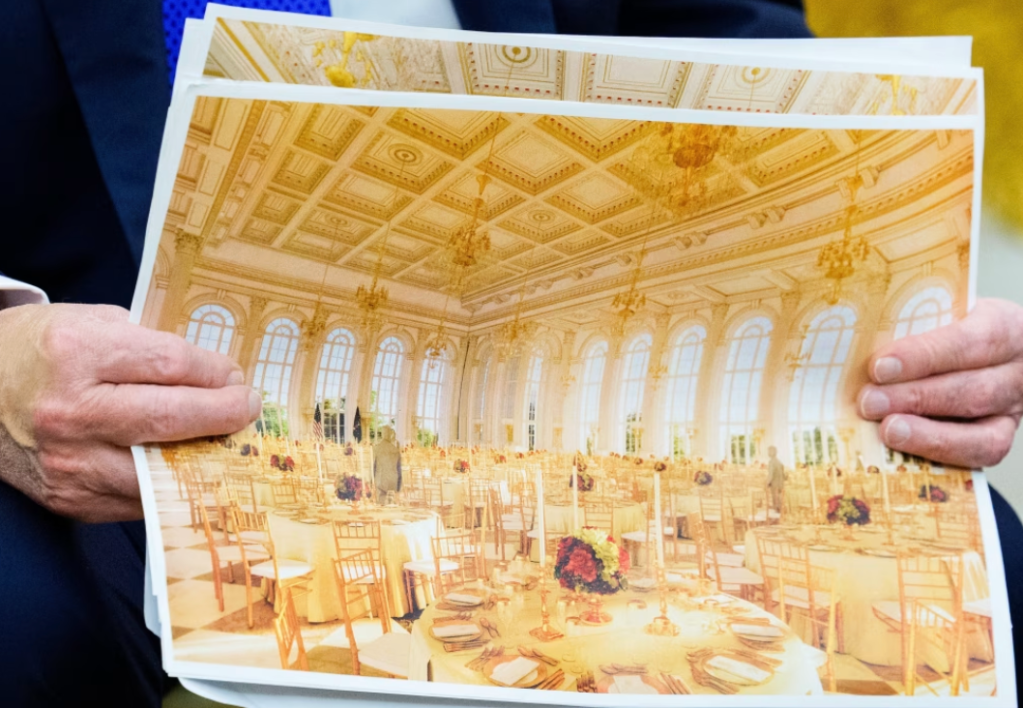
Critics of White House renovations also hated Jefferson’s colonnades and Truman’s balcony.
By The Editorial Board – Oct. 23, 2025 12:00 pm ET – Wall Street Journal
President Donald Trump holds a mockup of the White House ballroom in the Oval Office of the White House on Oct. 22. Aaron Schwartz – Pool via CNP/Zuma Press
The latest sign of incipient authoritarianism is apparently that President Trump is building a ballroom. After photos hit the wires showing construction equipment at the White House, tearing into the East Wing, critics lamented the lost quarters of the social secretary and the calligraphy office. Some urged Democrats to run in 2028 on a promise to raze Mr. Trump’s ballroom.
Take a breath, folks. There really is a case for a larger hall at the White House for holding big state dinners and other events, without having to pitch enormous tents on the South Lawn. Mr. Trump’s taste in decor runs toward garish, and there can be reasonable complaints about historical preservation, the architectural footprint, the lack of transparency on the private funding for this project, and the like.
But adding a ballroom to the White House isn’t destroying it, much less democracy, and controversy over such renovations is almost as old as the republic. The nonprofit White House Historical Association has an enlightening essay on the subject, written by the group’s president, Stewart McLaurin.
Thomas Jefferson’s addition of the east and west colonnades “faced immediate criticism for their cost and perceived extravagance,” he writes. Federalists in Congress said the columned walkways had a whiff of aristocracy unbefitting the building’s democratic simplicity.
Today it’s hard to imagine the White House without the North Portico, but when it was added under Andrew Jackson, it was called costly and ostentatious, Mr. McLaurin writes. Under Theodore Roosevelt, putting up the West Wing required removing glasshouses used for growing plants. One newspaper report said those alterations to the White House had “destroyed its historic value.”
Critics didn’t like TR’s huntsman taxidermy. They didn’t like the addition of the Truman Balcony within the South Portico. They didn’t like Jackie Kennedy’s rose garden. They didn’t like the historical loss when Richard Nixon covered Franklin Roosevelt’s swimming pool to create the White House briefing room. What would the press say if Mr. Trump wanted to restore it to FDR’s swimming pool?
The point is that a government office—and that’s what the White House is, aside from an official residence—can’t be set in amber, unchanging for all time. If Mr. Trump’s ballroom is a useful addition, perhaps his successors will warm to it, even if they sandblast away every golden surface. If it isn’t, then it can make way for something else that will help the President do the job for which the people elected him.
 Lord Buckbeak: "Will you come into my parlor?," said the Spider to the Fly.
Leave a comment