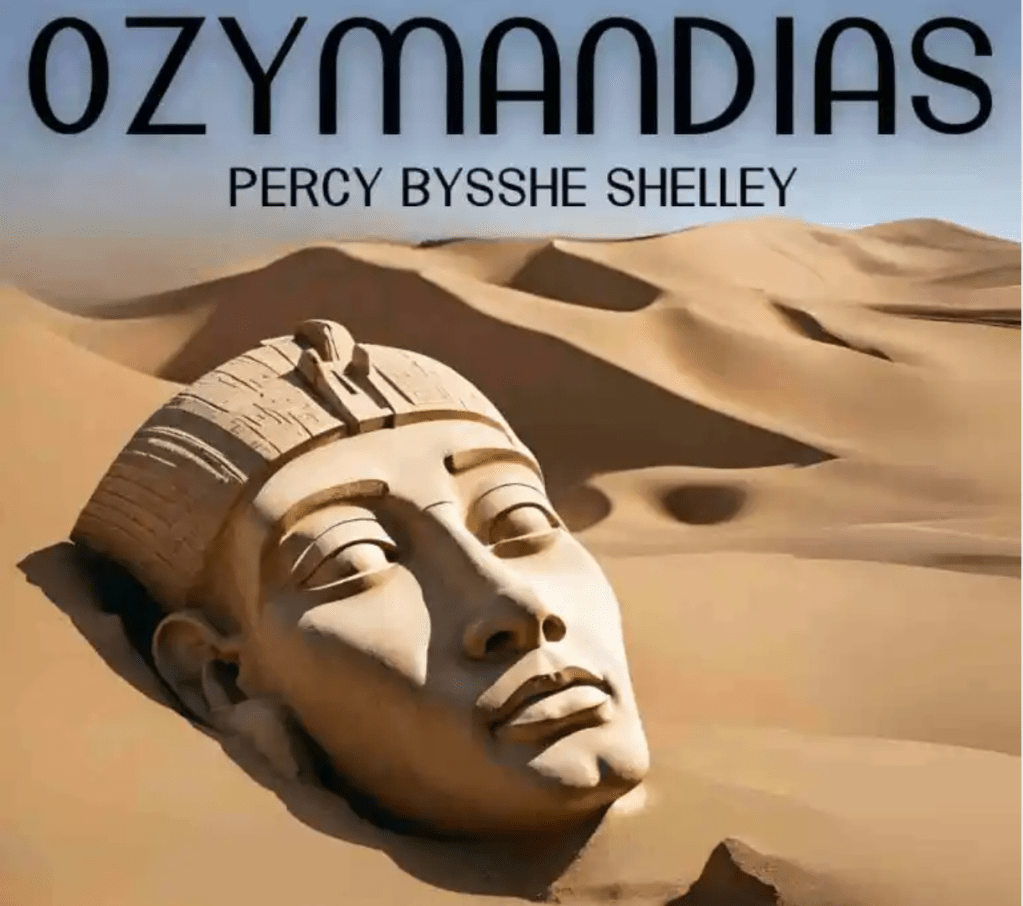
Evildoers pass from the scene, but evil will always be with us.
By Cynthia Ozick – Oct. 24, 2025 5:02 pm ET – WSJ
The ‘Younger Memnon’ statue, which inspired Percy Shelley’s poem ‘Ozymandias.’ amir makar/Agence France-Presse/Getty Images
Two millennia ago, the Greek historian Diodorus Siculus was dazzled by his view of a monumental statue at Aswan. “It is not simply for its size that this work merits approbation,” he wrote, “but it is also marvelous by reason of its artistic quality and excellent because of the nature of its stone, since in a block of so great a size there is not a single crack or blemish.”
This is not what can be seen today in Room 4 of the Egyptian Sculpture Gallery at the British Museum, where the broken remnants of Ozymandias—the head and a partial torso—are themselves gargantuan. The head with its striped mane and cobra diadem had long ago fallen off. The slablike rectangular beard and nose and cheeks and shoulders have an unexpectedly modernist, even Cubist, aspect. Napoleon had attempted, for the glory of France, to dig up the 7-ton fragments and failed. These the English, with the help of the Royal Engineers, a vast sledge on rollers, and innumerable fellahin pulling on ropes, were able to raise and transport in 1819 to a waiting and fascinated London. What had been left behind was a pair of mammoth legs standing alone in the sand.
Five years before, 21-year-old Percy Bysshe Shelley, already married to a pregnant wife, eloped with Mary Wollstonecraft Godwin, 16 and also pregnant, the daughter of two philosophers, one a pioneering feminist, the other a political anarchist. The two literary young lovers married in 1816, following Shelley’s first wife’s suicide. In the Christmas season of 1817, Shelley and Mary gathered with their children at home, together with a circle of writer friends, including Horace Smith, a banker, political writer and himself something of a poet. A competition was proposed as a diversion: Smith and Shelley would each compose a sonnet on the celebrated soon-to-arrive Egyptian colossus. Writing contests among these luminaries were not uncommon; the horrific automaton of Mary’s “Frankenstein: The Modern Prometheus” was the result of another such playful rivalry.
On this winter night, it was the stone effigy of the mighty Ozymandias—the Greek name for Ramesses II, the biblical pharaoh whose horses and riders were drowned in the Red Sea—that was to be captured in 14 lines. Still, how to imagine it, sight unseen? Smith, under the title “On a Stupendous Leg of Granite,” ends with rhyming wonder at “What powerful but unrecorded race / Once dwelt in that annihilated place.”
Two wholly abstract images: here we can perceive neither the loins and lineaments of the race nor the lay of the land of the place—while Shelley in his coda seizes on a visual grimness that morphs into the parched yet searing visionary: “. . . boundless and bare, / The lone and level sands stretch far away.”
Smith is unremembered. Shelley, the incontrovertible winner, defines the timeless history of tyranny itself, from Ramesses through Caligula to the mullahs of today’s Iran. The 20th century saw a cruel and seemingly unconquerable Hitler self-annihilated in a bunker in an airless tunnel, and his henchmen broken on the gallows; it saw the maddened Stalin, on the verge of initiating a major pogrom, silenced and dethroned by a massive stroke. Our own moment beholds Yahya Sinwar, cold-blooded mastermind of the Oct. 7, 2023, massacre in Israel, sitting in rubble and feebly batting a deadly drone with a stick.
“These lifeless things,” Shelley calls the statue’s scattered remains; and so much for this one unyielding miscreant. Yet behind that frown and wrinkled lip and sneer of cold command is an ignominious force that lives on, era after era, sometimes ebbing, always recurring, a Nile of evil intent, running through villages, cities, nations, continents, irrigating with its bitter waters the tongues of both scholars and the unlettered, eroding civilizations high and low, ancient and modern, enlightened and medieval. It carries in its wake names glorious and inglorious: Ferdinand and Isabella, Voltaire, Heidegger, Celine, T.S. Eliot, Ezra Pound, Chaucer, Shakespeare, Dostoyevsky, Kipling, Titus, Peter Stuyvesant, Charles Lindbergh, Richard Wagner, Roald Dahl, Henry Ford, Karl Lueger, Jeremy Corbyn and the inauspiciously looming figure of Zohran Mamdani.
All these and more are ingrained in the cautionary meaning of Shelley’s “Ozymandias”: “those passions which yet survive.” Mary Shelley warns us also: Beware the monsters you conceive. Dread what you create. Fear what you exalt.
Ms. Ozick is author, most recently, of “In a Yellow Wood: Selected Stories and Essays.”
Shelley’s ‘Ozymandias’
I met a traveller from an antique land
Who said: Two vast and trunkless legs of stone
Stand in the desart. Near them, on the sand,
Half sunk, a shattered visage lies, whose frown,
And wrinkled lip, and sneer of cold command,
Tell that its sculptor well those passions read
Which yet survive, stamped on these lifeless things,
The hand that mocked them and the hand that fed:
And on the pedestal these words appear:
“My name is Ozymandias, King of Kings:
Look on my works, ye Mighty, and despair!”
Nothing beside remains. Round the decay
Of that colossal wreck, boundless and bare
The lone and level sands stretch far away.
 Lord Buckbeak: "Will you come into my parlor?," said the Spider to the Fly.
Leave a comment