by Daniel J. Mahoney – Summer 2025 – Claremont Review of Books
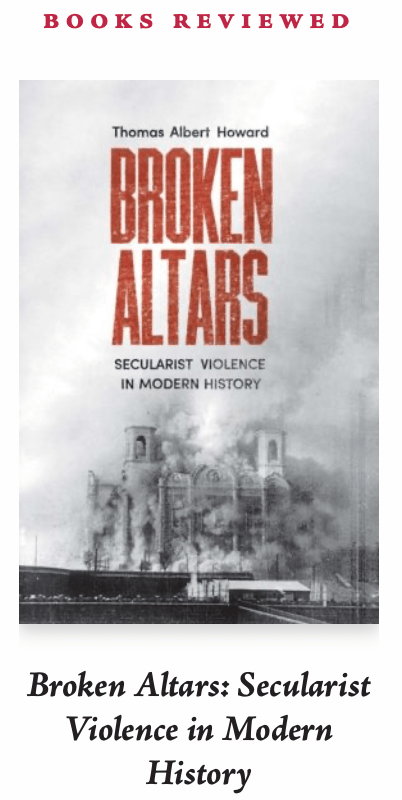
In his deeply informed new book, Broken Altars: Secularist Violence in Modern History, the intellectual historian Thomas Albert Howard challenges a widespread contemporary prejudice that identifies religion with violence and irrationality. Machiavelli made clear in The Prince that he could imagine no political evil graver than “pious cruelty.” But it turns out that impious cruelty has been far more destructive than the religious furies of old. “In terms of sheer numbers,” writes Howard in his introduction, “the misery, deaths, and destruction visited on religious communities by secularist regimes in the twentieth century vastly exceed the violence committed during early modern European wars of religion, which are routinely invoked to legitimize the necessity of the modern secular nation-state.”
There is secularism and there is secularism. Howard, a professor of history and the humanities at Valparaiso University, identifies various forms of “passive secularism” whose adherents, though sometimes irreligious themselves, eschew overt hostility to belief and defend religious liberty. But the modern world has also produced radical secularists who have perpetrated mass violence against people of faith. Howard divides these frenzied radicals into two broad groups. “Combative secularists” view religion with suspicion and attempt to belittle or diminish its influence. “Eliminationist secularists,” on the other hand, want nothing less than to wipe belief and believers from the earth altogether. It hardly needs saying that neither attitude is compatible with traditional moral constraints or genuinely liberal politics.
***
Howard astutely observes that both variants of radical secularism “are the offspring of the Enlightenment’s progressive wing—what the intellectual historian Jonathan Israel has called the Radical Enlightenment.” Combative secularism emerged chiefly among the fanatics and philosophes of the French revolution. Eliminationist secularism was more a product of the German ideologies put forward by Karl Marx and his intellectual progeny. What all radical secularists have in common, however, is a tendency to identify “progress” with the forced marginalization of religion in human and political life. They share an aspiration to “crush the infamous” thing—i.e., the Christian Church—as the ostensibly “moderate” Voltaire put it in 1762. Radical secularists see religion, especially Christianity, as “an obstructing, reactionary force” which must be controlled, marginalized, and eroded.
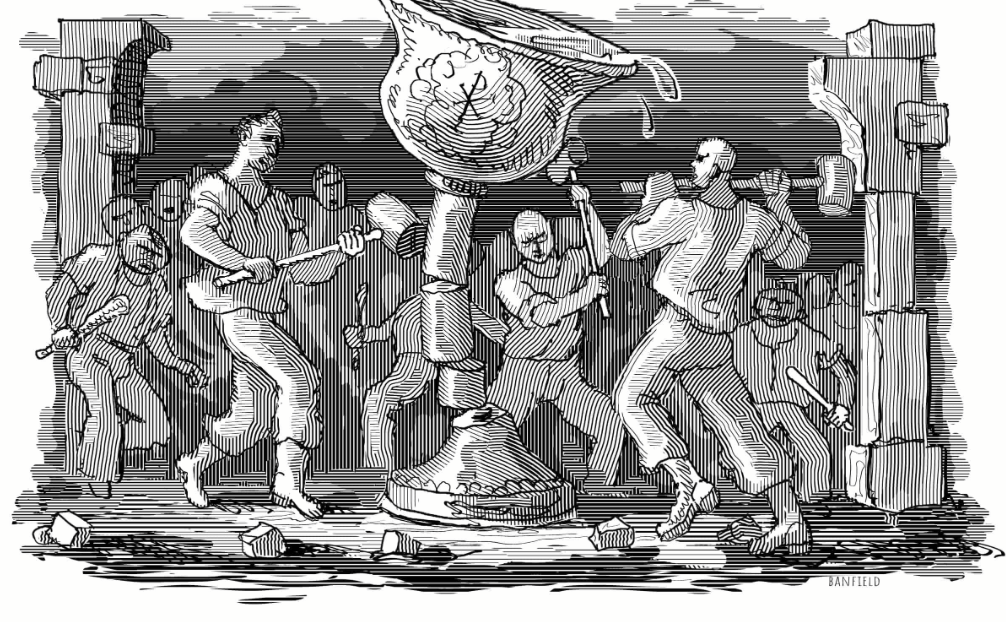
Combative secularism gave rise to paroxysms of violence in revolutionary France in the 1790s, in republican Spain after 1936 (and to some extent even before the outbreak of the Spanish Civil War), and in revolutionary Mexico in the 1920s and ’30s. In these once devoutly Catholic countries, militant secularism became the basis of a new political pseudo-religion based on “revolution” itself. Churches and monasteries were shuttered and destroyed. Iconoclasm became an instrument of state policy. Priests and nuns were cruelly guillotined, murdered, dismembered, and lit on fire. Sadism became a defining instrument of revolutionary praxis and an abiding mark of secularist zeal.
Spirited resistance to secularist repression by French Catholic peasants was met by genocidal violence in the Vendée region of western France between 1793 and 1796. Up to 200,000 people perished at the hands of revolutionary armies determined to level rebel villages and destroy the rebels’ families, including women and children who were counted among the “enemies of the Revolution.” In Paris, a comparatively modest 15,000 to 40,000 people were guillotined or died in jail between 1792 and 1794, at the height of the revolutionary terror. The Cristero rebels in 1920s rural Mexico, also Catholic peasants who fought for “Christ the King” against the draconian anti-Catholic measures of President Plutarco Elías Calles’s militantly secularist regime, met a similar fate. By the mid-1930s, the Church in Mexico legally had no “corporate existence, no real estate, no schools, monasteries or convents,” as chronicled in early novels by Graham Greene such as The Power and the Glory (1940).
Spain’s republican forces were particularly cruel. Their ostensible liberalism was vitiated by a macabre enthusiasm for beating, humiliating, torturing, and immolating clergy, bishops, and Catholic laymen. “Some dioceses lost almost all their clergy,” Howard writes. “Mutilations inflicted on the bodies revealed a morbid fixation on genitals, understandable in the context of traditional anti-clerical obsession with the sexuality of priests, monks and nuns.” In a particularly revealing interview, a republican militant explained his reasons for murdering one Father Domingo at Alcañiz in Aragon. When asked if the priest had “meddle[d] in politics and ha[d] personal enemies,” the militant replied: “No sir, Father Domingo was a very good man. But we had to kill all the priests.”
***
Today, the coalition of socialists and Communists that rules Spain distorts this history, equating the Nationalist forces under Francisco Franco with Hitler’s Nazis and so putting the republicans on the side of the angels. This is not an interpretation of events that stands up to historical scrutiny. To begin with, Franco’s anti-republican coalition (which indeed received support from Germany and Italy) included conservatives, Catholics, Carlists and more traditional monarchists, anti-Communists of a moderately republican stripe, as well as Falangists or Spanish fascists (who quickly lost influence on Franco’s regime in the years after 1945). Stalinists were as brutal on the republican side as Falangists were on the Nationalist side. Spain’s most distinguished philosopher, the self-described “aristocratic liberal” José Ortega y Gasset, went into several decades of self-imposed exile to avoid declaring support for either faction. Between the two, though, it was the totalitarians among the “republicans” who represented a decisive break with the principles of Western civilization.
Combative secularism took a less murderous but nevertheless distinctly authoritarian form in Mustafa Kemal’s (Atatürk’s) Turkey. Influenced by the extreme secularism of France’s Third Republic, Kemal undertook to redefine Islam as a “rational religion” so as to stigmatize all but the most attenuated forms of worship. His new secular republic was sneeringly hostile toward the “age-old rotten mentalities,” “tradition-worshipping,” “superstitions,” and “nonsense” of Turkey’s Muslim population. There was arguably more religious liberty under the “millet” courts of the Ottoman Empire, which administered separate systems of law for separate faith communities, than in secularist Turkey. Moreover, it was the “Young Turks,” nationalist partisans of secular modernity, who paved the way for the Armenian genocide in 1915 and 1916.
For a while, Atatürk’s regime looked like a successful example of political “refounding” in the Islamic world. The army zealously enforced a Turkish version of France’s laïcité (called laiklik in Turkish), whereby expressions of and appeals to faith were excluded from the public square. But the majority of the Turkish peasantry remained committed to the old Islamic ways. Dissidents increasingly came to view the Turkish republic as an anti-Islamic imposition on a people determined to practice their ancient faith. As one Muslim reformer quoted by Howard put it, Atatürk’s draconian secularism produced a semi-authoritarian state “unchecked by all traditional constraints as well as modern ones.” Nor was this of merely Turkish interest. As Howard points out, the Turkish model of top-down, authoritarian secularism is “the main model of secularism the Muslim world has been exposed to.” It has therefore crowded out more “benign” versions of secularism that would not have conflated secular politics with anti-religious prejudice in the minds of Middle Eastern observers.
***
Despite the outrages of these combative secular regimes, eliminationist regimes showed themselves over time to be still more radical, fanatical, and murderous. The nihilistic and coercive atheism at the heart of Marx’s thought gradually spawned the horrific atrocities of Leninism, Stalinism, and Maoism. These fanatical ideologies were at war with tradition and human nature from the beginning, and the driving motivator of that war was a searing hatred of religious belief. It infused every element of revolutionary theory and practice, justifying the worst of crimes.
The connection between atheism and totalitarianism is no coincidence. Karl Marx saw in religion only a crude “reactionary” servility that stood in the way of total human emancipation from all limits, including those imposed by the moral law and the innate human longing for transcendence. To use the philosopher Charles Taylor’s resonant phrase, Marxism was an “exclusive humanism” of the most extreme kind. Howard writes that it presented “a conception of reality that is irreducibly unmysterious.”
Militant and murderous atheism was an integral element of “really existing socialism” in every time and place. The short epigraph that opens chapter three of Howard’s book, “Soviet Severities,” is a slogan from the Soviet Union’s League of the Militant Godless: “Whoever is for Easter is against socialism.” This was the attitude from the dawn of the Soviet regime in 1917, to Communist Mongolia, Maoist China, East-Central Europe after 1945, Enver Hoxha’s Albania (where priests were executed for baptizing children), Fidel Castro’s Cuba, the Khmer Rouge’s “killing fields” in Cambodia, and the nightmarish Juche regime of the Kims in North Korea. Confronted with the human race’s deep-seated religious impulse, eliminationist governments resorted to ever more “extensive measures…to persecute, repress, and/or control religious elements in society.” Howard tells this disturbing story soberly but effectively, with impressive attention to detail. Remarkably—and revealingly—other academic literature on Communism has rather little to say on the subject.
***
For the Russian Bolsheviks and their revolutionary heirs, religious believers were nothing more than “harmful insects” and insidious “cockroaches” (to cite just two characteristic turns of phrase from Lenin and Trotsky). Orthodox Christians, Catholics, and other believers were targeted from the beginning of the Bolshevik regime. Omnipresent and all-too-crude Soviet propaganda portrayed “priests and the pious, along with kulaks” as “rats, vermin,” and “contemptible enemies of the people.” The Soviets accordingly set themselves to exterminate the religious by the exercise of tyranny and terror on a truly massive, indeed unprecedented, scale. Monasteries and places of penitence were closed. Those in the Arctic north on the Solovetsky Islands were even turned into the first Cheka-administered concentration camps, a story dramatically told in volume II of Aleksandr Solzhenitsyn’s The Gulag Archipelago (1975). Clergy, bishops, and laymen were tortured, drowned, and frozen to death.
Patriarch Tikhon of Moscow, a man of great spiritual integrity, was arrested and maltreated in the early 1920s for defending religious liberty and the prerogatives of the church. From War Communism in the early ’20s to collectivization in the early ’30s, both Lenin and Stalin carried out a campaign to humiliate the faithful. They closed and destroyed village churches, arrested and harassed priests, and prohibited religious practice of all kinds (outside of narrowly defined “private worship”) as “illegal, anti-Soviet activity.” At least 85,000 priests and nuns perished in the 1930s, along with hundreds of thousands, if not millions, of ordinary believers. This was the worst persecution of the Christian Church in modern or ancient times and deserves much greater attention than it has received.
***
Most dramatically, the Cathedral of Christ the Savior, Moscow’s most imposing church, was dynamited in 1931 to create a palatial seat for the Supreme Soviet, only to be turned later into a “brutalist-style open-air swimming pool.” (Happily, the church was painstakingly rebuilt after the fall of the Soviet regime.) Churches were closed by the tens of thousands. Many were reopened after the Nazi invasion in June 1941, in a transparent effort to get Russians to fight for “Mother Russia” when they would not do so for Communist totalitarianism. But no less than 15,000 churches were closed again in the Khrushchev era. Though critical of Stalin’s “cult of personality,” Nikita Khrushchev remained fully committed to the war against religion. He was arguably the last dyed-in-the-wool Leninist of the Soviet leaders—an “idealist” of sorts.
The Soviet assault on faith was not limited to Russia or to Christians. Religious Jews saw their synagogues and schools closed. The Soviet state nonetheless gained broad support from many “progressive” Jews, until it turned violently anti-Zionist after 1948. By 1967, religious and secular Jews alike were eagerly fleeing to Israel or the United States. Muslims were also persecuted en masse in Kazakhstan, where a third of the population perished during collectivization. In western Ukraine the Uniate, or Greek Catholic Church, was banned in 1946; all but one bishop perished at the hands of the atheist state. Lithuanian Catholics met equally systematic persecution, especially in the years from 1944 to 1954. “Hundreds of churches were closed; sacred art was destroyed and looted,” and tens of thousands of priests, nuns, and laymen were sent to languish in the Gulag.
But the Lithuanian Church endured. The underground samizdat publication The Chronicle of the Catholic Church in Lithuania intrepidly documented the persecution of the Church in the years from 1972 to the final collapse of the Soviet regime in 1990-91. In East-Central Europe, heroic churchmen such as József Cardinal Mindszenty in Hungary, Josef Beran in Czechoslovakia, Stefan Cardinal Wyszyński in Poland, and Archbishop Aloysius Stepinac in Croatia stood up to the totalitarian juggernaut and faced the full fury of the state. After 1978, a Polish pope, John Paul II, sustained the courage of the faithful and gave them hope for a time beyond totalitarian despotism. Their stories of witness and fidelity need to be far better known—not least by churches and believers themselves.
The Russian Orthodox church today is adamantly patriotic (perhaps too zealously so) and a pillar of the post-Communist Russian settlement. But it remains implacably anti-Communist. It actively honors those of the faithful who fell victim to Bolshevik persecution. Several thousand “Russian New Martyrs,” as they are called, have been canonized since the fall of the Soviet Union. This witness to the effectual truth of the Soviet regime’s anti-Christian villainy makes the moral and historical rehabilitation of the Soviet regime much less likely. It acts as a check on those within Vladimir Putin’s entourage who wish to conflate historic Russia with the USSR. Even President Putin still supports the inclusion of Solzhenitsyn’s Gulag Archipelago in Russia’s national high school curriculum, despite heated opposition to it from leading lights within the ruling “United Russia” party.
***
From the time of the Sino-Soviet split (circa 1960), it has been a requirement of entry into polite society to speak of the “polycentric” character of Communist regimes, nations, and movements, scoffing at unregenerate notions of “monolithic” Communism. Yet Communist regimes the world over do indeed share what the Russianist Martin Malia, in his 1994 book The Soviet Tragedy, described as a kind of “genetic code.” It includes a fierce commitment to engineering souls and nationalizing minds, active repression of real and imagined “enemies of the people,” and unrelieved contempt for peasants who wish to preserve traditional ways of life. In their visceral opposition to almost every manifestation of religious faith, Communist regimes have been remarkably “monolithic.”
Accordingly, Chinese Communism has been no less eliminationist than the Russian variety. Among the first peoples to be subjected to religious persecution on a massive scale by a Communist regime were the Lamaist Buddhists of Mongolia in the 1920s and ’30s. Between 1937 and 1938 alone, the numbers of lamas living in monasteries was reduced from 82,203 to 562. Their deeply rooted way of life was wiped out in a matter of years. The same policies were applied in occupied Tibet after 1950. Those lamas who were not killed or arrested faced grueling “struggle sessions, during which they had to wear dunce caps and carry placards itemizing their putative errors and crimes.” Howard reports that “entire monastic communities were sent to the coal mines.”
In China itself, Christians have been brutally persecuted since the beginning of the Communist dictatorship in 1949. The Roman Catholic Church has long been officially outlawed. Bishops and priests have been incarcerated for decades on end, and hundreds of thousands of the faithful (including adherents of the “underground” Catholic Church who remained loyal to Rome) were sent to undergo laogai, “reform through labor,” in the Chinese Gulag.
During the Cultural Revolution from 1966 to 1976, millions of people, including a great number of religious Chinese, died at the hands of the fanatical Red Guards unleashed on the Chinese populace by Mao Zedong. Believers were publicly humiliated, and religious items such as crucifixes were confiscated and destroyed. Today, though China’s economic policy has grown far more lenient, the Chinese Communist Party (CCP) remains deeply suspicious of all independent religious institutions and initiatives. Through aggressive surveillance and monitoring, the CCP aims to “Sinicize” Chinese Christianity, Buddhism, and Taoism, making the party the ultimate “star and compass” of religious groups.
***
Why do totalitarian regimes direct special hostility toward Christian churches? Arguably, they see Christianity as their enemy par excellence. The Christian religion is anti-totalitarian to its core. According to the words of Christ himself, Christians cannot render to Caesar what rightly belongs to God. A Christian must by definition set himself against a state that lays claim to total allegiance. It follows that totalitarian states must, by definition, set themselves against followers of Christ.
In a thoughtful conclusion to his book, Howard remarks that one does not have to romanticize the opponents of draconian secularism, such as the Nationalists in Civil War-era Spain or the hard-nosed Cristeros in revolutionary Mexico, to loathe and lament the physical cruelties and spiritual degradation unleashed by radical secularists in the late modern world. These fanatics waged active war with the imago Dei, the image of God that sets human beings apart from beasts. They created rigid and unresponsive political orders that calcified social life and retarded meaningful progress. They showed contempt for basic human decency and did what they could to permanently suspend the natural moral law in service of hubristic and utopian social engineering. They deserve the same opprobrium that has rightly been directed at National Socialism as an intrinsically criminal ideology.
But as Howard notes, a powerful double standard persists. Being an ex-Nazi carries with it “an ineradicable moral stigma,” while being an ex-Communist, Communist, or fellow-traveler (in the manner of Jean-Paul Sartre, Diego Rivera, or Pablo Neruda) is accompanied by no moral stain. Even scholarly and journalistic accounts that take stock of Soviet repression still say comparatively little about the degree, nature, and extent of the persecution inflicted upon believers. In contrast, the Communists who fell victim to the “Great Purge” of 1936 to 1938, when “the revolution began to devour its own children,” get plenty of attention in the literature. Western scholarship on Communism remains adamantly secularist in orientation. Perhaps that is one reason why Communism has managed to become fashionable once again. Lamentably, even supposedly “well-educated” young people know little or nothing about the trail of tears to which Marxism and all its derivatives have led. We have failed our youth miserably on this score.
***
Thomas Howard’s fine book helps rectify the situation. He concludes it by “emphatically restating that focusing on violence in the name of militant ideological secularism neither denies nor excuses violence in the name of religious belief.” Of course, outside of formidable Islamist juntas and tiny, isolated circles of Jewish and Christian extremists, almost all critics of secularist fanaticism are also principled defenders of religious liberty. They support a moderate and calibrated secularism in which respect for the autonomy of the temporal realm can align harmoniously with an active, even robust, religious presence within civil society. Howard rightly challenges the Enlightenment dogma “that religion is somehow inherently violent.” Christianity is not Islam—or Islamism—and has long made its peace with moderate forms of secularism. The “wars of religion” that followed the splintering of Christendom were a brazen affront to God and man. But it must be remembered that, contrary to legend, only 3,000 people perished during the three centuries of the Spanish Inquisition. There is a reason for this. Christianity, with its emphasis on human dignity and the universal moral law “written on the hearts of men,” is an inherently anti-totalitarian religion. It cannot long abide any human order, even an ostensibly “Christian” one, that rejects natural moral limits and constraints on human power.
A reconstituted liberalism, properly conservative in its sensibilities, will be obliged to learn lessons from the totalitarian tragedies of modern times. “The spirit of religion” and the “spirit of liberty,” as Alexis de Tocqueville famously put it, must again be “harmonized” if freedom is to regain its luster. Violence against the bodies and souls of human beings must be rejected in principle, and not in a superficial or specious way that makes ideological violence likely again in the future. At a minimum, if human dignity is truly to flourish in theory and in practice, civil society will have to recover its respect for the things of the spirit.
Daniel J. Mahoney is a senior fellow of the Claremont Institute, professor emeritus of Assumption University, senior visiting fellow at Hillsdale College in Washington, D.C., and the author, most recently, of The Persistence of the Ideological Lie: The Totalitarian Impulse Then and Now (Encounter Books).
==========================================================
The following is from the book “The Devil’s Delusion” pgs 22-25 by Dr. David Berlinski:
If the facts about the twentieth century are an inconvenience
for scientific atheism, suitably informed thought may always
find a way to deny them. The psychologist Steven Pinker has
thus introduced into the discussion the remarkable claim that
“something in modernity and its cultural institutions has
made us nobler.”
The good news is unrelenting: “On the scale of decades,
comprehensive data again paint a shockingly happy picture.”
Here is rather a more accurate assessment of the twen –
tieth and early twenty-first centuries. Anyone persuaded that
they represent a “shockingly happy picture” should make the
modest imaginative effort to discern the immense weight of
human misery conveyed by these statistics:
A Shockingly Happy Picture by Excess Deaths
First World War (1914–18): . . . . . . . . . . . . . . . . . . . . . 15 million
Russian Civil War (1917–22): . . . . . . . . . . . . . . . . . . . . 9 million
Soviet Union, Stalin’s regime (1924–53): . . . . . . . . . 20 million
Second World War (1937–45): . . . . . . . . . . . . . . . . . . 55 million
Chinese Civil War (1945–49): . . . . . . . . . . . . . . . . . . 2.5 million
People’s Republic of China, Mao Zedong’s
regime (1949–75): . . . . . . . . . . . . . . . . . . . . . . . . . . . . 40 million
Tibet (1950 et seq.): . . . . . . . . . . . . . . . . . . . . . . . . . . . . . . 600,000
Congo Free State (1886–1908): . . . . . . . . . . . . . . . . . . . 8 million
Mexico (1910–20): . . . . . . . . . . . . . . . . . . . . . . . . . . . . . . 1 million
Turkish massacres of Armenians (1915–23): . . . . . 1.5 million
China (1917–28): . . . . . . . . . . . . . . . . . . . . . . . . . . . . . . . . . 800,000
China, Nationalist era (1928–37): . . . . . . . . . . . . . . . 3.1 million
Korean War (1950–53): . . . . . . . . . . . . . . . . . . . . . . . . . 2.8 million
North Korea (1948 et seq.): . . . . . . . . . . . . . . . . . . . . . . 2 million
Rwanda and Burundi (1959–95): . . . . . . . . . . . . . . 1.35 million
Second Indochina War (1960–75): . . . . . . . . . . . . . . 3.5 million
Ethiopia (1962–92): . . . . . . . . . . . . . . . . . . . . . . . . . . . . . . 400,000
Nigeria (1966–70): . . . . . . . . . . . . . . . . . . . . . . . . . . . . . . 1 million
Bangladesh (1971): . . . . . . . . . . . . . . . . . . . . . . . . . . . 1.25 million
Cambodia, Khmer Rouge (1975–78): . . . . . . . . . . . 1.65 million
Mozambique (1975–92): . . . . . . . . . . . . . . . . . . . . . . . . . 1 million
Afghanistan (1979–2001): . . . . . . . . . . . . . . . . . . . . . . 1.8 million
Iran–Iraq War (1980–88): . . . . . . . . . . . . . . . . . . . . . . . . 1 million
Sudan (1983 et seq.): . . . . . . . . . . . . . . . . . . . . . . . . . . . 1.9 million
Kinshasa, Congo (1998 et seq.): . . . . . . . . . . . . . . . . 3.8 million
Philippines Insurgency (1899–1902): . . . . . . . . . . . . . . 220,000
Brazil (1900 et seq.): . . . . . . . . . . . . . . . . . . . . . . . . . . . . . 500,000
Amazonia (1900–1912): . . . . . . . . . . . . . . . . . . . . . . . . . . . 250,000
Portuguese colonies (1900–1925): . . . . . . . . . . . . . . . . . 325,000
French colonies (1900–1940): . . . . . . . . . . . . . . . . . . . . . 200,000
Japanese War (1904–5): . . . . . . . . . . . . . . . . . . . . . . . . . . . 130,000
German East Africa (1905–7): . . . . . . . . . . . . . . . . . . . . . 175,000
Libya (1911–31): . . . . . . . . . . . . . . . . . . . . . . . . . . . . . . . . . . 125,000
Balkan Wars (1912–13): . . . . . . . . . . . . . . . . . . . . . . . . . . . 140,000
Greco–Turkish War (1919–22): . . . . . . . . . . . . . . . . . . . . 250,000
A Shockingly Happy Picture by Excess Deaths (cont’d)
Spanish Civil War (1936–39): . . . . . . . . . . . . . . . . . . . . . 365,000
Franco Regime (1939–75): . . . . . . . . . . . . . . . . . . . . . . . . 100,000
Abyssinian Conquest (1935–41): . . . . . . . . . . . . . . . . . . . 400,000
Finnish War (1939–40): . . . . . . . . . . . . . . . . . . . . . . . . . . . 150,000
Greek Civil War (1943–49): . . . . . . . . . . . . . . . . . . . . . . . 158,000
Yugoslavia, Tito’s regime (1944–80): . . . . . . . . . . . . . . 200,000
First Indochina War (1945–54): . . . . . . . . . . . . . . . . . . . 400,000
Colombia (1946–58): . . . . . . . . . . . . . . . . . . . . . . . . . . . . . 200,000
India (1947): . . . . . . . . . . . . . . . . . . . . . . . . . . . . . . . . . . . . . 500,000
Romania (1948–89): . . . . . . . . . . . . . . . . . . . . . . . . . . . . . . 150,000
Burma/Myanmar (1948 et seq.): . . . . . . . . . . . . . . . . . . 130,000
Algeria (1954–62): . . . . . . . . . . . . . . . . . . . . . . . . . . . . . . . . 537,000
Sudan (1955–72): . . . . . . . . . . . . . . . . . . . . . . . . . . . . . . . . . 500,000
Guatemala (1960–96): . . . . . . . . . . . . . . . . . . . . . . . . . . . . 200,000
Indonesia (1965–66): . . . . . . . . . . . . . . . . . . . . . . . . . . . . . 400,000
Uganda, Idi Amin’s regime (1972–79): . . . . . . . . . . . . . 300,000
Vietnam, postwar Communist regime
(1975 et seq.): . . . . . . . . . . . . . . . . . . . . . . . . . . . . . . . . . . 430,000
Angola (1975–2002): . . . . . . . . . . . . . . . . . . . . . . . . . . . . . . 550,000
East Timor, conquest by Indonesia (1975–99): . . . . . 200,000
Lebanon (1975–90): . . . . . . . . . . . . . . . . . . . . . . . . . . . . . . 150,000
Cambodian Civil War (1978–91): . . . . . . . . . . . . . . . . . . 225,000
Iraq, Saddam Hussein (1979–2003): . . . . . . . . . . . . . . . 300,000
Uganda (1979–86): . . . . . . . . . . . . . . . . . . . . . . . . . . . . . . . 300,000
Kurdistan (1980s, 1990s): . . . . . . . . . . . . . . . . . . . . . . . . . 300,000
Liberia (1989–97): . . . . . . . . . . . . . . . . . . . . . . . . . . . . . . . . 150,000
Iraq (1990– ): . . . . . . . . . . . . . . . . . . . . . . . . . . . . . . . . . . . . 350,000
Bosnia and Herzegovina (1992–95): . . . . . . . . . . . . . . . 175,000
Somalia (1991 et seq.): . . . . . . . . . . . . . . . . . . . . . . . . . . . . 400,000
In considering Pinker’s assessment of the times in which
we live, the only conclusion one can profitably draw is that
such an excess of stupidity is not often to be found in nature.
 Lord Buckbeak: "Will you come into my parlor?," said the Spider to the Fly.
Leave a comment