Reality, myth, and World War II.
by Sean McMeekin – Summer 2025 – Claremont Review of Books

With 2025’s V-E day and V-J day anniversaries behind us, the Second World War will soon be 80 years in history’s rearview mirror. Very few veterans of the conflict remain alive. According to records in the National World War II Museum, as of the last survey in 2024, only 66,143 soldiers were still with us—less than 1% of the Americans who served.
True, many institutions that emerged out of the war to form the architecture of postwar international relations endure, from the International Monetary Fund (IMF) and World Bank created at Bretton Woods in July 1944, to the United Nations born at Yalta in February 1945. But their relevance recedes further every year. When was the last time anyone paid attention to a U.N. Security Council resolution, much less one from its General Assembly? Even the International Monetary Fund and World Bank, which inspired screaming headlines and protests in the 1990s over their interference in the affairs of developing nations, seem today like forgotten relics of a bygone age. Why, then, does this “Good War,” known to most Americans only from Hollywood films, invoke such passion?
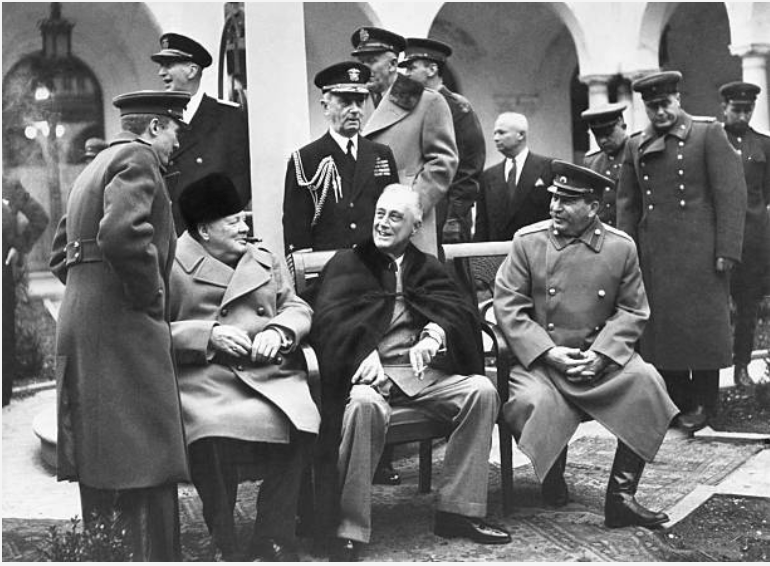
One reason is the role such storytelling has played in supporting the polite fictions that have always undergirded the postwar consensus. Only two of the U.N. Security Council’s five permanent members—the U.S. and the Soviet Union—had any real power in the post-1945 world. Postwar Britain was moribund, rationing foodstuffs into the 1950s, reduced to a kind of financial receivership to the United States. This situation precipitated our vaunted “special relationship,” i.e., eight decades of America bullying London. Charles de Gaulle’s France was allowed to pose as a victor, the legacy of Philippe Pétain’s Nazi-collaborationist Vichy regime swept under the rug. China may have power now, but the country was a basket case in 1945, and its Security Council seat was held until 1971 by Chiang Kai-shek’s government, based in Taiwan after it lost its civil war with Mao Zedong’s Communists in 1949. The Chinese Communist Party (CCP) which now holds that seat, unlike Chiang, was not even a belligerent in the war: Stalin’s USSR brokered an agreement with Tokyo in October 1940 whereby Japan and Mao agreed not to attack each other’s forces. Portraying this miscellany of states as the proud legacy of an anti-fascist triumph, rather than as a haphazard product of the war’s catastrophic after-effects, helps uphold the comic book fiction that the U.N. is to international relations what the Avengers are to the Marvel Cinematic Universe.
Still more fantastical are the half-truths which surround the war itself. Perhaps Americans in the 1940s were less naïve than those in 1917 who had believed President Woodrow Wilson’s airy promise that they were entering the fray because “the world must be made safe for democracy.” But they were bombarded with no less overwrought propaganda about an evil fascist “Axis” bent on world domination, told they were fighting for abstractions such as President Franklin D. Roosevelt’s “Four Freedoms,” and sold a whitewashed portrait of their wartime “Ally,” Josef Stalin, as “Uncle Joe.” Some of this wartime propaganda was later jettisoned out of embarrassment, such as the Stalinophilia which came to seem passé, if not downright treasonous, in the early Cold War years. Still, most of us were raised on a diet of dramatizations about democracy standing up to fascism as the righteous Allied armies delivered Europe from the clutches of wicked Hitler and the Holocaust, all while saving China, southeast Asia, and the Pacific region from Japanese aggression.
The real story of the Second World War is murkier than this, beginning with the U.S.’s role in it. If we fought a war against fascism, then why did we wait until 1941 to do so, 19 years after Benito Mussolini’s fascists came to power in Italy and six years after Italy invaded Abyssinia? If what was really meant was a war against Nazism, then why did we wait until Adolf Hitler had been in power for nearly nine years, five years after he remilitarized the Rhineland, three years after the Anschluss and Munich, two years after he invaded Poland, and nearly a year and a half after Germany invaded Denmark, Norway, France, and the Low Countries? Why, moreover, did we let Hitler declare war on the United States proactively in December 1941, rather than do it the other way around?
As for “armed aggression,” it is rich to say that we went to war to oppose this, when we did not do so in response to multiple such actions by Italy, Germany, and Japan before 1941, not to mention the similarly aggressive behavior between 1939 and 1941 by the Soviet Union—a country we not only did not go to war with, but supported vigorously with Lend-Lease aid and arms shipments even before the U.S. entered the war against Nazi Germany. Stalin’s Communist dictatorship was just as “unfree” as any of the Axis powers, indeed far more oppressive and murderous vis-à-vis its own subjects. By December 1941 it had invaded nearly as many countries as Nazi Germany and more than either Italy or Japan had done. If the “Good War” was a crusade for democracy or against armed aggression, why did we not go to war with the USSR?
Provoked Aggression
To be sure, difficult strategic decisions needed to be made in order to match means to ends. But FDR, like Wilson before him, was adept at the kind of moralizing rhetoric that seems to appeal to American voters, which helped to obscure the story of how we entered the war—and what our objectives were.
Contrary to the conventional wisdom, U.S. involvement in the conflict did not begin with the Japanese attack on Pearl Harbor on December 7, 1941, or Hitler’s declaration of war on Washington in its wake on December 11. Despite charging extortionate prices, the Roosevelt Administration had been arming and supplying Britain for 18 months before Pearl Harbor. After Roosevelt’s “Arsenal of Democracy” radio address on December 29, 1940 and the passage of the Lend-Lease Act of March 1941, it was generally understood that the U.S. was a belligerent in all but name and would back any country opposed to Hitler. Roosevelt even sent a personal envoy to the Balkans in January 1941, Colonel “Wild Bill” Donovan, with orders to assure regional leaders that “Franklin Roosevelt did not intend to let Great Britain lose this war.” In Belgrade, Donovan warned Yugoslav leaders that “if they made any sort of deal with Germany the United States would regard Yugoslavia as our enemy both during and after the war.” Getting the message, these men promptly staged an anti-German coup in Belgrade, which provoked the German invasion of Yugoslavia.
Most Americans, to be sure, knew little of all this. Many voters placed their faith in Roosevelt’s cynical promise, at a speech in Boston on October 30, 1940, in the last days of that year’s presidential race, that “your boys are not going to be sent to any foreign wars.” But the Germans and Italians knew all about Donovan—not incidentally the founder of the OSS, which later became the CIA—whose movements were discussed in headlines across Europe. So, too, did Hitler know about the Roosevelt Administration’s plan (“Rainbow Five”) to mobilize five million troops to fight a European war against Nazi Germany. It was “leaked” to the Chicago Tribune on December 4, 1941—just three days before Pearl Harbor. Impulsive and ultimately self-defeating as Hitler’s decision to declare war on the U.S. was, it did not exactly come out of nowhere.
Nor did the Pearl Harbor attack come out of the blue. The U.S. had irritated Japanese leaders repeatedly over the two previous decades, from the imposition of strict limits on Japanese naval spending at the Washington Conference in 1922, to the racial “exclusion” provision of the Johnson-Reed Immigration Act of 1924, to the progressive application of sanctions on Japan after its invasion of Manchuria in 1931 and mainland China in 1937, up to the de facto oil embargo the Roosevelt Administration applied in July 1941, at a time when Japan was burning through 450,000 metric tons of oil a month. Japan sent a high-level envoy to Washington in November 1941 to negotiate a compromise, offering two different packages that would have seen progressive Japanese disengagement from Indochina and China in exchange for the lifting of the oil embargo. Instead, the Roosevelt Administration replied with an ultimatum (the “Hull Note”) demanding immediate and full unconditional withdrawal, almost certainly knowing this would be unacceptable to any Japanese government. It was Emperor Hirohito and Prime Minister Hideki Tojo who made the fateful decision to attack the U.S. fleet lying in anchor at Pearl Harbor (along with the U.S.-held Philippines and British Singapore, Hong Kong, and Malaya). But they did not do so in a vacuum.
Few of the Americans whose relatives died at Pearl Harbor, or in bloody Pacific War island battles at Guadalcanal, on Peleliu, Iwo Jima and Okinawa, or in the Bataan Death March of captured war prisoners, have reason to doubt the righteousness of the war against Japan. Nor would they likely condemn President Harry Truman’s decision to drop atomic bombs on Hiroshima and Nagasaki in August 1945 to speed up Japan’s unconditional surrender. But some of them may be surprised to learn that, despite the moralistic tone of FDR’s “Day of Infamy” speech, the Roosevelt Administration did not respond to Pearl Harbor by unleashing a war of righteous fury against Japan. At the ARCADIA meetings with Winston Churchill in Washington that December, the president resolved that the U.S. would fight “Germany first”—and in the European theater it would prioritize “assistance to Russia’s offensive by all available means.” What this meant in practice was that the vast hydraulic forces of American war industry, the U.S. merchant marine and cargo shipping, were unleashed not against Japan but on behalf of Stalin’s Red Army, serving as a battering ram to bludgeon Nazi Germany into submission.
There are many things that can be said about the ARCADIA resolutions and their consequences. By prioritizing the German fronts, the Roosevelt Administration gave Japan room to run, prolonging the Asian war for years. By choosing to supply, feed, munition, and motor Stalin’s armies ahead of the British or U.S. armies, Roosevelt ensured that the Soviets would survive the German onslaught in 1941-42 and inflict the vast bulk of the casualties on the Wehrmacht afterward, likely saving American and British lives—while effectively using Soviet soldiers as cannon fodder, as the Russians have complained ever since. Maybe this shortened the European war; maybe it only prolonged and deepened the misery, particularly after Roosevelt committed the Allies to unconditional surrender in 1943 and ruled out negotiations with any German resistance figures, even those plotting to murder Hitler. Without question these policies, accompanied by merciless Anglo-American bombing raids on German cities, led to the destruction of Nazi Germany and the devastation of central Europe, which by 1945 was an apocalyptic wasteland. The Red Army raped and looted its way toward Berlin to squat in the ruins east of the Elbe River, and the U.S. army inherited most of the spoils west of it. Although Americans behaved less savagely than the Soviets, the Joint Chiefs of Staff nevertheless issued punitive orders, under “JCS 1067,” to ration “German resources” strictly, with “consumption held to the minimum,” and to “take no action that would tend to support basic living standards in Germany on a higher level” than prevailed elsewhere in the war-ravaged Europe of 1945.
Ain’t Too Proud to Beg
Britain may have a stronger moral claim than America to have taken a stand against Nazi aggression after the fall of France. But Americans are so steeped in Winston Churchill’s soaring wartime rhetoric that we forget he was not in power when Britain entered the war. It was Neville Chamberlain who made the critical decisions in the story, and it is curious that these are so little discussed, aside from Chamberlain’s “appeasement” of Hitler’s designs on Czechoslovak territory at Munich. In truth Chamberlain’s calculation in 1938, that neither Britain nor France had any real way of helping defend Czechoslovakia and should therefore not go to war on its behalf, was tenable and supported by Churchill at the time. (Churchill was right, however, to chide Chamberlain for the foolishness of going to Munich to beatify Hitler’s move, rather than simply issue a statement of condemnation as he had done over the Austrian Anschluss earlier that year.)
Chamberlain made the same calculation about Poland in 1939: Britain had no way of defending the country if Germany invaded. But this time, out of outrage that Hitler had gone beyond what he promised at Munich and seized more Czech territory, Chamberlain decided to take the very kind of principled stand against Hitler we are always told he should have done—that Churchill would have done, that supposedly all we wiser postwar would-be practitioners would have done in his place. He issued a guarantee to Poland, which convinced the Polish government it had Britain’s support, and so Warsaw cut off ongoing negotiations with Berlin over Danzig (Gdánsk) and the Polish corridor and decided to resist. Britain and France did declare war on Poland’s behalf, but they did basically nothing to help Poland before she succumbed to the joint invasion by Nazi Germany and Soviet Russia in September 1939. Nor did Britain liberate Poland, the casus belli in 1939, during or after a war which left that country in ruins, conquered by the same Red Army in 1945 that had invaded Poland in 1939 and this time stayed for good. Poland, the first and central victim of the war, never received reparations from Germany or Russia. Warsaw’s latest claim on Berlin, $1.3 trillion, was issued in 2022 and dismissed on the same grounds as all previous ones: that Poland forfeited its right to reparations in 1953, when it was a Soviet-occupied satellite state. There are no statues of Chamberlain or Churchill in Poland.
Britons have long wondered whether Churchill’s ultimate decision to fight on after the fall of France in Britain’s “finest hour,” rather than parley with Hitler, led to the best outcome for his people. Churchill clearly saved Britain’s honor, but the price in lives was immense, and the war bankrupted the Exchequer. Did Churchill’s brave stand lead to the fall of the British Empire he loved? Despite American fixation on Churchill’s legacy, the United States was not really affected by the consequences of this, his most fateful decision, except to inherit the spoils of the deflated empire after the war.
It was only in 1940 that Churchill’s career became truly entangled with the United States, and even then the relationship was entirely one-sided: Churchill constantly petitioned for American aid, arms, intervention, or deployments favorable to British interests, and he was usually refused, or granted concessions at extortionate prices. Roosevelt forced Churchill to “beg like Fala” (in the prime minister’s own words; Fala being the president’s dog) for a new tranche of dollars at Québec in September 1944. Even Churchill’s most famous “American” moment, the “Iron Curtain” speech on March 5, 1946 in Fulton, Missouri, was a plea for the U.S. to take over the imperial baton from a fading Britain, who could no longer afford its security commitments. With the “Truman Doctrine” pledges to Greece and Turkey that followed, President Harry S. Truman responded more generously than Roosevelt had done. But the essentials of the relationship remained the same. Viewed coldly, some Americans’ admiration for Churchill is not unlike the Gorbymania which followed Mikhail Gorbachev’s abject surrender of the Soviet position in Europe in 1989-90. Gorbachev, like Churchill before him, was reduced to begging for dollars at summits with President George H.W. Bush in 1990, the transcripts of which now make for painful reading.
My comparison of Churchill with a Soviet Communist leader may strike some readers as offensive. Unlike Gorbachev, Churchill came to power through real elections, thrived for decades in a competitive democratic system, and faced parliamentary scrutiny for his actions. Considered in the thoroughly British context that defined most of his career, he appears as a courageous and controversial statesman whose eloquence and often larger-than-life actions are worthy of close study. A brilliant writer who could command formidable fees for his books and speeches, Churchill was never reduced like Gorbachev to shilling for Pizza Hut to make ends meet. But in the fundamentals of their relationship with the United States and American power, their record was eerily similar.
It is important to emphasize this. Despite playing a predominant if not utterly dominant role in global affairs since World War II, Americans seem oddly oblivious to the effect U.S. power has on others. Some of this is by design. The U.N., World Bank, and IMF were conceived of, and have been mostly successful at, camouflaging U.S. dominance through multilateral institutions, even if the General Assembly later turned into a megaphone for channeling anti-American sentiments. Perhaps anticipating this, the Roosevelt Administration did not give it any real power. Put in terms non-Americans might understand, the United Nations and the “rules-based order” it supposedly upholds are a lot of American humbug. Created and mostly funded by the U.S., where its headquarters reside to this day, the U.N. has always existed at the sufferance of the U.S. government. Its resolutions are generally heeded or ignored in rough correlation with how closely they match the agenda of the presidential administration in Washington, D.C.
Stumbling Into Liberation
Another central moral claim of the “Good War” story—that the Allies (actually the Soviets) liberated the death camps in German-occupied Poland where the worst horrors of the Holocaust were carried out—is true only by accident. The Soviet Union certainly did not enter the Second World War in outrage at Nazi war crimes. Stalin’s armies had invaded Poland alongside Nazi Germany in September 1939, and had deported hundreds of thousands of Poles to Soviet labor camps, murdering nearly 22,000 officers and elites in cold blood in 1940 in the “Katyn forest massacre,” along with manifold other war crimes. Stalin’s armies had then attacked Finland in a naked war of aggression.
In the days after the fall of France in June 1940, when Churchill was making his “finest hour” stand, the Soviets had invaded Estonia, Latvia, Lithuania, and Romania, and subjected them to the same murderous mass deportations as Poland. The USSR had actually been expelled from the League of Nations after Stalin’s invasion of Finland, an ignominy the Axis powers had been spared because, as its general secretary caustically observed, “Germany, Italy, and Japan had at least the decency to resign from the League before committing flagrant aggression.” The lawless, mass-murdering Soviet dictatorship became an “Ally” and founding charter member of the “United Nations” for one reason only: Hitler turned on Stalin. The latter tried to bully the former into withdrawing German troops from Finland and Romania, and agreeing to a Soviet occupation of Bulgaria and Turkey in November 1940. Hitler’s reaction was to invade the USSR with Operation Barbarossa in June 1941.
Nor did the United States or Britain enter the war to put an end to the Holocaust, which had not begun at the time of Pearl Harbor, although there had been foreshadowing in the mass shootings of Jews, Commissars, and alleged partisans in German-occupied Poland and Soviet territory. In fact, Holocaust scholars now date Hitler’s decision to move ahead with the extermination of European Jewry to the days after Pearl Harbor, specifically to a speech he gave to Nazi Gauleiters in Berlin on December 12, 1941, explaining (as if this made sense) that with U.S. intervention, “the world war is here, [and] the extermination of the Jews must be the necessary consequence.” Neither Churchill nor Roosevelt can be blamed for Hitler’s descent into genocidal rage as the war began turning against him—it was Hitler who declared war on the U.S. the day before this blood-curdling speech. Nor can it be said that either statesman went to war to end an evil they did not know of yet.
Even once this evil emerged, the Holocaust had little to do with how or why the war was fought. As the Nazi extermination camps ramped up with “Operation Reinhard” in 1942, most Britons and Americans remained unaware of them. Though the story reached Churchill and Roosevelt via brave Polish underground fighters, neither the British Royal Air Force nor U.S. Army Air Forces attempted to disrupt logistics by bombing rail lines leading to Treblinka, Sobibor, Auschwitz, or the death camps themselves. Nor did the Roosevelt Administration take special action on behalf of Jews in Nazi-controlled Europe, beyond creating a “War Refugee Board” in January 1944, which accomplished little. Roosevelt’s “legacy regarding the Holocaust” is at best “controversial,” as the Holocaust Museum in Washington tells us. Of course we must honor the memory of Holocaust victims for the atrocities they endured at Nazi hands, but it is historical malpractice to claim that their suffering was the cause that inspired the U.S., Britain, the USSR, or other United Nations to fight Germany.
Avengers…Assemble?
Is it mere hair-splitting to observe that the war was fought for different, less morally clear-cut reasons at the time than Americans were later told? We salute the sacrifice of our 416,800 fallen soldiers for their role in bringing about the downfall of Hitler, an evil genocidal dictator, and Nazi Germany, as well as Tojo’s regime in Tokyo, which carried out horrendous war crimes in Manchuria and China. But it does matter that we continue to perfume the story, because the white lies we tell about the war are used to justify other wars—wars that often turn out badly. In recent years, Americans have been told they had to stand up to aggressive dictators like Slobodan Milošević in Serbia, Saddam Hussein in Iraq, Muammar Gaddafi in Libya—all would-be “Hitlers” who (like the real one, for that matter) posed no easily discernible threat to the United States. (The famous map Roosevelt invoked in a radio broadcast in late October 1941, showing Nazi plans to conquer South and Central America, was a forgery concocted by British spies in Rockefeller Center.) We toppled these mini-Hitlers all right. But the results were so disastrous—from the alienation of Russia, to sectarian bloodshed in Iraq and the rise of ISIS, to refugee crises and the opening up of mass migration lanes through Libya to Europe—that almost no one defends these wars of choice today.
Even the Gulf War of 1990-91, despite being waged more for traditional reasons of state and generally seen as a success, was dressed up at the time by President Bush as a crusade for a “New World Order,” as if the sanctity of the borders surrounding a small desert kingdom was the prime concern of the U.S. and its client states, rather than preventing Hussein’s Iraq from achieving a chokehold over the Gulf’s oil supplies. National borders change all the time, after all. The so-called United Nations counted 51 “founding member” states in 1945, had ballooned to 166 by 1991, and registers 193 today. Is the United States truly bound to defend the evolving territorial integrity of all 193 member states?
The U.N. Security Council was supposed to provide a check on the body’s universalist pretensions. But it, too, has long since abandoned any contact with geopolitical reality. In 2025, the Security Council presidency is rotating once a month among the following states in alphabetical order: Algeria, China, Denmark, France, Greece, Guyana, Pakistan, Panama, the “Republic of Korea,” Russia, Sierra Leone, and Slovenia. This line-up bears scarcely more relation to the victorious coalition of 1945 than the U.N. General Assembly.
There was a moment, at the end of the Cold War, when the U.N. Security Council might have become a more serious venue, like the old Concert of Europe, for Great Powers of roughly equal standing to adjudicate disputes or agree on a course of action in crises involving smaller countries. The Gulf War, unlike the Kosovo, Iraq, and Libyan wars that followed, was given legitimacy by Security Council Resolutions. Admittedly this was partly because of the desperate position of both Gorbachev’s USSR, at the time so broke the Soviet delegation left a conference in Madrid without paying its hotel bills, and Communist China, then struggling to regain its international footing after the Tiananmen Square Massacre of 1989. The U.S. could have been more magnanimous, accepting some limitations on American power—for example by declining to go to war against Serbia in 1999 or Iraq in 2003 after Russia made clear its opposition in the Security Council (as did France in the latter case along with, more quietly, China each time).
Instead, in both of these cases—and in Afghanistan, too, after 9/11—Washington chose to use NATO as a kind of gimcrack multilateral cover for what were basically elective U.S. wars, kicking the U.N. and its Security Council to the sidelines. Russia’s objections to all this, and to NATO expansion, were clear at the time, and have become louder and sharper as Russia has recovered its strength in the Putin era. The deleterious consequences are now plain to see.
After Russia invaded Ukraine in February 2022, many Western statesmen and commentators pronounced the postwar order “dead,” in the sense that Great Powers no longer respect the sanctity of international borders. The Russians, predictably, have retorted that Washington did not respect the borders of Iraq, Afghanistan, Libya, Syria, or the many other countries the U.S. has invaded or occupied since 1991. True, the U.S. has not made territorial claims on these countries in the way Vladimir Putin has done with Ukraine, but this is not a distinction likely to impress Iraqis or Afghanis who lived under U.S. occupation for years, or unsympathetic third parties like Communist China.
Perhaps it is more accurate to say that the postwar order of the Cold War years was always precarious, relying on a balance of terror between two superpowers which prevented proxy wars in Korea, Vietnam, and Afghanistan from turning into Great Power conflagrations. We might add that, in the flush of triumph and arrogance as the USSR collapsed, the U.S. missed a chance to forge a more balanced order. The Soviets withdrew their troops from Germany and Eastern Europe, forfeiting the spoils of victory and bringing an end to a war that had not quite finished in 1945. We Americans might have done the same, disbanding NATO as an alliance directed against a Communist superpower that no longer existed, maybe withdrawing troops from Japan as well, and inviting Germany and Japan—two American allies—to join the U.S., Russia, China, Britain, and France in a revamped Security Council +2, a kind of geopolitical G7 of genuine world powers.
Instead, the U.S. chose to continue its ongoing, apparently endless occupation of Germany and Japan while expanding NATO well beyond the Elbe, into East Germany, Poland, Hungary, and beyond, right up to Russia’s frontier and even inside the old Soviet borders in the Baltic countries. Somehow politicians and paid propagandists have managed to sell NATO as a kind of harmless but prestigious club of “democracies,” rather than a lethally armed military alliance directed at Russia. But this, too, is American humbug, and everyone knows it, not least the countries that joined NATO precisely because they want a U.S. security umbrella against Russia.
Stories Have Consequences
Can we finally retire the exaggerations about the triumph of democracy over fascism in 1945? The idea that the victorious powers of 1945 upholding the U.N. order are all “democracies” is fanciful. Communist China may be a Great Power now, but the CCP was not a victor in 1945, and there is nothing remotely democratic about CCP governance. The member nations of NATO may be democratic, but this alliance was never part of the “United Nations” postwar settlement—indeed, it was basically a refutation of it, with the Soviet Union replacing Nazi Germany as the strategic adversary. In that sense, the postwar order was already dead by 1949, when NATO was created as a counterweight to increasingly aggressive Soviet behavior in eastern Europe. The very existence of NATO, even before it became entangled in a full-on proxy war in Ukraine, makes nonsense of the idea that there is or was a postwar consensus accepted by the world’s Great Powers, as it has always excluded and is hostile by definition to Russia.
It may be too late to reverse the course of NATO expansion and the unsanctioned wars since 1991 that have done so much to erode U.S. prestige, standing, and wealth. But it is not too late to rethink the stale postwar consensus and build something that works. Eight decades of U.S. occupation have thoroughly snuffed out any militaristic tendencies in Germany and Japan. Can we finally wish them well and go home, inviting Berlin and Tokyo, at long last, into the family of fully sovereign nations? If Communist China deserves a permanent seat on the U.N. Security Council despite not having fought Japan or Germany like the other members, there is no logical reason these longtime U.S. allies could not be given the same honor.
We need not shut down every one of the 750-odd military bases the U.S. military operates in 80-odd countries, but it may be time to rethink a few outdated commitments, too. The original “America First” movement asked why the U.S. should get involved in African or European border disputes involving Mussolini or Hitler, or Asian ones involving Japan. Although usually now dismissed as “isolationism,” these were legitimate questions about U.S. national interests that helped discipline President Roosevelt, ensuring that (despite FDR’s provocations and a lot of skullduggery behind the scenes) it was only after the U.S. was attacked overtly, and public opinion was aroused, that this country went to war. That was the last time we did so with actual declarations by Congress, according to proper constitutional procedure. Today we might ask why U.S. troops still defend the borders of South Korea, or the U.S. extends security commitments to Ukraine, or guarantees, through NATO, the borders of Estonia, Latvia, Lithuania, Finland, and Sweden, along with 27 other member countries. Whether or not Congress ever again exercises its war powers before the U.S. military engages foreign enemies, could we not have a genuine public discussion of the tripwires our foreign alliance commitments have laid that might lead us into war with Russia or another serious adversary?
If skeptics ever ask whether these security commitments serve genuine U.S. interests, they are shouted down with the usual claim about Putin’s alleged designs on his European neighbors—he is yet another Hitler who must be stopped before it is too late, we are told. Since Russia’s governing establishment bases much of its legitimacy and ceremony on World War II mythology—their “Great Patriotic War” is an even hoarier and less self-critical version of the “war against fascism” story than Americans are fed—this is a bizarre analogy. Russian rhetoric about the war in Ukraine is positively steeped in Great Patriotic War themes: judging by the Moscow media, Russian troops are fighting a war against Nazism (or “Ukro-Nazism”), with a direct line tracing back from the Azov battalion and other neo-Nazi formations to collaborators with the Wehrmacht in German-occupied Ukraine. This is overwrought, of course, but no less overwrought than NATO propaganda fantasies about Putin invading Europe. In their different ways, Americans and Russians are equally addicted to childish Good War propaganda. But real history is no fairy tale, and it is high time we all grow up and move on. Surely we can do better.
Sean McMeekin is a professor of history at Bard College, and the author, most recently, of Stalin’s War: A New History of World War II (Basic Books) and To Overthrow the World: The Rise and Fall and Rise of Communism (Basic Books).

 Lord Buckbeak: "Will you come into my parlor?," said the Spider to the Fly.
Leave a comment