Julian Fellowes’s beloved British series reaches its end with a graceful, engaging big-screen drama that sees the Crawleys weathering social scandal and financial woes at the onset of the 1930s.
By Kyle Smith – Sept. 11, 2025 3:01 pm ET – Wall Street Journal

Hugh Bonneville in ‘Downton Abbey: The Grand Finale.’ Photo: Focus Features
Julian Fellowes’s “Downton Abbey” is one of the greatest television soaps ever written, but amid all the aristo intrigue, the parade of wicked schemers, the imperiled fortunes and two of the most crushing death scenes in the history of the medium, it’s also something more. Its overarching theme, which it has developed with exquisite care since the series began, is that change must come. But it must be managed properly, with due consideration for the past and all its traditions and obligations.
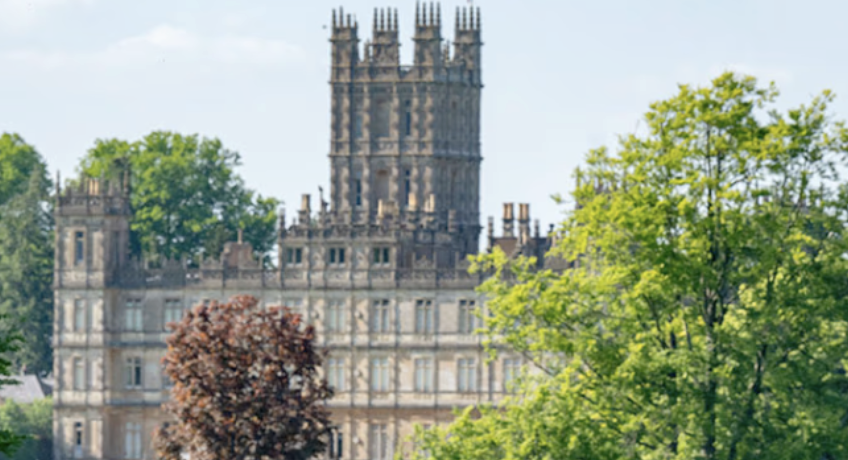
A certain dread flutters through the stomach at the prospect of the drama reaching its 55th and last chapter—“Downton Abbey: The Grand Finale,” the third theatrical release following 52 episodes of the 2010-15 TV series, which aired on PBS in the U.S. One hopes for an emphatic close, but not too emphatic; let’s not have the grand old estate get demolished, or invaded by aliens, or—I shudder to type the words—sold off to a bounder. The titular building (in reality, Highclere Castle in Hampshire, England) is by now a beloved star in its own right, and the prospect of it falling into the wrong hands, albeit fictitiously, is unbearable.
I shouldn’t have worried. The writer Mr. Fellowes and director Simon Curtis have constructed their valedictory with all due grace. The movie begins with an appropriately movie-ish tableau—a dazzling re-creation of Piccadilly Circus in 1930—but quickly settles into a comfy tale of social conflict: Lady Mary (Michelle Dockery) is getting divorced. This act is so deplorable that she gets thrown out of a fancy ball in London and invitees are no longer showing up to Downton dinners as expected.
Michelle Dockery Photo: Focus Features
Meanwhile, there’s a business visit from her mother’s brother from America, Harold Levinson (Paul Giamatti), who brings along his financial adviser and friend Gus (Alessandro Nivola). The family has suffered from the market crashes of the previous fall, but the two men assure Lord Grantham (Hugh Bonneville) and his wife, Cora (Elizabeth McGovern), that they will manage their way through the storm.
Handsome film star Guy Dexter (Dominic West), who in the previous film swept off with the house’s former servant Barrow (Robert James-Collier), returns to England, and this time he’s got another friend in tow: Noël Coward (Arty Froushan), the playwright and actor who in real life was one of the most beloved celebrities of the period. In Coward’s visit lies a potential rebuilding stratagem: With the downstairs folk spreading the news to servants from neighboring estates, word gets around that the stage superstar will be the guest of honor at dinner, and anyone who continues to ostracize Lady Mary socially will be missing out on a chance to bask in his glow. Suddenly the gentry decide they’re free that night after all.
Elizabeth McGovern and Laura Carmichael Photo: Focus Features
As usual, Mr. Fellowes is making a subtle point beneath the sly comedy: One kind of aristocracy is being supplanted by another, and no one wants to be left behind. He again gives his large and beloved cast of characters beautiful shadings and crisp dialogue that exactly suits each personality, not forgetting to allow the audience reasons to laugh or even cheer. I especially loved the archaic slang (“He’s made a complete bish of things”) and the unashamed patriotism that unites all classes (“I’m English and I thank God for it!” notes the retiring head butler, Jim Carter’s Mr. Carson).
Such a sentiment would not have been out of place in a work by Coward, whose love of country would today make him seem like an odd duck among the showbiz wits and cognoscenti. Fascinated by all of the drama in the house, the Coward here starts to dream up a play inspired by his chats with Lady Mary, and when someone mentions “private lives,” a twinkle appears in his eye.
Contrived? A bit, but winkingly so. Coward’s presence provides Mr. Fellowes with a pleasing tool with which to bring the series full circle, all the way back to the first episode, in which the sinking of the Titanic was a crucial plot point. When Coward muses aloud about building the seagoing disaster into his next piece—this would be the play and later Oscar-winning best picture of 1933, “Cavalcade”—the audience is reminded that noble families and their travails are woven into the historical fabric of England, and that there is a collective, never-ending urge to make sense of the present by freshening up stories from the past. If you emerge from this movie with a strong urge to rewatch the entire saga, you won’t be alone. Neither will those who emerge with tears of gratitude in their eyes.
Appeared in the September 12, 2025, print edition as ‘‘Downton’ Gets Its Denouement’.
 Lord Buckbeak: "Will you come into my parlor?," said the Spider to the Fly.
Leave a comment