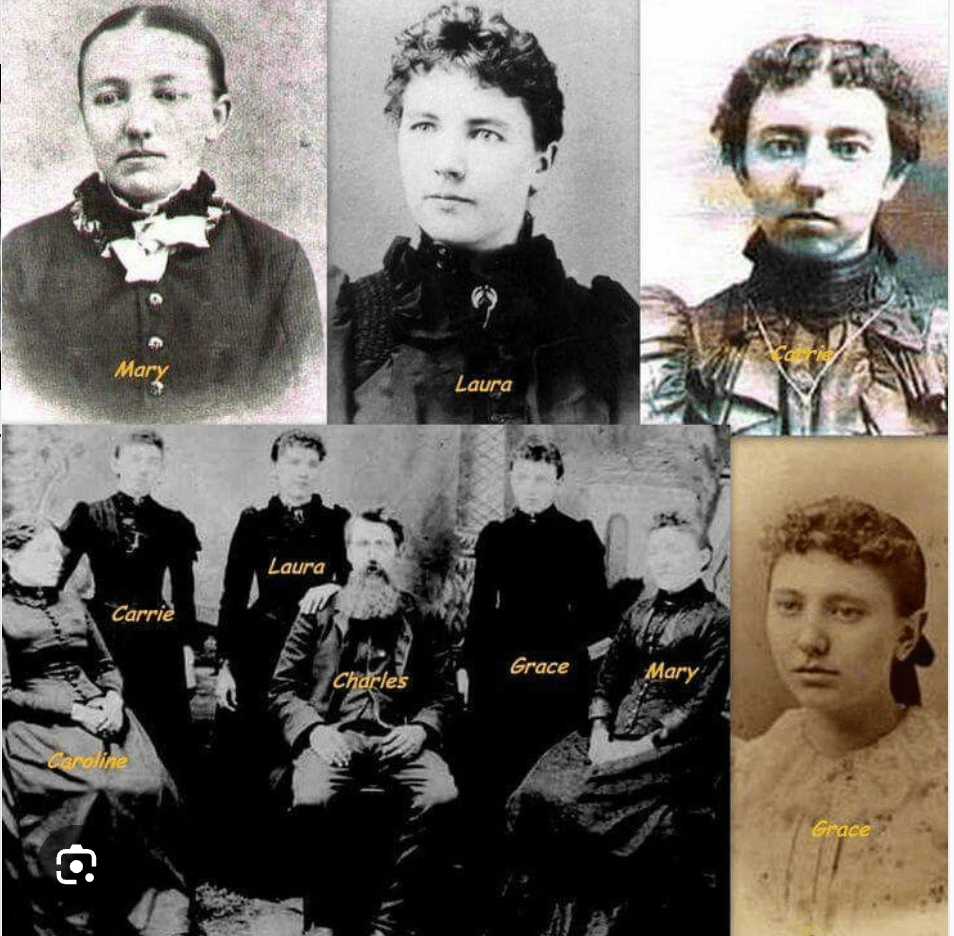
The first thing to know is that Laura Ingalls Wilder said and wrote very little about her Christian beliefs. She considered that a private matter and disliked people talking openly about their religious experiences.
Because Laura’s daughter Rose edited, sometimes a lot, her hand-written manuscripts before publishing it is unclear if this is Laura’s view of Sundays or more of Rose’s view of Sundays or a fictionalized version from both. (See note on factualness of the “Little House” books below **)
The following is an excerpt from the transcript of the Shaun Tabatt show where he interviews John Fry who has written a biography of Laura Ingalls Wilder’s religious life.
=====================================================
Today, my special guest is John Fry, and we’re going to be discussing his brand-new book A Prairie Faith: The Religious Life of Laura Ingalls Wilder. John, it is truly an honor, sir. Welcome to the show.
“… there’s other biographies that have addressed, her faith in, you know, in in the course of telling Laura Ingalls Wilder’s life. One of the best ones is by, a scholar named John Miller, who I actually got to know in the nineties. He’s a good friend. And, he sort of argues that, Laura was a very committed Christian. Christianity was very central to her life and worldview. But as I read, or as I read the Little House books, if you read the Little House books, not all the descriptions of the church in them are positive. Some of them have a real negative edge.
And that got me wondering what’s the best way of explaining this. The other layer in that is, that Laura Ingalls Wilder wrote handwritten manuscripts of each of these books and then handed them off to her daughter, Rose Wilder Lane, who typed them and edited them as, she went along. And they together actually created the books that got published. And at when they were writing them in the late twenties and early thirties, Rose was an agnostic. She had pretty much rejected, the organized church and Christianity, sort of had some cultural pulls towards Islam. Actually, she had traveled to the Middle East. And I thought, what’s really what’s the story? Who’s writing what in in these books? And I thought, maybe I can contribute to that by trying to tease that out.
Shaun Tabatt: And in terms of research, primary sources, historical sites, museums, what was some of the ground you traversed, so to speak, to get ready to write this book or in the midst of the writing process?
John Fry: Yep. Yeah. So, it’s interesting. So Laura Ingalls Wilder’s daughter, Rose, is a fascinating woman. She was a journalist and a writer in the early 20th century. Ended up writing a biography of Herbert Hoover at one point, one of Charles Lindbergh. So her papers are actually all at the Herbert Hoover Presidential Library, which is in Eastern Iowa. And as part of her papers is a bunch of correspondence between her and her mother, Laura Ingalls Wilder, as they were writing these books. And some, TypeScript drafts of the, of the Little House books and, some other materials from Laura.
===================================================
Laura Ingalls Wilder
Chapter 5.
SUNDAYS.
Now the winter seemed long. Laura and Mary began to be tired of staying always in the house. Especially on Sundays, the time went so slowly.
Every Sunday Mary and Laura were dressed from the skin out in their best clothes, with fresh ribbons in their hair. They were very clean, because they had their baths on Saturday night.
In the summer they were bathed in water from the spring. But in the wintertime Pa filled and heaped the washtub with clean snow, and on the cookstove it melted to water. Then close by the warm stove, behind a screen made of a blanket over two chairs, Ma bathed Laura, and then she bathed Mary.
Laura was bathed first, because she was littler than Mary. She had to go to bed early on Saturday nights, with Charlotte, because after she was bathed and put into her clean nightgown, Pa must empty the washtub and fill it with snow again for Mary’s bath. Then after Mary came to bed, Ma had her bath behind the blanket, and then Pa had his. And they were all clean, for Sunday.
On Sundays Mary and Laura must not run or shout or be noisy in their play. Mary could not sew on her nine-patch quilt, and Laura could not knit on the tiny mittens she was making for Baby Carrie. They might look quietly at their paper dolls, but they must not make anything new for them. They were not allowed to sew on doll clothes, not even with pins.
They must sit quietly and listen while Ma read Bible stories to them, or stories about lions and tigers and white bears from Pa’s big green book, The Wonders of the Animal World. They might look at pictures, and they might hold their rag dolls nicely and talk to them. But there was nothing else they could do.
Laura liked best to look at the pictures in the big Bible, with its paper covers. Best of all was the picture of Adam naming the animals.
Adam sat on a rock, and all the animals and birds, big and little, were gathered around him anxiously waiting to be told what kind of animals they were. Adam looked so comfortable. He did not have to be careful to keep his clothes clean, because he had no clothes on. He wore only a skin around his middle.
“Did Adam have good clothes to wear on Sundays?” Laura asked Ma.
“No,” Ma said. “Poor Adam, all he had to wear was skins.”
Laura did not pity Adam. She wished she had nothing to wear but skins.
One Sunday after supper she could not bear it any longer. She began to play with Jack, and in a few minutes she was running and shouting. Pa told her to sit in her chair and be quiet, but when Laura sat down she began to cry and kick the chair with her heels.
“I hate Sunday!” she said.
Pa put down his book. “Laura,” he said sternly, “come here.”
Her feet dragged as she went, because she knew she deserved a spanking. But when she reached Pa, he looked at her sorrowfully for a moment, and then took her on his knee and cuddled her against him. He held out his other arm to Mary, and said:
“I’m going to tell you a story about when Grandpa was a boy.”
The Story of Grandpa’s Sled and the Pig.
“WHEN your Grandpa was a boy, Laura, Sunday did not begin on Sunday morning, as it does now. It began at sundown on Saturday night. Then everyone stopped every kind of work or play.
“Supper was solemn. After supper, Grandpa’s father read aloud a chapter of the Bible, while everyone sat straight and still in his chair. Then they all knelt down, and their father said a long prayer. When he said, “Amen,” they got up from their knees and each took a candle and went to bed. They must go straight to bed, with no playing, laughing, or even talking.
“Sunday morning they ate a cold breakfast, because nothing could be cooked on Sunday. Then they all dressed in their best clothes and walked to church. They walked, because hitching up the horses was work, and no work could be done on Sunday.
“They must walk slowly and solemnly, looking straight ahead. They must not joke or laugh, or even smile. Grandpa and his two brothers walked ahead, and their father and mother walked behind them.
“In church, Grandpa and his brothers must sit perfectly still for two long hours and listen to the sermon. They dared not fidget on the hard bench. They dared not swing their feet. They dared not turn their heads to look at the windows or the walls or the ceiling of the church. They must sit perfectly motionless, and never for one instant take their eyes from the preacher.
“When church was over, they walked slowly home. They might talk on the way, but they must not talk loudly and they must never laugh or smile. At home they ate a cold dinner which had been cooked the day before. Then all the long afternoon they must sit in a row on a bench and study their catechism, until at last the sun went down and Sunday was over.
“Now Grandpa’s home was about halfway down the side of a steep hill. The road went from the top of the hill to the bottom, right past the front door, and in winter it was the best place for sliding downhill that you can possibly imagine.
“One week Grandpa and his two brothers, James and George, were making a new sled. They worked at it every minute of their playtime. It was the best sled they had ever made, and it was so long that all three of them could sit on it, one behind the other. They planned to finish it in time to slide downhill Saturday afternoon. For every Saturday afternoon they had two or three hours to play.
“But that week their father was cutting down trees in the Big Woods. He was working hard and he kept the boys working with him. They did all the morning chores by lantern-light and were hard at work in the woods when the sun came up. They worked till dark, and then there were the chores to do, and after supper they had to go to bed so they could get up early in the morning.
“They had no time to work on the sled until Saturday afternoon. Then they worked at it just as fast as they could, but they didn’t get it finished till just as the sun went down, Saturday night.
“After the sun went down, they could not slide downhill, not even once. That would be breaking the Sabbath. So they put the sled in the shed behind the house, to wait until Sunday was over.
“All the two long hours in church next day, while they kept their feet still and their eyes on the preacher, they were thinking about the sled. At home while they ate dinner they couldn’t think of anything else. After dinner their father sat down to read the Bible, and Grandpa and James and George sat as still as mice on their bench with their catechism. But they were thinking about the sled.
“The sun shone brightly and the snow was smooth and glittering on the road; they could see it through the window. It was a perfect day for sliding downhill. They looked at their catechism and they thought about the new sled, and it seemed that Sunday would never end.
“After a long time they heard a snore. They looked at their father, and they saw that his head had fallen against the back of his chair and he was fast asleep.
“Then James looked at George, and James got up from the bench and tiptoed out of the room through the back door. George looked at Grandpa and George tiptoed after James. And Grandpa looked fearfully at their father, but on tiptoe he followed George and left their father snoring.
“They took their new sled and went quietly up to the top of the hill. They meant to slide down, just once. Then they would put the sled away, and slip back to their bench and the catechism before their father woke up.
“James sat in front on the sled, then George, and then Grandpa, because he was the littlest. The sled started, at first slowly, then faster and faster. It was running, flying, down the long steep hill, but the boys dared not shout. They must slide silently past the house, without waking their father.
“There was no sound except the little whirr of the runners on the snow, and the wind rushing past.
“Then just as the sled was swooping toward the house, a big black pig stepped out of the woods. He walked into the middle of the road and stood there.
“The sled was going so fast it couldn’t be stopped. There wasn’t time to turn it. The sled went right under the hog and picked him up. With a squeal he sat down on James, and he kept on squealing, long and loud and shrill, ‘Squee-ee-ee-ee-ee! Squee-ee-ee-ee-ee-ee!’
“They flashed by the house, the pig sitting in front, then James, then George, then Grandpa, and they saw their father standing in the doorway looking at them. They couldn’t stop, they couldn’t hide, there was no time to say anything. Down the hill they went, the hog sitting on James and squealing all the way.
“At the bottom of the hill they stopped. The hog jumped off James and ran away into the woods, still squealing.
“The boys walked slowly and solemnly up the hill. They put the sled away. They sneaked into the house and slipped quietly to their places on the bench. Their father was reading his Bible. He looked up at them without saying a word.
“Then he went on reading, and they studied their catechism.
“But when the sun went down and the Sabbath day was over, their father took them out to the woodshed and tanned their jackets, first James, then George, then Grandpa.
“So you see, Laura and Mary,” Pa said, “you may find it hard to be good, but you should be glad that it isn’t as hard to be good now as it was when Grandpa was a boy.”
“Did little girls have to be as good as that?” Laura asked, and Ma said:
“It was harder for little girls. Because they had to behave like little ladies all the time, not only on Sundays. Little girls could never slide downhill, like boys. Little girls had to sit in the house and stitch on samplers.”
“Now run along and let Ma put you to bed,” said Pa, and he took his fiddle out of its box.
Laura and Mary lay in their trundle bed and listened to the Sunday hymns, for even the fiddle must not sing the week-day songs on Sundays.
“Rock of Ages, cleft for me,” Pa sang, with the fiddle. Then he sang:
“Shall I be carried to the skies,
On flowery beds of ease,
While others fought to win the prize,
And sailed through bloody seas?”
Laura began to float away on the music, and then she heard a clattering noise, and there was Ma by the stove, getting breakfast. It was Monday morning, and Sunday would not come again for a whole week.
=======================================================
Of all the Ten Commandments the fourth is the least understood. Sabbath keeping – and breaking – was a big part the Gospels’ telling of Christ’s ministry.
“Remember the Sabbath day by keeping it holy. Six days you shall labor and do all your work, but the seventh day is a sabbath to the Lord your God. On it you shall not do any work, neither you, nor your son or daughter, nor your male or female servant, nor your animals, nor any foreigner residing in your towns. For in six days the Lord made the heavens and the earth, the sea, and all that is in them, but he rested on the seventh day. Therefore the Lord blessed the Sabbath day and made it holy.” Ex 20:8-11
What is certain about the Sabbath is that it was created for man, not man for the Sabbath (Mark 2:27). So that should be our starting place when interpreting the meaning and purpose of the Fourth Commandment. We also can clearly understand that constant work, days on end, is not good for you. We also see that no labor at all is also not good for you. People need something productive to do. Watching video games or TV all day every day is destructive. You need one day, at least, in seven to recuperate and rest from your labors. As part of that day off from our normal labors we use some part of it to formally participate in corporate worship. Is this formal worship to be 12 hours, 8 hours, 4 hours, 2 hours or 1 hour?
As I have noted before, and this may be original with me (I’ve not seen it anywhere else – but it may be), that strictly speaking the Sabbath commandment also contains a positive duty: Six days you shall labor and do all your work. We know from the words of Jesus that a day contains 12 hours (John 11:9) and so a work week was to consist of six, 12-hour work days. Strict sabbatarians should therefore work six, 12-hour days. No weekends only a week end. Saturday (or Sunday) is just another work day and that “day” is 12 hours not 8.
What does “keep it holy” mean? Holy, Hebrew qodesh, is the word consecrate or separate. We separate this day from the rest of the week. We remember Yahweh (I am) as the creator of the heavens and the earth and as Israel’s Deliverer from bondage. The primary bondage of the Hebrews in Egypt was endless, hard labor and the oppression of foreign “gods”. As we have seen throughout the world where the Judeo-Christian ethic does not reign there is either endless labor or practically no productive labor. “A song of ascents. Of Solomon. Unless the LORD builds the house, its builders labor in vain; unless the LORD protects the city, its watchmen stand guard in vain.” (Psa 127:1)
Also as noted in Laura Ingall’s story above it is difficult to decide if the Sabbath allows any recreational activities or should it require only sitting still and being quiet, i.e., rest. I know from my family’s experience that once you start recreating on Sunday the whole day seems to get taken over, especially with youth sports or NFL games on TV. Finding the happy medium in everything is a lifelong pursuit.
========================================================
Is Little House in the Big Woods a true story? **
AI Overview
Little House in the Big Woods is not a strictly true story but an autobiographical novel based on Laura Ingalls Wilder’s childhood memories, incorporating both true elements of pioneer life and fictionalized or omitted details for narrative and child-friendly purposes. The book reflects her real family and experiences but simplifies complex or difficult parts of their lives, creating a story that is largely accurate but not a comprehensive historical record.
What is true:
- The book is based on the childhood of Laura Ingalls Wilder, the author.
- It accurately describes details of pioneer life in the 1870s and 1880s in Wisconsin.
- The family did live in a log cabin and faced challenges, though these are sometimes softened in the book.
What is not entirely true or is fictionalized:
- Omissions:Wilder omitted darker or more complex aspects of her family’s life, such as extreme poverty, debts, and the death of her younger brother.
- Age Discrepancy:In the book, Laura is 5 years old when her family lives in the woods; in reality, she was 3.
- Creative Liberties:To make the stories more engaging and appropriate for children, details were often changed or invented, sometimes with the help of her daughter, Rose Wilder Lane.
In summary:
While Little House in the Big Woods is an autobiographical account, the author took creative liberties to tell a compelling story. Her autobiography, Pioneer Girl, provides a more unfiltered account of her life.
=========================================================
Is ‘Little House on the Prairie’ a children’s classic or a libertarian primer?
By M. J. Andersen Globe Correspondent,January 29, 2017, 12:00 a.m. – Boston Globe

ONE WINTER maybe a dozen years ago, my aunt brought back some pineapples from Hawaii. One was intended for my parents, who lived in a small town an hour from her home in Brookings, S.D. But how to deliver it?
A few phone calls established that a couple from my parents’ town planned to attend a basketball game in Brookings and were willing transport the pineapple back home. My aunt delivered it to them in the stands, and later that night, my parents were awakened by a thud, then the sound of their front door closing. The next morning, a pineapple stood on their kitchen counter.
Brookings is a short drive from DeSmet, S.D., which proudly advertises itself as the onetime home of Laura Ingalls Wilder, author of the popular “Little House on the Prairie” series. Born 150 years ago on Feb. 7, Wilder would have recognized the neighborly impulse that carried a pineapple 60 miles across frozen fields.
Based on her family’s late-19th-century homesteading experiences, Wilder’s eight children’s books are stocked with examples of neighbor helping neighbor. A woman nurses the fictionalized Ingalls family through a severe illness; Pa Ingalls helps some passing cattle drivers move their herd; a bachelor acquaintance offers nails to aid construction of the family’s cabin.
Facing down blizzards, fires, wolves, and Indian war parties, the Ingallses came to symbolize American self-reliance. But if the lend-a-hand tradition remains alive in the rural Midwest, the ideal of self-sufficiency has taken a beating.
That’s partly because the subsistence farming of Wilder’s era has been replaced by large mechanized operations. In addition, an extensive subsidy system has developed to protect farmers from unpredictable weather and gyrating prices.
Still independent in spirit, the farmers I know frequently say they would prefer to take their chances on the free market. Some wryly describe their occupation as “farming the government.” In South Dakota, resentment of government handouts has always run deep.
If this heartland backlash sounds familiar, it should. The resourceful pioneer family of Wilder’s books has become the ur-myth among libertarians everywhere. They claim that ever since the New Deal, politics have corrupted this virtuous American fable.
New scholarship on Wilder tracks how her books may have been deliberately engineered to fuel the limited-government movement. In a just published work, “Libertarianism on the Prairie,” Christine Woodside fleshes out earlier arguments that Wilder’s only child, Rose Wilder Lane, edited the Little House series to reflect her own political leanings.
Lane was an established writer who served as editor and agent on the books, though for years she kept her role largely hidden. She had grown up humiliated by the poverty on her parents’ farm, and left home at an early age. Making her way to San Francisco, she found work as a journalist, married, and divorced. She traveled abroad and sampled life in New York before rejoining her parents in 1928, on what turned into a years-long stay.
Despite their fruitful collaboration on the books, the mother-daughter relationship was often tense. Lane’s private writings complain of a lack of maternal love.
As the Depression unfolded, her politics turned sharply rightward. Along with Ayn Rand and Isabel Patterson, she is considered one of the “founding mothers” of libertarianism. In letters, Rand and Lane quarreled over the desirability of neighbor helping neighbor. Rand thought mutual aid was for weaklings. Lane regarded community support as positive.
Lane’s views fully flowered in her 1943 tract, “The Discovery of Freedom: Man’s Struggle Against Authority,” which became a staple of the libertarian movement. She used royalties from the Little House books to support a “Freedom School,” established in the 1950s near Colorado Springs. Among those attending were Charles and David Koch. At her death, in 1968, Lane directed future royalties to her protege, Roger Lea MacBride — the Libertarian Party candidate for president in 1976.
Lane’s libertarian proclamations may help explain why the Little House books have been enlisted repeatedly in the conservative cause. Meghan Clyne argued in the conservative publication National Affairs that Wilder is a role model whose books illustrate the worth of self-reliance. She called for building a historical-appreciation movement around them, to counter what she sees as a growing dependence on government.
But while the Little House vision of the past may appeal to libertarians, the reality of pioneer life muddies the picture. Like so many settlers, the Ingalls family obtained free land under the 1862 Homestead Act. Their failed attempts at farming kept them moving from place to place.
Moreover, Wilder’s seeming indifference to the expulsion of Native Americans from the land can inspire a distinct chill. The cabin memorialized in “Little House on the Prairie” was erected illegally on land set aside for the Osage tribe. The Ingallses were eventually forced to abandon it.
While some have tried to claim the books as conservative propaganda, others have seen a subtler process at work. A 2008 book by Anita Clair Fellman, “Little House, Long Shadow: Laura Ingalls Wilder’s Impact on American Culture,” suggests that the books subconsciously influence Americans to be more receptive to conservative principles, such as resisting federal regulation.
As a loving family that overcame tremendous odds to survive in the wilderness, the Ingallses are not just quintessential American heroes. They are the epitome of American longing — possibly the perfect poster family for today’s values voters. No surprise, then, that Ronald Reagan reportedly called the 1970s TV series based on the Little House books his favorite show.
A century and a half after Laura Ingalls’s birth, South Dakota children are still schooled in the genuinely grim hardships of early settlement days. But, unlike in my childhood, they also learn about the cruel losses dealt to native tribes.
Although Wilder’s books continue to enchant, most readers realize that there’s no going back to the frontier. Many also realize that self-reliance, however desirable, may be a stretch. Global economic forces can defeat the most determined self-made individual, as the 2008 financial crisis painfully illustrated.
Rose Wilder Lane clung to her libertarian views to the end, taking her self-sufficient stance on a few acres in Danbury, Conn., and scheming to avoid taxation. Her feelings of deprivation growing up may have driven her politics. But they may also have been the vital sauce that brought a cherished set of children’s classics to life. Somehow, they merged with her mother’s stories, leaving a small house that continues to loom large in the American imagination.
M.J. Andersen is a former editorial-page writer for The Providence Journal and the author of the memoir “Portable Prairie: Confessions of an Unsettled Midwesterner.”
 Lord Buckbeak: "Will you come into my parlor?," said the Spider to the Fly.
Leave a comment