
Read how each of the apostles spread out to minister and evangelize and how many of the apostles died for their faith.
Ken Curtis, Ph.D. | Updated Dec 10, 2024 – Christianity.com
The Bible teaches that the original 12 disciples of Jesus Christ were Peter, Andrew, John, James, the son of Zebedee, Philip, Bartholomew, Thomas, Matthew, James the son of Alphaeus, Thaddaeus, Simon the Zealot, and Judas Iscariot. Judas betrayed Jesus initiating his arrest and journey to be crucified on the cross. Judas was replaced by Matthias.
The Original 12 Apostles
“The names of the [original] twelve apostles are these: first, Simon, who is called Peter, and Andrew his brother; James the son of Zebedee, and John his brother; Philip and Bartholomew; Thomas and Matthew the tax collector; James the son of Alphaeus, and Thaddaeus; Simon the Cananaean, and Judas Iscariot, who betrayed him.” (Matthew 10:2-4)
Matthias Replaces Judas
So one of the men who have accompanied us during all the time that the Lord Jesus went in and out among us, beginning from the baptism of John until the day when he was taken up from us—one of these men must become with us a witness to his resurrection.” And they put forward two, Joseph called Barsabbas, who was also called Justus, and Matthias. And they prayed and said, “You, Lord, who know the hearts of all, show which one of these two you have chosen to take the place in this ministry and apostleship from which Judas turned aside to go to his own place.” And they cast lots for them, and the lot fell on Matthias, and he was numbered with the eleven apostles. (Acts 1:21-26)
The apostles were not the kind of group you might have expected Jesus to send forth on his mission to reach the world. There was nothing incredibly unique or spectacular about them. The twelve apostles were just ordinary working men. But Jesus formed them into the backbone of the church and gave them the most extraordinary task imaginable: calling the entire world, including the mightiest empire ever known, to repentance and faith in the risen Christ. You can be sure that any educated, first-century Roman citizen would have laughed at any prediction that, within three centuries, the Christian faith would be the official faith of the empire.
The Dispersion of the 12 Apostles
Here are the respective missionary locations for the Apostles as found in Book 3 of the Church History of Eusebius:
Meanwhile the holy apostles and disciples of our Saviour were dispersed throughout the world. Parthia, according to tradition, was allotted to Thomas as his field of labor, Scythia to Andrew, and Asia to John, who, after he had lived some time there, died at Ephesus. Peter appears to have preached in Pontus, Galatia, Bithynia, Cappadocia, and Asia to the Jews of the dispersion. And at last, having come to Rome, he was crucified head-downwards; for he had requested that he might suffer in this way. What do we need to say concerning Paul, who preached the Gospel of Christ from Jerusalem to Illyricum, and afterwards suffered martyrdom in Rome under Nero? These facts are related by Origen in the third volume of his Commentary on Genesis.
Many wonder how the 12 apostles died, but The New Testament tells of the fate of only two of the apostles: Judas, who betrayed Jesus and then went out and hanged himself, and James, the son of Zebedee, who was executed by Herod about 44 AD (Acts 12:2). Read how each of the apostles spread out to minister and evangelize and how many of the apostles died for their faith.
How Did the 12 Apostles Die?
Reports and legends abound, and they are not always reliable, but it is safe to say that the apostles went far and wide as heralds of the message of the risen Christ. An early legend says they cast lots and divided up the world to determine who would go where so all could hear about Jesus. They suffered greatly for their faith and, in most cases, met violent deaths because of their bold witness and faith in Christ.
Peter and Paul
Both were martyred in Rome about 66 AD, during the persecution under Emperor Nero. Paul was beheaded. Peter was crucified upside down at his request since he did not feel worthy to die in the same manner as his Lord.
Andrew
He went to the “land of the man-eaters” in what is now the Soviet Union. Christians there claim him as the first to bring the gospel to their land. He also preached in Asia Minor, modern-day Turkey, and Greece, where he is said to have been crucified.
Thomas
He was probably most active in the area east of Syria. Tradition has him preaching as far east as India, where the ancient Marthoma Christians revere him as their founder. They claim that he died there when pierced through with the spears of four soldiers.
Philip
He possibly had a powerful ministry in Carthage in North Africa and Asia Minor, where he converted the wife of a Roman proconsul. In retaliation, the proconsul had Philip arrested and cruelly put to death.
Matthew
He was the tax collector, and writer of a Gospel ministered in Persia and Ethiopia. Some of the oldest reports say he was not martyred, while others say he was stabbed to death in Ethiopia.
Bartholomew
He had widespread missionary travels attributed to him by tradition: to India with Thomas and back to Armenia, Ethiopia, and Southern Arabia. There are various accounts of how he met his death as a martyr for the gospel.
James
He was the son of Alpheus and is one of at least three James referred to in the New Testament. There is some confusion as to which is which, but this James is reckoned to have ministered in Syria. The Jewish historian Josephus reported that he was stoned and then clubbed to death.
Simon, the Zealot
As the story goes, he ministered in Persia and was killed after refusing to sacrifice to the sun god.
Matthias
He was the apostle chosen to replace Judas. Tradition sends him to Syria with Andrew and to death by burning.
John
The only one of the apostles generally thought to have died a natural death from old age. He was the church leader in the Ephesus area and is said to have taken care of Mary the mother of Jesus in his home. During Domitian’s persecution in the middle ’90s, he was exiled to the island of Patmos. There he is credited with writing the last book of the New Testament–the Revelation. An early Latin tradition has him escaping unhurt after being cast into boiling oil in Rome.
Influence of the 12 Apostles Today
The names of Jesus’ apostles have become the most common names for males in the Western world. How many do you know who are named John, Pete, Tom, Andy, Jim, Bart, or Phil?
At least four of the apostles were fishermen. Can this be part of why one of the earliest and most prominent Christian symbols was the fish? The Greek word for fish, ichthus, formed an acrostic: Iesous Christos Theou Uios Soter, which means “Jesus Christ, Son of God, Savior.”
After the death of the apostles, we do not find significant missionary figures of the stature of Paul. Yet the faith continued to spread like wildfire, even though Christianity was declared illegal until the 4th century under Emperor Constantine.
======================================================
HOW THE APOSTLES DIED
September 8, 2021 – Amos Osei Kofi’s Post – Facebook page
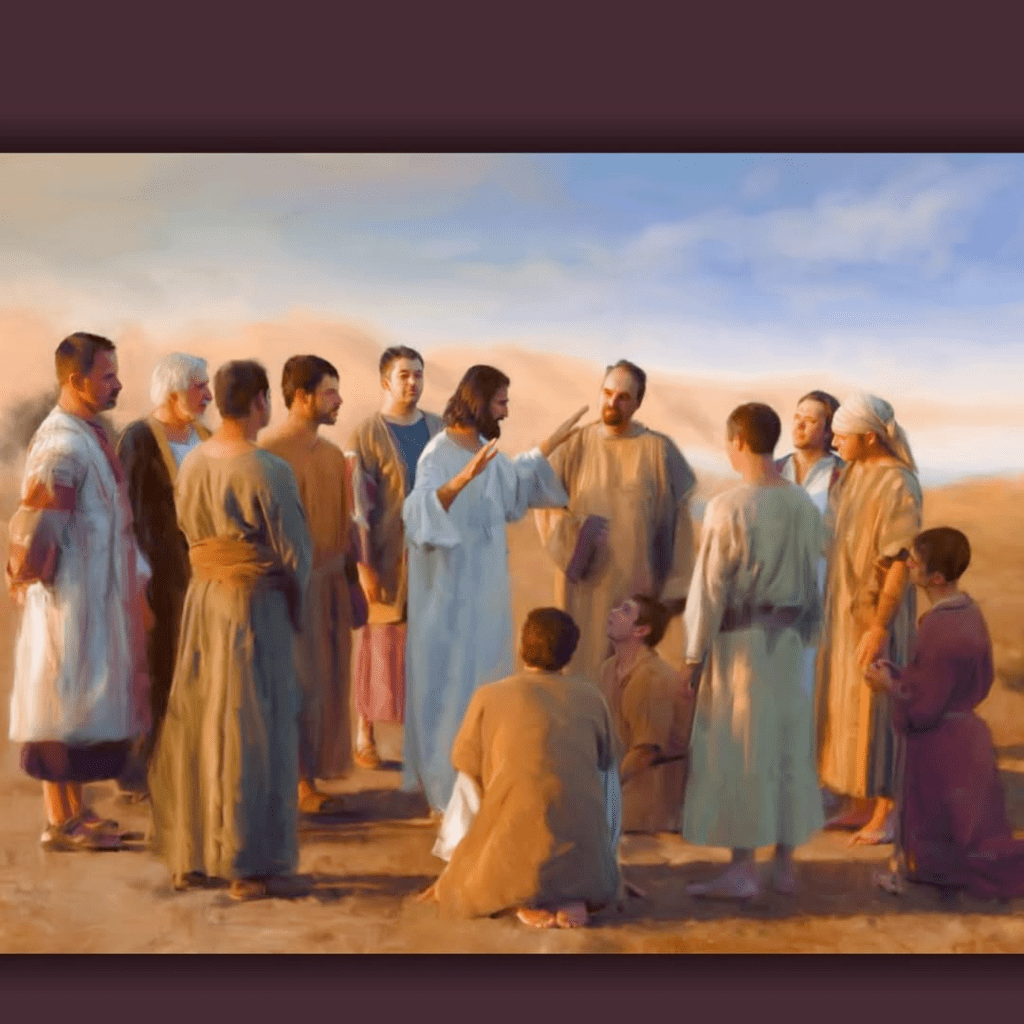
1. Matthew. Suffered martyrdom in Ethiopia, Killed by a sword wound.
2. Mark. Died in Alexandria, Egypt , after being dragged by Horses through the streets until he was dead.
3. Luke. Was hanged in Greece as a result of his tremendous Preaching to the lost.
4. John. Faced martyrdom when he was boiled in huge Basin of boiling oil during a wave of persecution In Rome. However, he was miraculously delivered From death.
John was then sentenced to the mines on the prison Island of Patmos. He wrote his prophetic Book of Revelation on Patmos . The apostle John was later freed and returned to serve As Bishop of Edessa in modern Turkey . He died as an old man, the only apostle to die peacefully
5. Peter. He was crucified upside down on an x shaped cross. According to church tradition it was because he told his tormentors that he felt unworthy to die In the same way that Jesus Christ had died.
6. James. The leader of the church in Jerusalem , was thrown over a hundred feet down from the southeast pinnacle of the Temple when he refused to deny his faith in Christ. When they discovered that he survived the fall, his enemies beat James to death with a fuller’s club.
This was the same pinnacle where Satan had taken Jesus during the Temptation.
7. James the Son of Zebedee was a fisherman by trade when Jesus Called him to a lifetime of ministry.
As a strong leader of the church, James was beheaded at Jerusalem. The Roman officer who guarded James watched amazed as James defended his faith at his trial.
Later, the officer Walked beside James to the place of execution. Overcome by conviction, he declared his new faith to the judge and Knelt beside James to accept beheading as a Christian.
8. Bartholomew. Also known as Nathaniel. He Was a missionary to Asia. He witnessed for our Lord in present day Turkey. Bartholomew was martyred for his preaching in Armenia where he was flayed to death by a whip.
9. Andrew. He Was crucified on an x-shaped cross in Patras, Greece. After being whipped severely by seven soldiers they tied his body to the cross with cords to prolong his agony.
His followers reported that, when he was led toward the cross, Andrew saluted it in these words, “I have long desired and expected this happy hour. The cross has been consecrated by the body of Christ hanging on it”. He continued to preach to his tormentors For two days until he expired.
10. Thomas. He Was stabbed with a spear in India during one of his missionary trips to establish the church in the Subcontinent.
11. Jude. He Was killed with arrows when he refused to deny his faith in Christ.
12. Matthias. The apostle chosen to replace the traitor Judas Iscariot. He was stoned and then beheaded.
13. Paul. He Was tortured and then beheaded by the evil Emperor Nero at Rome in A.D. 67. Paul endured a lengthy imprisonment, which allowed him to write his many epistles to the churches he had formed throughout the Roman Empire. These letters, which taught many of the foundational Doctrines of Christianity, form a large portion of the New Testament.
 Lord Buckbeak: "Will you come into my parlor?," said the Spider to the Fly.
Leave a comment