Natalia Alamdari – Flatwater Free Press – Lincoln Journal Star
My cmnt: My wife and I have sponsored four or five children through Children International for over 40 years. These children have all resided in the Philippines. Through ours (and many others’) sponsorships these children have an opportunity to go to school, get a good education, and become self-sustaining citizens. It would not surprise me at all if some of these teachers went through that program as children.
My cmnt: This type of sad story is repeated over and over again. Democrats cause a problem. In this case making the children of illegal immigrants or temporary workers automatic U.S. citizens because they are born here. I worked with a person from Schuyler for many years. He stated how the town’s schools had become completely overrun with Spanish language speaking children with little command of English. Most teachers and most students graduating from Teachers colleges in Nebraska and surrounding states don’t speak and are certainly not fluent in Spanish. When you bring in illiterate people who produce illiterate children who do not assimilate, do not learn English, and tend to cause crime issues the native white population eventually leaves. Discipline problems in the classroom abound. Word gets around and newly graduating teachers stay away.
My cmnt: The reason Schuyler is overrun with illegal immigrants and those with temporary worker permits is because the greedy owners of the massive meat packing/processing plants in Schuyler demand them. If they were required to pay a decent wage and provide decent working conditions Americans would do these jobs. As it is they import cheap labor and ruin whole communities.
My cmnt: Because of the Philippines’ Spanish colonial heritage upwards to one million Filipinos speak Spanish and hence bringing them to U.S. schools with a high percentage of Spanish language speakers makes a lot of sense. However a better solution would be to send illegal immigrants and their children back to their countries of origin and do the same with those on temporary workers’ visas before their children start kindergarten.
My cmnt: The second big issue causing teacher shortages is how the democrats have ruined public education in much of the country. In Catholic and other private schools students wear uniforms, are taught about the Christian religion, and are expected to behave in acceptable ways conducive to allowing all the students an opportunity to learn and to feel safe. Libness hates all of that and so creates classroom environments that other students and their parents find unacceptable. I come from a family of public school teachers and they will all tell you that over the past 40 years the democrats have made the publics schools poor places to get a good education. As more stupid and foolish democrat policies are implemented the sooner older teachers retire and new teachers look for another profession.
SCHUYLER — In a classroom 7,903 miles from home, Dorina Ramos counts down from five.
It’s a new strategy for Ramos, a classroom management tactic she picked up after arriving in Schuyler.
“They know that after that time, if they are still misbehaving, they will be reported to the office,” the 37-year-old teacher said in clear and practiced English.
Nine months ago, Ramos and 12 other teachers left their lives in the Philippines to teach at Schuyler Community Schools, joining the growing number of Filipino teachers across the state.
In Nebraska, vacant teacher jobs are still three times as high as they were the year before the COVID-19 pandemic. More teachers than ever are leaving the profession, administrators said, and not enough new teachers are entering it.
My cmnt: Another stupid and unnecessary democrat problem. Because democrats demagogued Covid-19 and scared the hell out of teachers (mostly democrat voters) by telling them they were “all gonna die” primary school teachers (mostly women) are still scared of children giving them Covid and killing them. Hence, because of these two lies, we have a shortage of primary school teachers.

Dorina Ramos passes out a worksheet while teaching a lesson in a physical science class in Schuyler. A group of teachers from the Philippines moved to Schuyler this year to teach under H-1B visas. Rebecca S. Gratz, for the Flatwater Free Press
Colleges and the state have pursued long-term attempts to fix the teacher pipeline. But in the short term, schools have started to look internationally. At least eight Nebraska school districts — many of them rural — have hired from the Philippines. More still are considering it.
“We knew that (the) teacher shortage was coming … so we wanted to give it a shot. Which, thank God we did, because without those staff, all those positions would have been vacant,” said Kevin Mills, director of human resources for North Platte Public Schools.
But challenges arise when hiring internationally, said Tim Royers, president of the Nebraska State Education Association, the union representing teachers.
“If you’re turning to a solution because you can’t find anybody else — whether that’s an international teacher, whether that’s an alternative certification pathway — if you’re turning to that solution in desperation, you’re making the wrong move period,” Royers said.
***
Blocks away from the high school where Ramos teaches, Rona Cariit walks between the desks of her brood of second graders. She compliments their handwriting, makes sure their letters stay between the lines.
Principals at Schuyler Community Schools had been getting applicants from the Philippines for years, said Alicia Keairnes, assistant principal at the elementary school. But they’d pretty much ignored them.
Now, international applications are about all they see, she said.

Rona Cariit (left) helps Erika Millan, 7, with a worksheet while teaching second grade at Schuyler Elementary School. She is one of 13 teachers hired from the Philippines by the district. A number of Nebraska school districts have looked overseas to find new teachers. Rebecca S. Gratz, for the Flatwater Free Press
Last school year, nearly 50 teachers left the district, a mix of early retirements and resignations. The turnover was double what the district saw the year before.
It was time to consider those international applications.
“We got to the point where we had to fill the classrooms, and there just were not enough teachers,” said Bill Comley, head principal at the elementary school.
No one tracks how many Nebraska districts have hired abroad. But the Flatwater Free Press found such districts in suburban Omaha, and northeast Nebraska cities like Columbus and Schuyler. Tiny Loup County in the Sandhills hired an English teacher. North Platte to the west brought in six new teachers. Walthill on the Omaha reservation hired a music teacher. In total, at least eight districts have hired teachers from the Philippines.
The two countries have similar curriculums and grading systems, and similar school calendars, making teachers from the Philippines a good fit for schools in the U.S.

Dorina Ramos earned a bachelor’s degree in physics and a master’s in teaching in the Philippines. She came to Nebraska to teach at Schuyler Community Schools for the 2024-25 school year. She and other Filipino teachers say they plan to stay in the district for the coming school year. Rebecca S. Gratz, for the Flatwater Free Press
Schuyler’s international teachers are hired on H-1B visas, which offer a path to a green card and let teachers bring their families to Nebraska. The teachers are paid the same salary as their American counterparts, and are represented by the teachers union.
“Our hope was not to bring them here on a business transaction,” Comley said. “Our job is to actually hope they want to stay and be a part of the community.”
***
School districts used to get dozens — sometimes hundreds — of applicants for teaching jobs, said Bret Schroder, the superintendent in Schuyler. Now, it’s common to get one or two applicants.
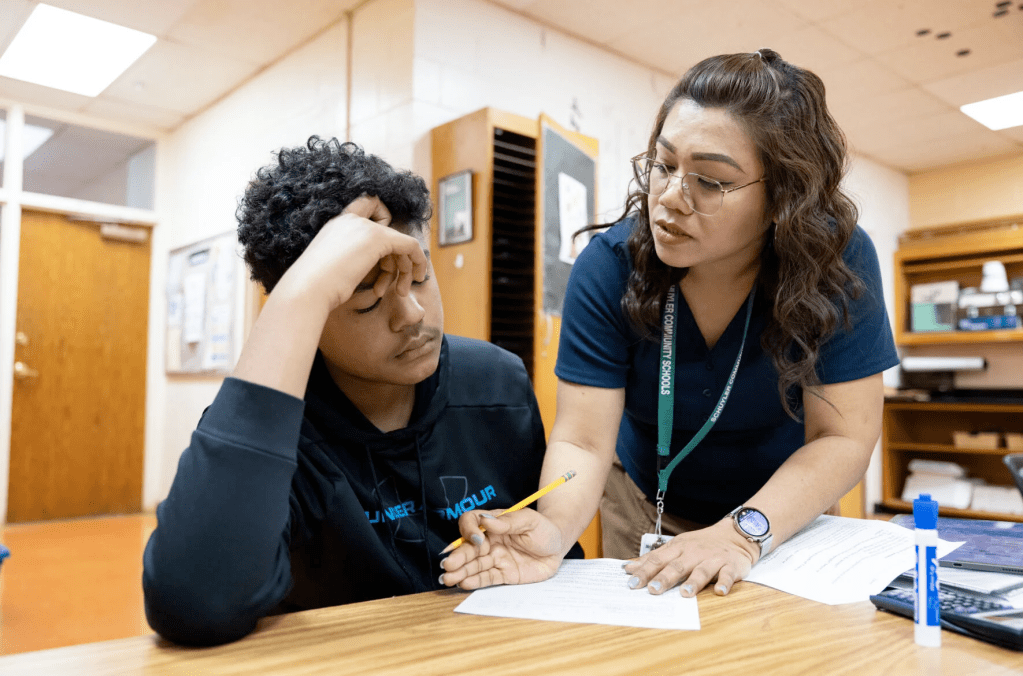
Dorina Ramos (right) helps freshman Cesar Nava, 15, with a worksheet in a physical science class in Schuyler. Schuyler Community Schools hired Ramos and 12 other Filipino teachers for the 2024-25 school year. While the district would prefer to hire locally, the international hires have helped ease the teacher shortage following a large number of departures. Rebecca S. Gratz, for the Flatwater Free Press
In 2023, unfilled teaching jobs in the state peaked at 908, according to the Nebraska Department of Education’s annual vacancy survey. Of those 908 unfilled jobs, 361 were left empty.
That number has gone down a bit, but it’s still higher than the years before the COVID-19 pandemic.
Fewer people are entering the profession. In 2012, 1,804 people completed teacher prep programs at Nebraska colleges. That dropped to 1,366 people in 2022.
More teachers are also leaving the job early. Nebraska had 461 fewer full-time teachers in 2023 compared to 2012, according to state Department of Education data.
Teachers are citing extreme burnout and are struggling with student behavior, according to teachers union surveys.
“It’s almost like this death spiral,” Royers said of the turnover. “You have this burnout, people are leaving the profession. They can’t fill the positions. That leads to higher class sizes, higher case loads. More folks get burnt out, more folks walk away.”
And, he said, hiring internationally isn’t helping.
“To hire folks from another country to do those roles that they can’t fill because they’re not electing to adopt policies that their teachers are asking for, makes (teachers) feel even more unwanted,” Royers said.
Schroder said he would love to hire teachers from Nebraska and surrounding states. But the shortage of applicants has forced districts to find solutions now.

Rona Cariit teaches second grade at Schuyler Elementary School. The U.S. and Filipino education systems share many similarities, but there also are some glaring differences, Cariit noted. Rebecca S. Gratz, for the Flatwater Free Press
“I want to see more young people go into teaching. And having teachers stay in the profession longer would be a positive step … but that doesn’t address the need right now of not having enough teachers to fill classrooms across not only our state, but our country,” he said.
***
Ramos stepped off the plane in Omaha with two other teachers she’d never met before. She had been traveling for 24 hours, after leaving behind her husband and two daughters.
With 16 years of teaching experience, she’d interviewed with schools in North Carolina, Texas and Alaska before accepting the job in Schuyler. She’d even taken out a loan to cover the nearly $10,000 that went to the recruiting company, her plane ticket and passport processing fees.
But it was OK, she said. In the Philippines, saying you’ve worked in the U.S. is a big deal. She wanted to learn more about teaching and technology and western culture. And she could make more money in Nebraska than she ever could in the Philippines.
Teaching was a childhood dream for Ramos, inspired by the teachers she had growing up. In college, she majored in physics, then got her master’s in teaching.
She traveled to Schuyler from Batangas, a city of about 350,000 people, where agriculture drives the economy.
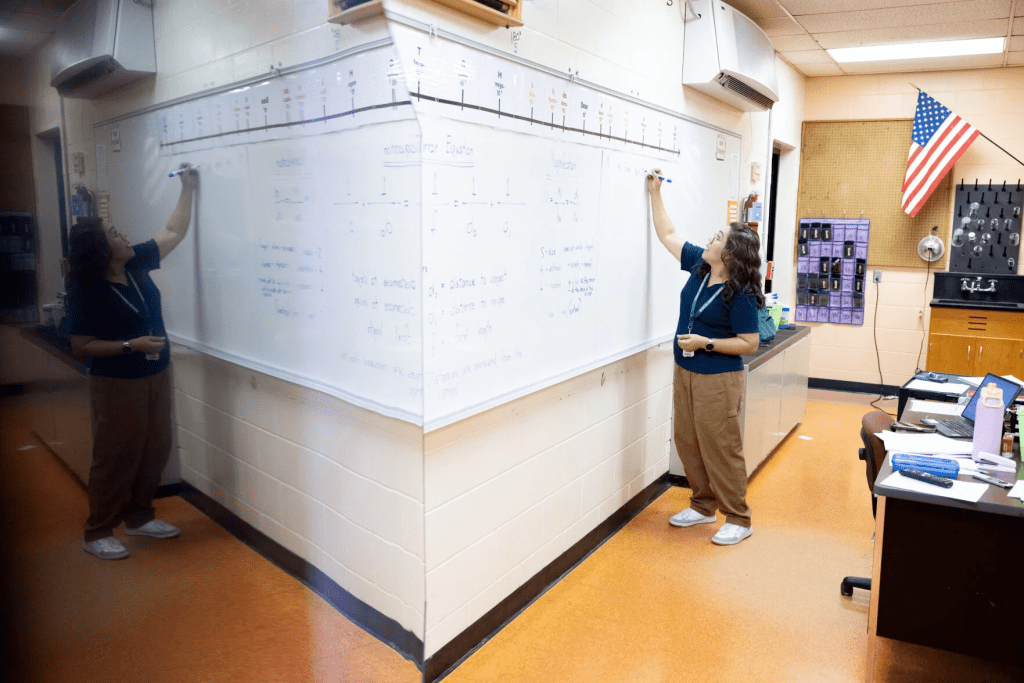
Dorina Ramos left her family and life in the Philippines to teach at Schuyler Community Schools. Nebraska’s teacher shortage has forced some districts to widen their search beyond the U.S. Rebecca S. Gratz, for the Flatwater Free Press
Before Ramos and the other teachers even got to Nebraska, Comley and Keairnes were lining up rental houses and furniture for them.
Once the teachers arrived, the pair of principals helped them set up bank accounts and cell phones, and get Social Security numbers. They found someone local who could teach them to drive. For months, Comley and Keairnes gave teachers rides to school.
“We have to get them on their feet so that they feel like they are supported and confident that their living situation, their basic needs are met first,” Keairnes said. “Because we can’t expect them to take care of 20 kids in a classroom when their own basic needs aren’t met.”
Teaching in America comes with a mental toll. Many teachers had to cancel plans to visit home after President Donald Trump took office and started making sweeping immigration changes. They were scared that they’d have visa issues when returning to the States.
My cmnt: This stupid little dig at our wonderful President Trump, especially after the braindead zombie pseudo-president Joe Biden, is unnecessary. President Trump welcomes immigrants from other countries who want to pursue the American Dream, work jobs, take care of themselves, stay out of criminal trouble, assimilate, know English and contribute to society in positive ways. These Filipino teachers fit that bill perfectly.
There are similarities between the two education systems that make it easier for Filipino teachers to get certified here. But there are key classroom differences, too. In the Philippines, yelling at students is acceptable, Cariit said. Students in the Philippines give their teachers gifts every holiday, and all say good morning when they enter the classroom each day. Ramos’s high schoolers roll in sleepy and quiet.
In the past year, administrators have watched their teachers grow more confident in managing student behavior, as well as in their English and pronunciation, Comley said. The first couple of months were difficult, Ramos said, but she feels more capable in her classroom — and ready for a second school year.
All 13 of the teachers from the Philippines plan to return to Schuyler for a second school year. Six more will join them.
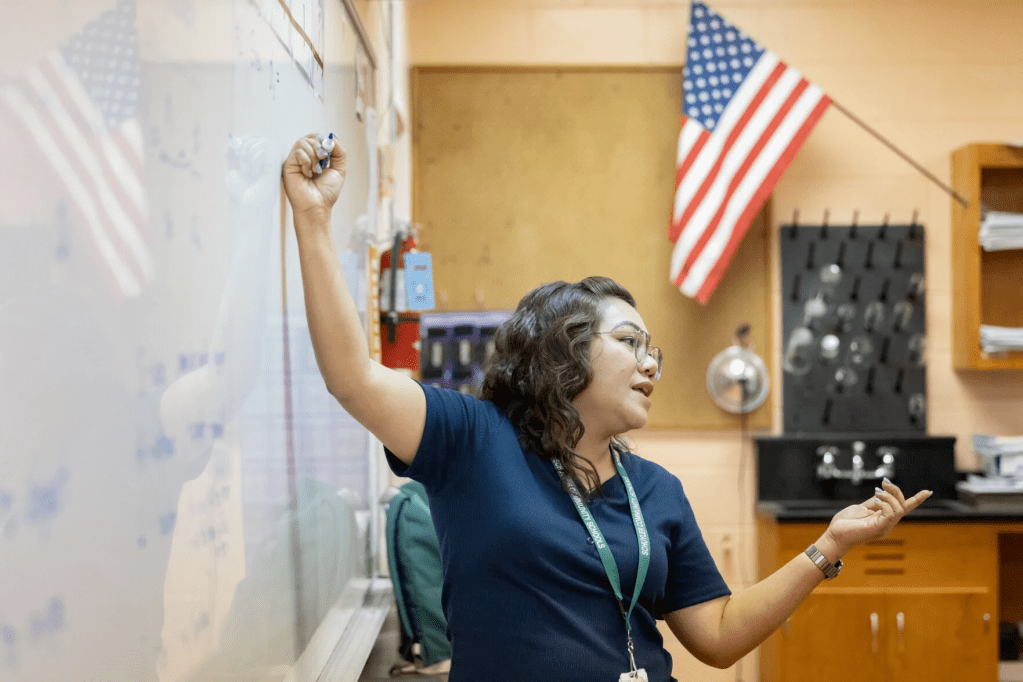
Dorina Ramos earned a bachelor’s degree in physics and a master’s in teaching in the Philippines. She came to Nebraska to teach at Schuyler Community Schools for the 2024-25 school year. She and other Filipino teachers say they plan to stay in the district for the coming school year. Rebecca S. Gratz, for the Flatwater Free Press
“These are folks who are well-trained educators with master’s degrees and doctorates and years of experience,” Schroder said. “They may be bringing skills and strengths and approaches to teaching that we haven’t looked at yet. So what can we learn from them?”
The Flatwater Free Press is Nebraska’s first independent, nonprofit newsroom focused on investigations and feature stories that matter.
 Lord Buckbeak: "Will you come into my parlor?," said the Spider to the Fly.
Leave a comment