“American students will be better off without.”
By Mairead Elordi – Feb 6, 2025 DailyWire.com

Betsy DeVos, who served as Secretary of Education during President Donald Trump’s first term, is calling for her former workplace to be shuttered.
Trump is reportedly preparing to sign an executive order that would gut the Education Department’s core functions, as well as call on Congress to work on eliminating it altogether. The department has already placed dozens of staffers on leave.
In an op-ed published Thursday by The Free Press, DeVos acknowledged that the idea may sound “a bit radical.”
“But having spent four years on the inside as secretary of education, struggling to get the department’s bureaucracy to make even the smallest changes to put the needs of students first, I can say conclusively that American students will be better off without,” she wrote.
She noted that the latest Nation’s Report Card, which came out last week, shows students even further behind in reading and math than they were in 2019.
About seven in 10 fourth-graders do not read at grade level, and six in 10 fourth-graders are behind in math, the data show.
Also, the gaps between the highest and lowest performing students are “as wide as they have ever been, and by many measures, even wider,” DeVos said. The lowest performing fourth- and eighth-graders’ scores sank in 2022 and even further last year.
DeVos also pointed out that the Education Department does not actually do much educating.
“Nothing could be more important to our success as a nation than having well-educated citizens,” she said. “But don’t be fooled by the name: the Department of Education has almost nothing to do with actually educating anyone.”
The department does not run any schools or set curricula, and in most states, it makes up a small percentage of K-12 public school funding.
“So what does it do? It shuffles money around; adds unnecessary requirements and political agendas via its grants; and then passes the buck when it comes time to assess if any of that adds value,” DeVos said.
“The only certain benefactor of the DOE’s existence is its patron saint: the teachers unions,” she added.
During the Biden administration, the department focused on canceling student loans, reinterpreted Title IX to favor trans-identifying males, and caused delays in aid for families when it tried to simplify the Free Application for Federal Student Aid (FAFSA) form, DeVos said.
She recommended the department send education funding straight to states and schools as a block grant, let the Justice Department enforce civil rights law, and give the student loan program to financial institutions rather than education bureaucrats.
“While it is true that no federal agency has ever seen its doors closed, there must be a first for everything. On the merits, the Department of Education has earned such a historic distinction,” she said.
===============================================================
Betsy DeVos: Shut Down the Department of Education

I served as the 11th U.S. secretary of education. That’s how I know it’s beyond repair.
By Betsy DeVos – 02.06.25 — U.S. Politics – The Free Press
Since its creation in 1979, the Department of Education has sent well more than $1 trillion to schools with the express purpose of closing the gaps between the highest and lowest performers. Today, those gaps are as wide as they have ever been, and by many measures, even wider.
Last week, the latest Nation’s Report Card came out, giving us a clear assessment of where student achievement stands. The report, published by the National Assessment of Educational Progress (NAEP), tells us that in reading and math, most students were even further behind than they were in 2022. Which was worse than where they were in 2019. Which was worse than 2013.
How bad is it? Seven in 10 American fourth graders are not proficient readers, meaning they struggle with reading grade-level literature and comprehending informational texts. Forty percent graded out at “below basic,” meaning they struggle with basic comprehension. In math, the picture is similar: six in 10 fourth graders are behind in math.
The gap between the highest and lowest performers has grown by 10 percent since 2019. Don’t be fooled into believing this is a Covid-19 by-product. The lowest performing eighth-grade readers are significantly worse off than their peers were in 1992, the first year the NAEP was administered. In fact, their scores this year are the lowest in recorded history:
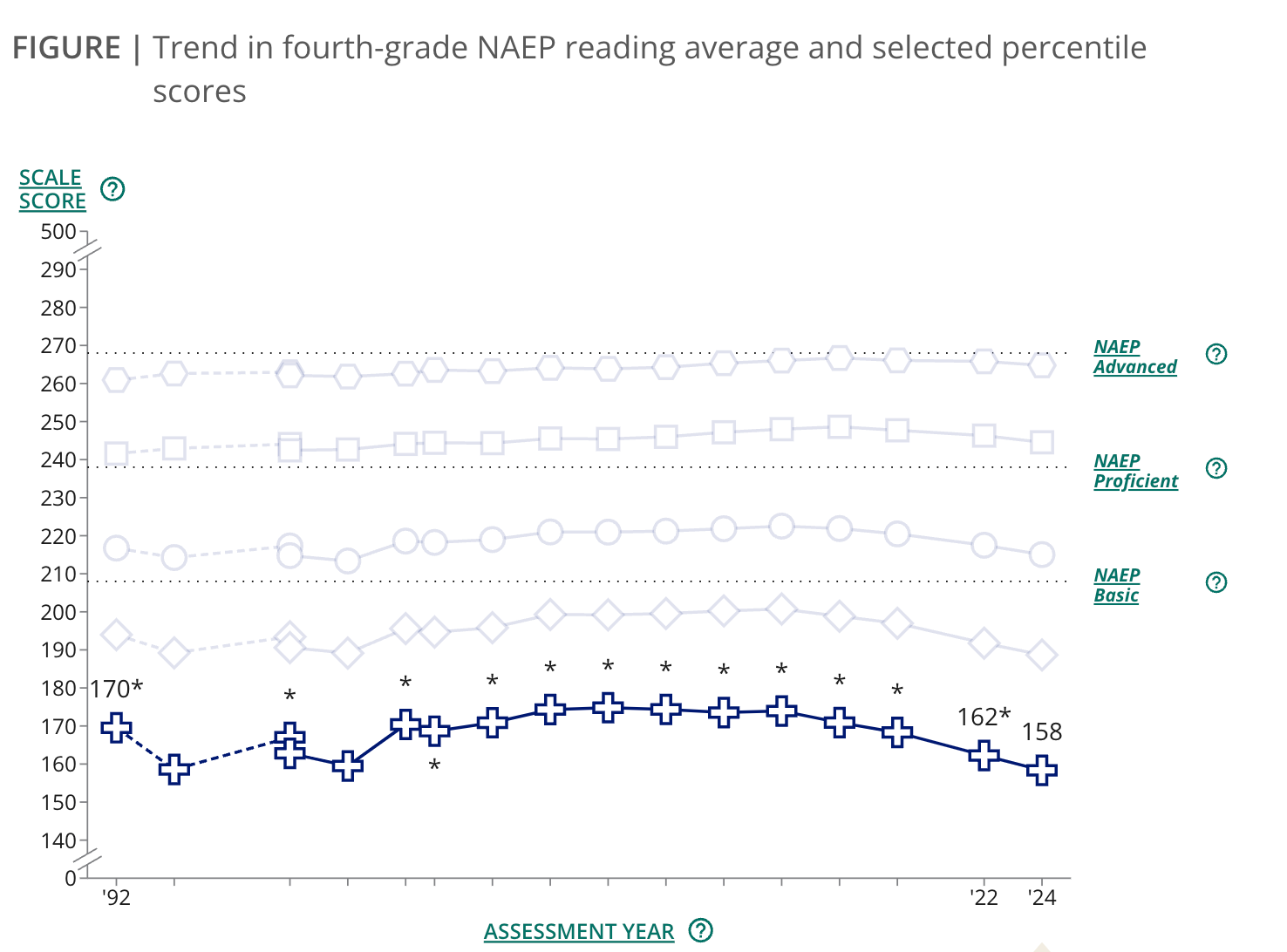
Consider this “Exhibit A” as to why the Department has failed at its mission and no longer needs to exist.
I can understand how that idea, which President Donald Trump is committed to advancing, might sound a bit radical. But having spent four years on the inside as secretary of education, struggling to get the department’s bureaucracy to make even the smallest changes to put the needs of students first, I can say conclusively that American students will be better off without.
Nothing could be more important to our success as a nation than having well-educated citizens. But don’t be fooled by the name: the Department of Education has almost nothing to do with actually educating anyone.
The Department of Education does not run a single school. It does not employ any teachers in a single classroom. It doesn’t set academic standards or curriculum. It isn’t even the primary funder of education—quite the opposite. In most states, the federal government represents less than 10 percent of K–12 public education funding.
So what does it do? It shuffles money around; adds unnecessary requirements and political agendas via its grants; and then passes the buck when it comes time to assess if any of that adds value.
Here’s how it works: Congress appropriates funding for education; last year, it totaled nearly $80 billion. The department’s bureaucrats take in those billions, add strings and red tape, peel off a percentage to pay for themselves, and then send it down to state education agencies. Many of them do a version of the same and then send it to our schools. The schools must then pay first for administrators to manage all the requirements that have been added along the way. After all that, the money makes it to the classroom to help a student learn—maybe.
In other words, the Department of Education is functionally a middleman. And like most middlemen, it doesn’t add value. It merely adds cost and complexity.
=================================================================
Close Department of Education? Former schools chief Betsy DeVos makes the case. | Opinion
In the decades since the U.S. Department of Education was created in 1979, taxpayers have spent hundreds of billions of dollars and not gotten much in return.
Ingrid Jacques – USA TODAY – Nov. 25, 2024
In their failed bid to keep the White House, Democrats fixated outsize attention on Project 2025, a conservative blueprint for an incoming Republican administration.
Progressives painted the document as scary and something to fight. And while President-elect Donald Trump disavowed any direct ties to the project, he is advocating for some of its ideas.
Chief among them is eliminating the U.S. Department of Education, an idea Trump mentioned frequently on the campaign trail.
It’s not a new concept, however. In conservative and libertarian circles, it’s been discussed for years, and for good reasons.
After all, in the decades since the creation of a federal education department in 1979, taxpayers have spent hundreds of billions of dollars and not gotten much in return.
The department consumes roughly $80 billion a year, and that number keeps going up even as test scores have gone down (especially after schools remained closed during the COVID-19 pandemic).
The department employs more than 4,000 people, and this bureaucracy has saddled states with lots of red tape. All the oversight, however, hasn’t translated into better results for kids – which was the whole point of escalated federal involvement.

A better idea? Send more of the funding directly to the states, where school boards and parents can have more say in their children’s education.
No one has been more of a proponent of this idea than former Education Secretary Betsy DeVos. DeVos, who oversaw the department during Trump’s first term, knows firsthand the inefficiencies and ineffectiveness of the department.
Trump last week nominated former wrestling executive and former Small Business Administration head Linda McMahon to be his next Education secretary, so DeVos won’t have the job a second time.
Even so, she wants to help the second Trump administration dismantle the Education Department in any way she can.
‘It’s been an abject failure’
I spoke with DeVos last week about why she supports getting rid of the department she once ran.
“I think you need to back up and start from asking the question, ‘Has the Department of Education actually been successful in its mission?’ And I would say by any measure, no, it’s been an abject failure,” DeVos told me. “And so looking at the failure after trillions of dollars spent and kids still in a downward trajectory, particularly following COVID academically, what can you do to depower this federal agency that is not aligned around what’s right for kids, but is totally aligned around an agenda driven by what’s right for adults and their issues?”
Trump can’t just snap his fingers and dissolve the department. Congress would have to pass the legislation first, and though Trump will have a Republican-controlled House and Senate, it’s not by a large margin.
Even if the Education Department sticks around in some form, its former chief believes there’s room for improvement.
“Shy of that, there are many ways you can turn back to states, local communities and importantly, directly to families, the resources appropriated by Congress,” DeVos said. “Let’s talk about turning that decision-making to the most local level possible and rendering the bureaucracy meaningless in that equation and by virtue of that, eliminating the need for those positions.”
That would benefit both kids and taxpayers.
Let the states compete through school choice
If federal regulations and oversight couldn’t improve U.S. education, perhaps more robust school choice could.
In the past few years, a dozen states, including Arizona and Florida, have passed sweeping school choice reforms – offering universal private school options to families. It looks like Texas could be next in 2025. More are likely to join.
It’s this kind of progress at the state level that further lends the federal bureaucracy moot.
“I think it would be the simplest, and it would be effective in that it would give each state the opportunity to target those resources most directly to the kids who need the most help and to do it in different and creative ways” DeVos said. “We always talked about the states being the laboratories for democracy. They also compete with one another, and that’s a good thing because a state that sees a neighboring state doing something better and attracting more families, or more investment, or both might then change their decision-making around what they’re doing.
DeVos continues to support a federal school choice tax credit program and is hopeful Congress will take up the idea. She sees it as a way to support what states are already doing – or to encourage more to follow suit.
“They (parents) are the ones best situated to figure out what kind of education is going to best work for that child,” she said. “And we’ve seen the support for this go up amongst every demographic in the last few years.”
Despite past disagreements, DeVos is hopeful about Trump’s second term

Since Democrats haven’t shown any interest in reforming the Education Department, DeVos knows it’s up to Republicans to address what’s broken. She’s hopeful about what Trump and Republicans in Congress could accomplish.
And she’s hopeful, even though she and Trump had a falling out over his actions on Jan. 6, 2021, which DeVos called “not defensible in any way.” She resigned the following day, after calling into question whether the 25th Amendment could be invoked to remove the president.
DeVos seems to have put the past behind her to fight for what’s best for kids and parents: “I am very optimistic that this second term is going to be one of progress for the American people at the most local level to really deal with and address some of these very vexing problems that this current administration has let get far worse under Biden’s leadership.
“And I have great optimism that in a second term, President Trump is going to accomplish a lot of really important things on behalf of the American people.”
I hope she’s right.
Ingrid Jacques is a columnist at USA TODAY. Contact her at ijacques@usatoday.com or on X, formerly Twitter: @Ingrid_Jacques
 Lord Buckbeak: "Will you come into my parlor?," said the Spider to the Fly.
Leave a comment