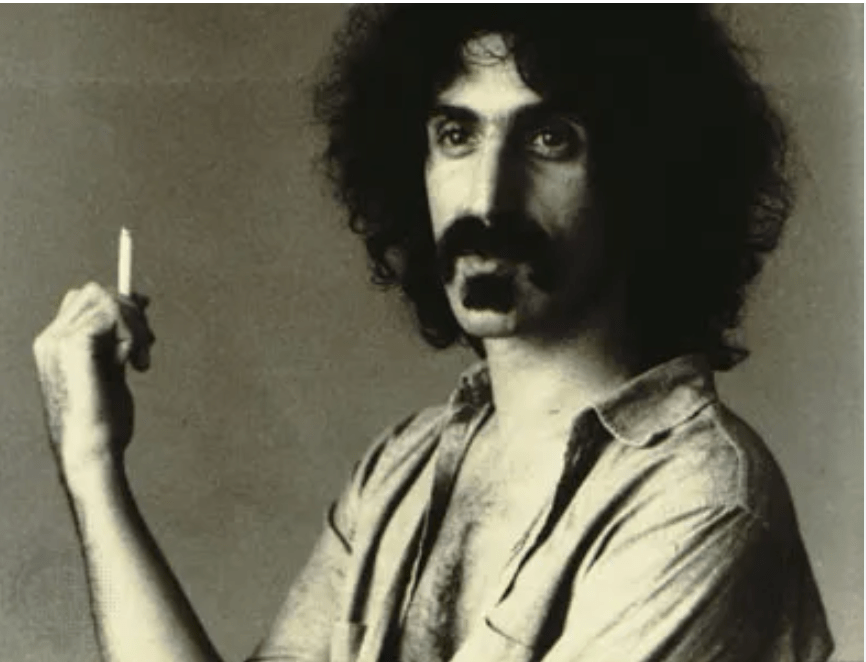

My cmnt: Here’s another interesting post on Moon Unit growing up with her parents.
=====================================================
The legacy of Frank Zappa’s children and grandchildren
My cmnt: I took this from petpuppy on Reddit which cited no sources so take it for what it’s worth. I’m having a notoriously hard time finding an authoritative source, such as Tobin’s Spirit Guide, for Zappa’s children’s full names.
Frank Zappa was a musician in the 70’s and his legacy of children is an… interesting one.
We’ll start with the oldest, a daughter named Moon Unit Zappa.
According to Frank’s wife, Gail Zappa, Frank gave her the option between Moon and Motorhead, of which she chose Moon. They chose Unit because now having their first child, they were a family unit.
Moon has a daughter named Mathilda Plum Doucette.
Second, is Frank’s son Dweezil Zappa, who was born Ian Donald Calvin Euclid Zappa. When Dweezil was born, the nurse refused to put “Dweezil” on his birth certificate. Frank began naming off the names of his fellow musicians and friends, and that’s what was written instead. At age 5, Dweezil learned how the nurse refused the name Dweezil, and insisted upon legally changing his name to Dweezil.
The name Dweezil was originally a nickname Frank had made up for a twisted toenail of Gail’s.
Dweezil has two daughters, Zola Frank Zappa, and Ceylon Indira Zappa.
Next up is Frank’s third son, Ahmet Emuukha Rodann Zappa. Gail says that the name Ahmet was the name of an imaginary butler that was an inside joke of the family’s. Rodan came from an imaginary giant pterodactyl from a Japanese film.
Ahmet has one daughter, named Halo Violetta Zappa.
Lastly is Frank’s youngest daughter, Diva Muffin Zappa (some sources say: Diva Thin Muffin Pigeen Zappa). Frank and Gail say Diva got her name due to being an extremely loud and noisy baby.
Diva has no children.
I would also like to add an honorable mention to their cousin, Lala Cassandra Sloatman, who has a daughter named Lula Henrietta.
=============================================================
By Randall Roberts – July 1, 2016 9:13 AM PT – LA Times
Frank Zappa’s rich musical and cultural legacy, and which children have a right to profit off it, have recently become the subject of a public and contentious family battle.
The children of Frank and Gail Zappa – Moon Unit, Dweezil, Ahmet and Diva – were left unequal shares of the Zappa Family Trust, which owns the rights to a massive trove of music and other creative output by the songwriter, filmmaker and producer — more than 60 albums were released during Zappa’s lifetime and 40 posthumously.
Thanks to a decision by their mother, who died in 2015, Ahmet, 42, and his younger sister, Diva, 36, share control of the trust — to the dismay and anger of their two older siblings, Dweezil, 46, and Moon, 48, who received smaller portions.
But each inherited equal levels of their father’s independent spirit, a sensibility that is seeing renewed attention due to the arrival of the documentary “Eat That Question: Frank Zappa in His Own Words.”
Below is a look at what the Zappa kids are up to now.
Moon Unit Zappa
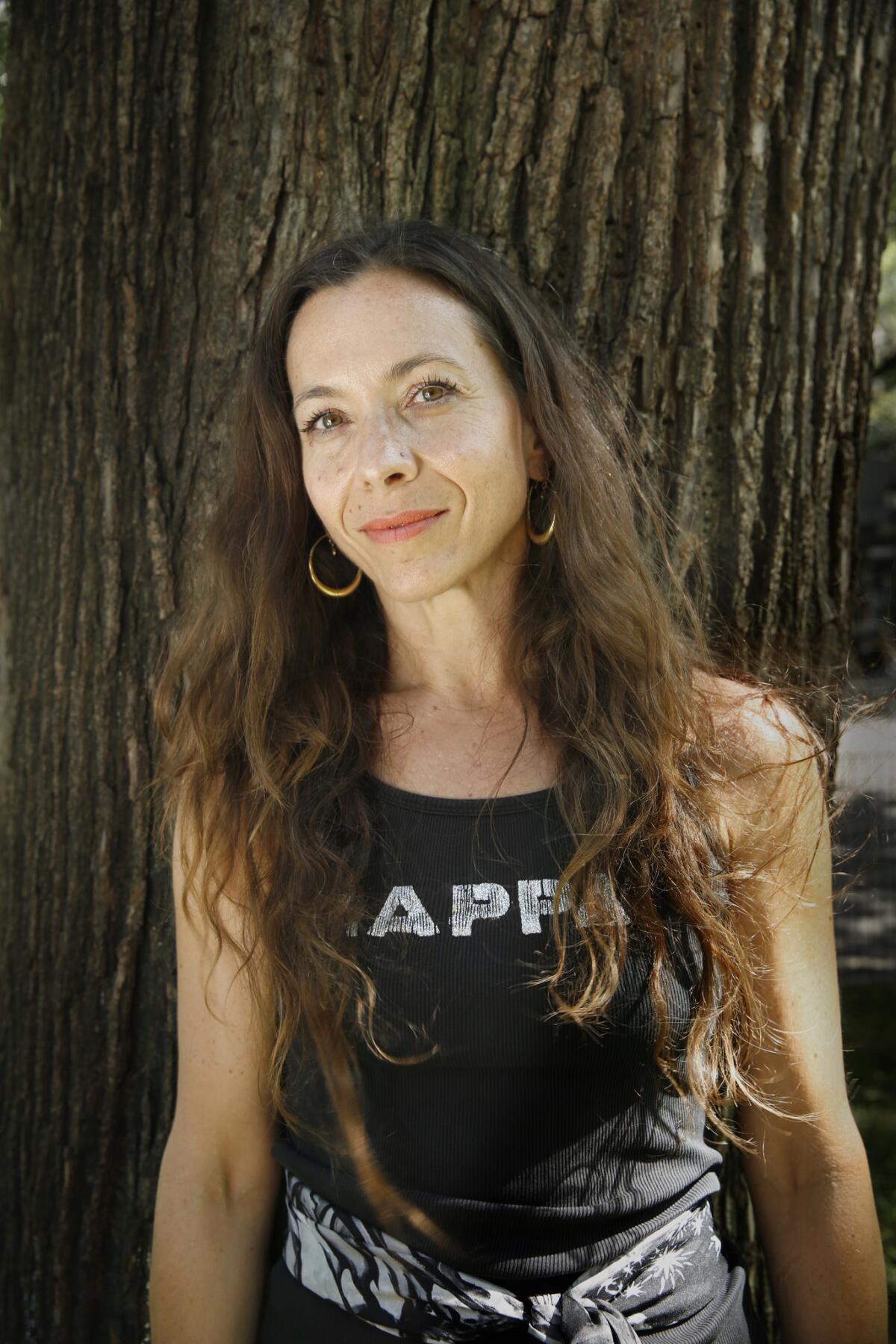
The eldest Zappa child is arguably the most well-known, due in large part to her teenage star turn on “Valley Girl.” The song, a collaboration between father and daughter that appeared on Frank’s 1982 album “Ship Arriving Too Late to Save a Drowning Witch,” poked fun at the California Valleyspeak dialect unique to teenage girls in the San Fernando Valley at the time.
In the intervening decades, Moon has continued to live a creative life, appearing on such TV series as “Curb Your Enthusiasm,” “Grey’s Anatomy” and “How I Met Your Mother.” More recently, she voiced a character on the Fox’s animated show “High School USA!” Moon writes for film and television, does stand-up comedy and recently held a storytelling show in Portland, Ore. The artist is also very involved in yoga.
During a recent conversation, Moon (who considers “Unit” to be her middle name) said that she had wanted to help spread the word about her father’s work and legacy but that Gail had mostly declined her ideas. She noted this was not a family fight over money or unfair proportions, recently tweeting, “This is about having to ask permission for use on OUR last name & creative exclusion.”
“There were so many times that I had gone to her. I had suggested a biopic and a documentary. I had lined up all these elements,” said Moon, adding that she also pitched a family reality show and a curated album of Frank’s music designed with teenage girls in mind. “Every single idea I brought to her, she shot down.”
Moon said she loved “Eat That Question,” the new documentary about her father, calling it “such a universal story about following your calling, and how that road is not an easy road. It requires a kind of stamina and dedication, and that’s a great story, whether you’re a fan of that music or not.”
At the top of Moon’s creative to-do list is a project sure to excite fans of Zappa and Los Angeles culture: “I’m working on a book about growing up in my crazy house.”
Don’t expect her to pull any punches.
Dweezil Zappa
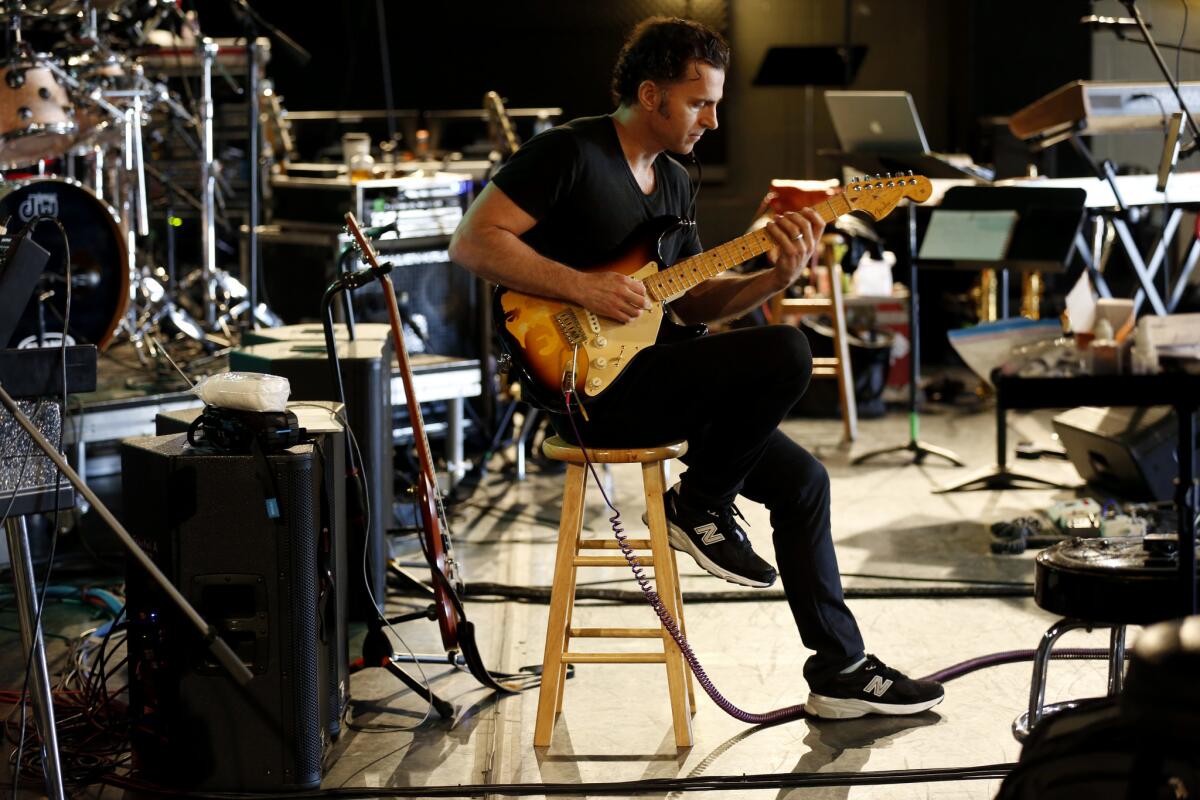
The oldest son, perhaps best known to the public as an MTV VJ in the 1980s, is the most musically focused of the four kids. It’s Dweezil’s beef with the trust that first drew press attention to the behind-the-scenes drama surrounding use of the Zappa name.
Specifically, the trust is trying to prevent Dweezil from touring as either Zappa Plays Zappa or Dweezil Zappa Plays Frank Zappa, citing trademark violations.
Until the tussle is settled, Dweezil will be touring under his own name, and he has dubbed that sojourn the Cease and Desist tour. He and his band will be performing his father’s work, with particular attention paid to songs from the Mothers of Invention’s “Freak Out!,” which this week celebrated its 50th anniversary.
I, of all the people in the family, spent time with him doing something because we had it in common — guitar [and] music.
— Dweezil Zappa said of his father
Dweezil takes his job as Frank’s musical ambassador seriously. “My concern is to just be able to continue to enjoy the music, live within the music, play the music, and express that and allow new people to discover that in a live situation,” he said.
“I, of all the people in the family, spent time with him doing something because we had it in common — guitar [and] music.”
In addition to playing his father’s music, the skilled guitarist has landed guest appearances over the years with such artists as Winger, Pat Boone, Spinal Tap (lead guitar on “Break Like the Wind”), Weird Al Yankovic and the Dixie Dregs.
Last year, Dweezil released his first solo album in nine years, “Via Zammata,” featuring work that mixes rock, jazz and funk. The album’s highlights include the mesmerizing instrumental “Truth,” the jangly, Beatles-esque pop of “Just the Way She Is” and a Zappa-inspired experiment called “Malkovich,” which features vocals by John Malkovich.
Dweezil Zappa begins his Cease and Desist tour in El Prado, N.M., on July 1.
Ahmet Zappa
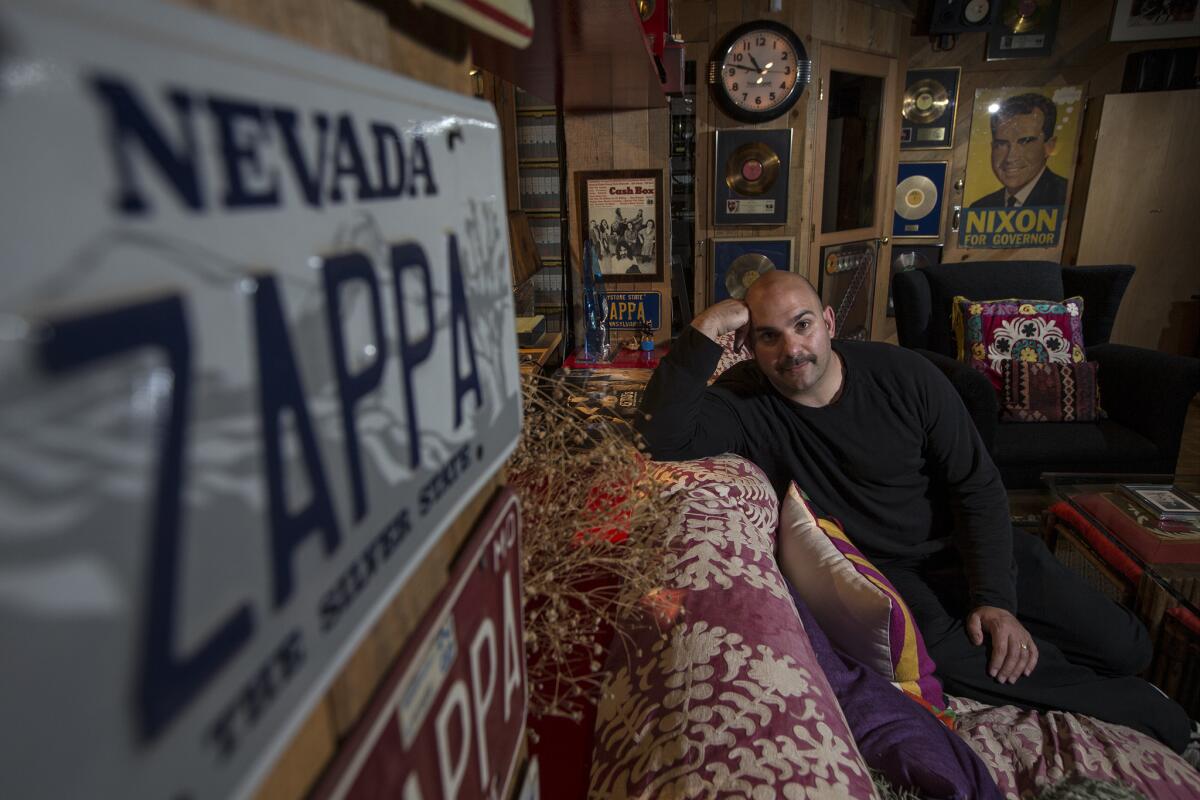
Ahmet has taken charge of day-to-day operations of the Zappa Family Trust. Although those responsibilities are myriad and include running its record labels, advancing Frank’s legacy and protecting his copyrights, Ahmet views his main role as serving the will of the fans and “for people to make the connection to my father’s entire body of work.”
Running the trust is “totally in my wheelhouse,” he said during a recent conversation at the Zappa compound. In his professional career, he’s run a division of Disney called Kingdom Comics and, with his wife, Shana Muldoon Zappa, created the Disney-owned brand Star Darlings, which is centered on empowering tween girls. Star Darlings merchandise includes books and dolls and is available at Wal-Mart, Target and other big-box stores.
What’s great about Frank is that he really is the person guiding things, because he said it, he played it, he shot it. He really is the moral compass.
— Ahmet Zappa
Said Ahmet, “I always wanted to be a storyteller. That makes me the happiest – storytelling in any medium.”
He added that when it comes to his philosophy on matters of the trust, he need only refer to his father’s blueprint. “What’s great about Frank is that he really is the person guiding things, because he said it, he played it, he shot it. He really is the moral compass.”
Describing his father as “a complicated person” and an amazing musician, Ahmet said that one of his jobs as trustee was to convey the sheer breadth of Frank’s compositional skills. “One thing that I want people to understand, which I think is underdeveloped, is the focus of him as a modern-day composer. His orchestral pieces, that aspect of his life — more and more people want to play that music, which makes me so happy.”
Ahmet added that while his dad provided posthumous guidance, he learned how to run the business by looking to his mom. Citing “what my mother endured, and her business mind, and her creativity,” he said, “It’s pretty cool to be more like Gail Zappa.”
Diva Zappa
The youngest Zappa child is also the most press-shy.
Speaking on the phone from London earlier in the month, Diva had just returned from Prague, where the Czech National Symphony Orchestra had performed an evening of her father’s music. She said that one of her primary roles in the trust is to be present when her father’s work is highlighted.
“What do I think my responsibility is? To show up and be open,” she said. “Experience everything. Show up and see what happens and try to do the best I can in every situation for the good of everyone in my family. And that’s including future generations. Everything we do is really to take care of all of us.”
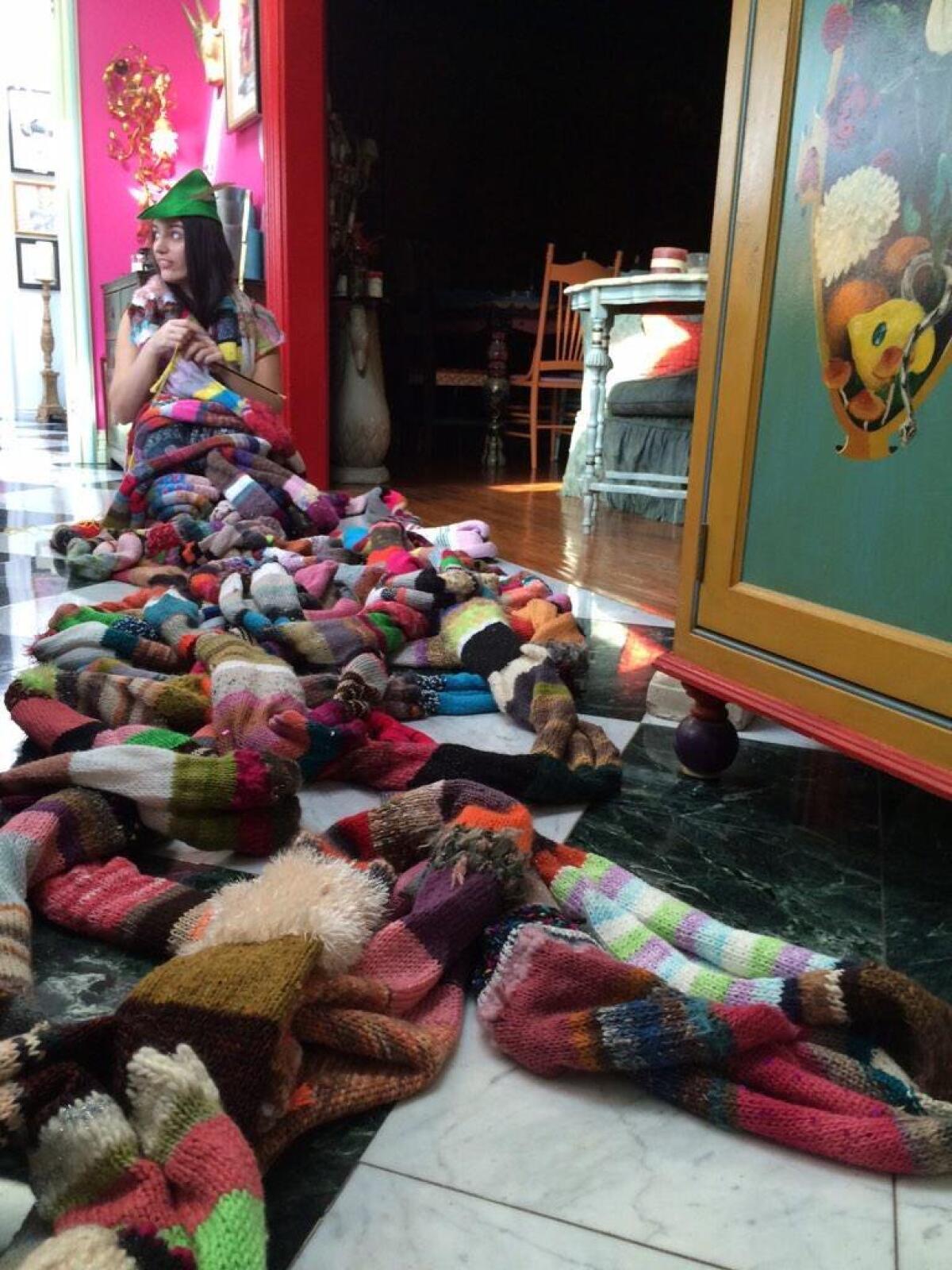
Aside from her role in ensuring Frank’s legacy, Diva is a visual artist and fashion designer who works with knitwear.
“When I knit, I never know what will happen,” Diva told the British newspaper the Independent in 2011. “I am inspired by all that is around me, light, trees, leaves, colours, breath, sounds, sparks, magic, beauty, frustration, heat, love, coffee, humour, feathers, shadows, smells… everything. It all gets in there somehow.”
The designer’s work appeared on the Grammy red carpet in 2009 when Metallica bassist Robert Trujillo’s wife, Chloe, wore a Diva dress.
Diva is currently at work on a scarf, but not just any scarf. “Emilio the Scarf” is a project with its own Twitter handle. Described on the profile page as “a magical piece of art,” the scarf promises that “one day I will be 5,280 feet long.”
ALSO
What was Frank Zappa’s Net Worth?
Frank Zappa was an American musician, composer, guitarist, recording engineer, record producer, and film director who had a net worth of $1 million at the time of his death. Frank was an unprecedented rock musician. He was known for his terrific musical knowledge and outrageous sense of humor. In a 3+ decade-long career, Zappa composed atypical works ranging from rock and jazz to orchestral and musique concrète musical pieces. He is considered to be one of the most innovative performers and creators of his time. He produced more than 60 albums during his lifetime, some together with the band “The Mothers of Invention” and others as a solo artist. His estate has released more than 40 posthumous albums.
A self-taught composer as he was and influenced by various types of music, Frank created tunes that critics often found difficult to categorize. In addition to his vast musical opus, he was a loud critic of mainstream education and organized religion, as well as a passionate advocate for freedom of speech, self-education, political participation, and the abolition of censorship.
Financial Situation at Death
The exact value of Frank’s estate at the time of his death is extremely difficult to pin down. By some reports, years after Frank’s death, the estate was “beyond broke,” perhaps even millions of dollars in debt at the time he died. His daughter Moon would later claim that she was pressured into selling a home to help raise $250,000 needed for Frank’s cancer treatments.
The situation worsened after his death, thanks largely to an expensive battle his widow waged with a record company over the digital streaming rights to his catalog. Frank’s children fought for years over the right to perform using the last name “Zappa” and the ability to monetize their father’s image. In the years after his death, the estate has earned many millions of dollars through licensing agreements, merchandise sales, film rights, memorabilia and more.
In November 2016, just two months after the siblings finalized the sale of Frank’s former home, Dweezil stated in an interview that his late mother, Gail, had “run herself and the business into the ground, spent $20 million in lawsuits and by her demise was $6 million in debt.“
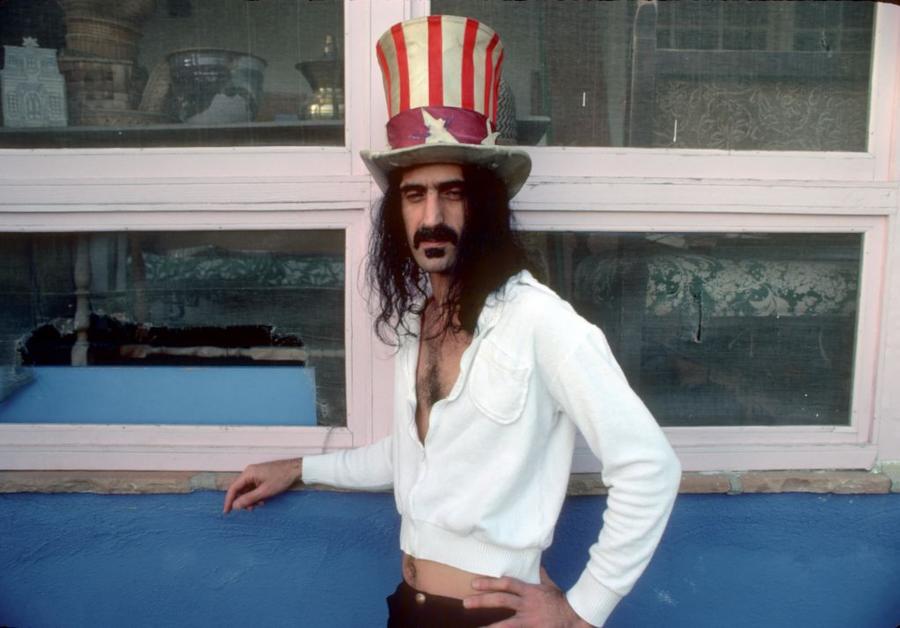
(Photo by Michael Ochs Archives/Getty Images)
Estate Battle
After his death, control over Frank Zappa’s estate passed to his widow, Gail. When Gail died in 2015, she chose to NOT leave her four surviving children equal shares of the Zappa Family Trust. Instead, she left 30% to Ahmet and Diva Zappa while also making them co-trustees. Dweezil and Moon Unit Zappa only received 20% and were not trustees. In essence, this put control over the estate in the hands of Ahmet and Diva, with Ahmet taking on the more active business management role.
Because he is not a trustee, technically, Dweezil Zappa needs permission from his brother to perform Frank’s music at his own concerts. He also would sell Frank-related merchandise. For many years, Dweezil performed as a band called Zappa Plays Zappa. When family tensions over the use of the name arose, he defiantly re-named the tour “50 Years of Frank: Dweezil Zappa Plays Whatever the F@%k He Wants – The Cease and Desist Tour.” He stopped selling Frank-related merchandise.
The siblings battled for decades. Ahmet and Dweezil ceased speaking to each other. The estate wasn’t finally settled until March 2019, when a Los Angeles judge finally approved a settlement agreement between three of the four children (everyone except Moon Unit). According to the 2019 settlement terms, all income generated by the performance of Frank’s music or the sale of his likeness must be split four ways.
Catalog Sale
In June 2022, Frank Zappa’s family trust reached a deal to sell his entire song catalog to Universal Music Group for an undisclosed amount. The deal included Frank’s vast film and unreleased music archives. The estate had a previous deal in place with UMG that allowed the music management company to make his music available to stream since 2012.
Laurel Canyon Home
In the late 1960s, Frank paid $74,000 for what would become an infamous home in LA’s Laurel Canyon neighborhood. The home was also his music studio. In June 2016, several months after his widow Gail’s passing, the home was listed for $5.5 million. In August 2016 Lady Gaga bought the house for $5.25 million.
Early Life
Zappa was born in Baltimore, Maryland, on December 21, 1940, to parents Rose Marie and Francis Zappa. His mother was of Italian and French ancestry, while his father was Sicilian, Greek, and Arab. He was the eldest of four total children and the family often spoke Italian at home. Due to his father’s career in the defense industry, the family moved often. The family lived near a U.S. military chemical warfare facility for some time during Zappa’s childhood, which had a profound effect on the boy, as can be heard in his later creative work, which often refers to warfare and the defense industry. Zappa also had a number of health conditions during his childhood, including asthma and earaches, and the family ultimately relocated to San Diego for health reasons.
Zappa attended Mission Bay High School in San Diego, where he joined his first band as a drummer. The family then moved to Lancaster in the Mojave Desert, where Zappa attended Antelope Valley High School. He again joined a band and continued developing his musical interest, deciding to learn how to play the guitar. Entirely self-taught, Zappa was composing his own musical arrangements by his final years in high school. He briefly attended Chaffey College but withdrew after one semester as he decided to devote his time to becoming a professional musician and composer.
Career
Zappa spent much of his early career playing in different nightclubs and composing the soundtracks and scores for low-budget films. He also worked as a producer for a number of local artists and eventually came to run his own recording studio, which he dubbed Studio Z.
He also joined a local R&B band, the Soul Giants, which was subsequently renamed the Mothers. After Zappa convinced the band they should be playing his music, they were able to land a record deal with famous producer Tom Wilson. It was with his help that they released the groundbreaking and experimental album, “Freak Out!” Wilson also produced the Mothers’ second album, “Absolutely Free” in 1967.
The band then moved to New York to pursue a contract at the Garrick Theater. Zappa made a name for himself in the avant-garde music scene of the city. It was there that the Mothers also released their third and most well-received album, “We’re Only in It for the Money” in 1968, which was produced by Zappa himself. From that period onward, Zappa produced all of the Mothers’ albums. At the same time, he also continued working on the business side of his career by producing albums and tracks for other bands like Captain Beefheart and the Persuasions.
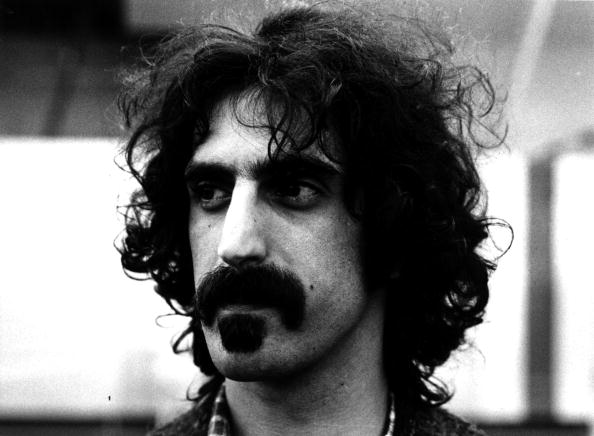
Evening Standard/Getty Images
In 1969, Zappa decided to break up the Mothers due to financial strain and began releasing solo music with his “Hot Rats” album. However, he decided to reform the Mothers only a year later, in 1970. The new band debuted together on the soundtrack for the 1971 film, “200 Motels,” and then began touring. While playing a show in London, Zappa was pushed off the stage by a jealous fan, which resulted in significant injury and forced Zappa to use a wheelchair for over half a year. He wasn’t able to begin touring again until 1972.
Over the next decade, Zappa dealt with a number of business breakups with various record labels, resulting in a number of lawsuits. However, the 1970s ended on a high, with Zappa releasing two of his most successful albums, “Sheik Yerbouti” and “Joe’s Garage” on his own record label, Zappa Records. He later released a number of purely instrumental albums and began using the Synclavier, an early digital synthesizer, throughout most of the 1980s. In 1986, he remastered all of his earlier works to CDs and undertook his last tour in 1988.
Personal Life
Zappa married Kathryn Sherman in 1960, though the couple divorced in 1963. In 1967, he married Adelaide Sloatman after meeting her on a promotional tour for the album “Freak Out!” Claiming that he fell in love within a couple of minutes, the couple remained together until Zappa’s death and had four children. Adelaide is better known today as Gail Zappa.
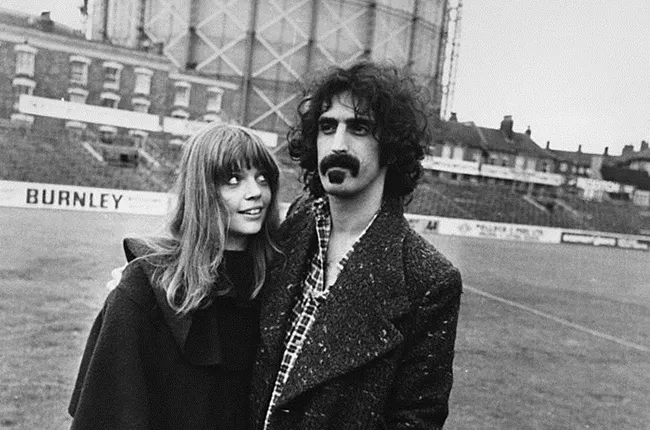
Gail & Frank in Sept. 1972 – Getty Images
Gail and Frank had four children: Moon, Dweezil, Ahmet, and Diva.
Zappa was somewhat of a controversial figure, openly expressing his views on limited government, atheism, and anti-censorship. He also did not support formal education and refused to pay for his children to go to college.
In 1990, Zappa was diagnosed with advanced prostate cancer, which had gone unnoticed for a number of years and was thus considered inoperable. Zappa continued working after his diagnosis, finally completing a major musical work that he had begun in the 1980s, “Civilization Phase III,” and giving a number of concerts around the world in cities like Prague, Los Angeles, and Frankfurt. However, his deteriorating health eventually forced him to stop performing.
Frank Zappa passed away at home on December 4, 1993, only a couple of weeks before his 53rd birthday. The family held a private ceremony for him the following day, and he was buried in an unmarked grave at the Westwood Village Memorial Park Cemetery in Los Angeles.
In the years following his death, Zappa has been honored by a number of awards and publications. He was inducted into the Rock and Roll Hall of Fame in 1995 and named one of VH1’s “100 Greatest Artists of Hard Rock” in 2000. One of his final works, “Civilization Phase III” won a Grammy Award in 1996, and he was also awarded the Grammy Lifetime Achievement Award in 1998.
Frank Zappa
American musician
Also known as: Frank Vincent Zappa
Written by Charles Shaar Murray – Fact-checked by The Editor of this encyclopedia
Last Updated: Dec 17, 2024 •Article History – Encyclopedia Britannica
Quick Facts In full: Frank Vincent Zappa Born: December 21, 1940, Baltimore, Maryland, U.S. Died: December 4, 1993, Los Angeles, California (aged 52) Awards And Honors: Grammy Award (1997)Rock and Roll Hall of Fame and Museum (1995) Notable Works: “200 Motels”
Frank Zappa (born December 21, 1940, Baltimore, Maryland, U.S.—died December 4, 1993, Los Angeles, California) was an American composer, guitarist, and satirist of the 1960s, ’70s, and ’80s.
Zappa was, in no apparent order, a first-rate cultural gadfly dedicated to upsetting American suburban complacency and puncturing the hypocrisy and pretensions of both the U.S. political establishment and the counterculture that opposed it; a contemporary orchestral composer uncompromisingly rooted in 20th-century avant-garde tradition; a rock bandleader who put together a series of stellar ensembles both under the rubric of the Mothers of Invention and under his own name; an erudite lover of the most esoteric traditions of rock and roll and of rhythm and blues; an innovative record producer whose use of high-speed editing techniques predated the later innovations of hip-hop; and one of the premier electric guitar improvisers of a generation that included Jimi Hendrix, Eric Clapton, and Jeff Beck. One of the great polymaths of the rock era who, arguably, possessed a broader range of skills and interests than any of his peers, he was an instinctive postmodernist who demolished the barriers and hierarchies separating “high” and “low” culture.
Zappa was a prolific workaholic who released more than 60 albums in his 30-year career. His first release with the original Mothers of Invention, the conceptual double album Freak Out! (1966), was a key influence on the Beatles’ Sgt. Pepper’s Lonely Hearts Club Band, released the following year. By way of wry acknowledgment, the cover of the Mothers’ third album, We’re Only in It for the Money (1968), parodied that of Sgt. Pepper’s, just as the music challenged the Beatles’ visions of love and beauty with the deliberate “ugliness” with which Zappa assailed what he saw as the totalitarian philistinism of the establishment and the vacuous fatuity of many aspects of hippie subculture. Zappa was not a hippie, he claimed. He was a “freak.” Britannica QuizPop Culture Quiz
After retiring the name the Mothers of Invention in the late 1970s, Zappa withdrew from explicit political commentary and released, under his own name, the enormously influential jazz-rock fusion album Hot Rats (1969), which featured a memorable vocal from his old friend Don Van Vliet, better known as Captain Beefheart. Throughout the 1970s Zappa released instrumental albums that featured orchestral music, jazz, his own guitar improvisations, and, later, synthesizers and sequencers. He also released rock-oriented vocal albums that, like most of his live concerts, specialized in jaw-dropping displays of technical virtuosity and crowd-pleasing exercises in misogynistic grossness such as “Titties & Beer” (1978) and “Jewish Princess” (1979).
In the 1980s, by contrast, Zappa was sufficiently angered by the policies of U.S. Pres. Ronald Reagan’s administration to rediscover politics. He set up voter-registration booths in the lobbies of his concerts and memorably testified against censorship at the Parents’ Music Resource Center hearings in 1985 in Washington, D.C. In the wake of Czechoslovakia’s Velvet Revolution (1989), Zappa was invited to Prague, where he met with the country’s new president, Václav Havel. A longtime admirer of Zappa’s commitment to individual freedom, Havel named him a special ambassador to the West on trade, culture, and tourism, but U.S. officials pressured Havel into retracting the appointment.
Through it all, Zappa continued recording. He had an unlikely hit single with “Valley Girl” (1982), which featured a rap by his daughter Moon Unit, and, shortly before his death from prostate cancer in 1993, he was finally recognized as a composer of “serious” music when his Yellow Shark suite was performed and recorded by Germany’s Ensemble Modern. Zappa was posthumously honoured when a set of his pieces was performed during the Proms festival at London’s Royal Albert Hall. Considering that he had been banned from the Albert Hall in 1970 when the theatre manager objected to some of the saltier lyrics from Zappa’s motion picture 200 Motels (1971), this was no mean achievement. Similarly, an annual festival celebrating Zappa thrived in the early 21st century in Bad Doberan, Germany (formerly in East Germany), where his music had once been banned.
Zappa was inducted into the Rock and Roll Hall of Fame in 1995, and he was a 1997 recipient of the Grammy Award for lifetime achievement. His life was chronicled in the documentaries Eat That Question: Frank Zappa in His Own Words (2016) and Zappa (2020).
 Lord Buckbeak: "Will you come into my parlor?," said the Spider to the Fly.
Leave a comment