
Theories suggest the writer did not compose his famous works like ‘Hamlet’ and ‘Julius Caesar.’
By Barbara Maranzani Updated: Aug 21, 2024 11:04 AM EDT – biography.com

Photo: Hulton Archive/Getty Images
Shakespeare Ultimate Study Guide
The son of a glovemaker and sometimes municipal politician from Stratford-upon-Avon, William Shakespeare seems to have risen from modest means to become one of history’s greatest writers, a peerless poet and dramatist whose works have thrilled readers for more than 400 years. But did Shakespeare actually write the works attributed to his name?
Modern-day historians believe that some of his works may have been partially written in tandem with others. But some scholars and even fellow writers are skeptical that Shakespeare wrote any of his celebrated sonnets or plays, and that “Shakespeare” was actually a pseudonym used to disguise the true identity of the real author. Surrounded by difficult issues regarding social class and education, the Shakespeare authorship question isn’t new, with dozens of possible theories about who the “Bard of Avon” really was — or wasn’t.
The argument against Shakespeare hinges on key critiques
Anti-Stratfordians, the nickname given to those who contend Shakespeare wasn’t the true author, point to a significant lack of evidence as proof of their claims. They argue that records of the time indicate that Shakespeare likely received only a local primary school education, did not attend university, and therefore would not have learned the languages, grammar and vast vocabulary on display in Shakespeare’s works, some 3,000 words. They note that both of Shakespeare’s parents were likely illiterate, and it seems as if his surviving children were as well, leading to skepticism that a noted man of letters would neglect the education of his own children.
They also note that none of the letters and business documents that survive give any hint of Shakespeare as an author, let alone a one famous during his lifetime. Instead, the written records detail more mundane transactions, like his pursuits as an investor and real estate collector. If Shakespeare’s worldly wisdom was the result of post-grammar school reading and travel, they argue, where is the evidence that he ever left England? Why was their no public mourning for him when he died? And why does his will, which listed a number of gifts to family and friends, not include a single book from what would presumably be an extensive library?
For those who firmly believe that Shakespeare was the true author of his plays, the Anti-Stratfordians are simply choosing to ignore the facts. A number of Shakespeare’s contemporaries, including Christopher Marlowe and Ben Jonson, came from similarly modest families. There were no public claims during Shakespeare’s lifetime that he was acting as a pseudonym. In fact, Tudor officials responsible for ascertaining authorship of plays attributed several works to Shakespeare, Jonson and others, including actors who had performed his plays, paid tribute to him in the years following his death and even helped arrange publication of his works.
Some believe Francis Bacon is the ‘real’ Shakespeare
Francis Bacon was one of the earliest alternatives put forward, beginning in the mid-19th century. A graduate of Cambridge, Bacon was highly accomplished. He was one of the creators of the scientific method, was a well-regarded philosopher, and rose through the ranks of the Tudor court to become Lord Chancellor and a member of the Privy Chamber. But was he also the “real” Shakespeare?
That’s the argument the Baconians make, alleging that Bacon wanted to avoid being tainted with a reputation as a lowly playwright, but also felt compelled to pen plays that secretly took aim at the royal and political establishment in which Bacon played a key part. Supporters claim that philosophical ideas originated by Bacon can be found in Shakespeare’s works, and debate whether Shakespeare’s limited education would have provided him with the scientific knowledge, as well as legal codes and traditions, which appear throughout the plays.
They believe that Bacon provided clues behind for intrepid later scholars, concealing secret messages or ciphers about his identity as a kind of literary trail of breadcrumbs. Some have gone to even further extremes, arguing that Bacon’s ciphers reveal a larger, alternative history of the Tudor era, including what an outlandish theory that Bacon was actually Elizabeth I’s illegitimate son.
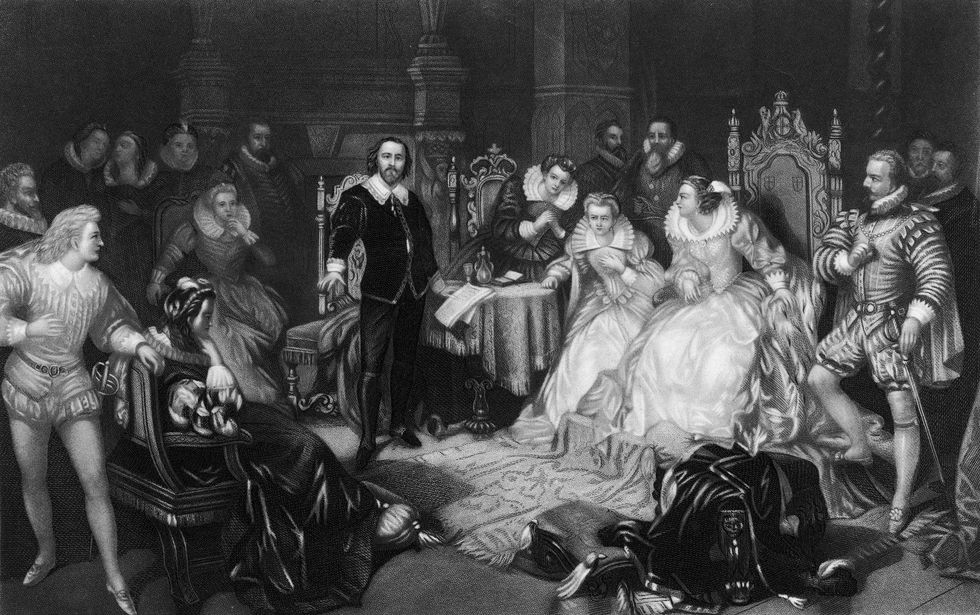 Photo: Archive Photos/Getty Images – Shakespeare reciting work before the court of Elizabeth I.
The Oxfordian theory supports the notion that Edward de Vere was Shakespeare
Edward de Vere, the 17th Earl of Oxford, was a poet, dramatist and patron of the arts, whose wealth and position made him a high-profile figure in Tudor times (he was raised and educated in the household of Elizabeth I’s chief advisor, William Cecil). De Vere stopped publishing poetry under his own name shortly after the first works attributed to Shakespeare appeared, leading Oxfordians to claim that he used Shakespeare as a “front” to protect his position. They argue that an annual royal annuity De Vere received from court may have used to pay Shakespeare, allowing De Vere to maintain public anonymity.
For these supporters, De Vere’s extensive travel throughout Europe, including his deep fascination with Italian language and culture, are reflected in the numerous Italian-set works in the Shakespeare canon. De Vere also had a lifelong love of history, particularly ancient history, making him well-suited to write dramas such as Julius Caesar. They also point to his family relationship to Arthur Golding, the author of a translation of the ancient Roman poet Ovid’s “Metamorphosis,” a translation which literary scholars agree was highly influential on whoever wrote the Shakespeare works.
A chief criticism of the Oxford theory is that De Vere died in 1604 — but the accepted Shakespeare chronology indicates that more than a dozen works were published after his death. Despite this and other inconsistencies, De Vere’s defenders remain steadfast, and the Oxfordian theory was explored in the 2011 film, Anonymous.
Another contender is Christopher Marlowe
A celebrated playwright, poet and translator, Marlowe was a star of the Tudor age. His work undoubtedly influenced a generation of writers, but could he also have been the true author of Shakespeare’s works in addition to his own? Supporters of the Marlovian theory, first popularized in the early 19th century, argue that there are significant similarities in the two writing styles that cannot be overlooked, although modern analysis has called this into dispute.
Like Shakespeare, Marlowe was from a modest background, but his intellectual ability saw him awarded both Bachelor and Master’s degrees from Cambridge University. Historians now believe he balanced his literary career with a clandestine role as a spy for the Tudor court. Marlowe’s support for anti-religious groups and publication of what was deemed an atheist work left him in a precarious and dangerous position.
Marlowe’s mysterious death in May 1593 has led to centuries of speculation. Although a coroner’s inquest conclusively concluded he had been stabbed during an argument in a pub, conspiracies swirl that his death was faked. Possibly to avoid an arrest warrant for that anti-religious writing. Or to help hide his role as Cecil’s secret agent. Or, as the Marlovians believe, to allow Marlowe to assume a new literary career as Shakespeare, whose first work under that name went on sale two weeks after Marlowe’s death.
Several women have also been forward as potential candidates
In the 1930s, author Gilbert Slater proposed that Shakespeare’s work may not have been written by a well-educated nobleman — but by a well-educated noblewoman. Drawing on what he saw as feminine attributes to subject matter and writing style, as well as the long list of strong, convention-breaking female characters, Slater declared that Shakespeare had likely been a front for Mary Sidney. The sister of poet Philip Sidney, Mary received an advanced classical education, and her time spent at the court of Elizabeth I would have provided ample exposure to the royal politics that played such a key role in Shakespeare’s work.
Mary was an accomplished writer, completing a highly praised translation of religious works, and several “closet dramas” (plays written for private or small-group performances), a format frequently used by women of the era who were unable to openly participate in the professional theater. Mary was also a noted arts patron, running a prominent literary salon that counted poets Edmund Spenser and Jonson among its members and providing funds to a theater company that was one of the first to produce Shakespeare’s plays.
More recently, Emilia Bassano has been the focus of renewed research. The London-born daughter of Venetian merchants, Bassano was one of the first English women to publish a volume of poetry. Historians believe Bassano’s family were likely converted Jews, and the inclusion of Jewish characters and themes, treated in a more positive way than by many other authors of the day, could be explained by Bassano’s authorship. So, too, could the frequent settings in Italy, particularly Venice, with which Bassano obviously had close ties.
Emilia was an uncommon name in Tudor-era England but is used frequently for Shakespeare’s female characters, as are variations of her last name. Some also point to autobiographical details of Bassano’s life, including the visit to Denmark of members of the household she was raised, a setting made famous in Hamlet. She was the mistress of one of the key patrons of Shakespeare’s acting company, which likely brought her in contact with the Bard, and some have surmised that she may have been his mistress.
Some famous names have voiced their support for any number of possible alternatives
Mark Twain argued the case for Bacon in a short work, “Is Shakespeare Dead?” and his close friend Helen Keller concurred. Sigmund Freud wrote a letter supporting the Oxfordian claim, and even fellow poet Walt Whitman chimed in, raising his doubts that Shakespeare had the education and background to produce the works attributed to him.
Modern-day Anti-Stratfordians include those who perform Shakespeare’s words, including actors Michael York, Derek Jacobi, Jeremy Irons, and Mark Rylance, a former artistic director of London’s reconstructed Shakespeare’s Globe Theater and the author of a book championing Bacon as the true author. The debate has even attracted the attention of two former U.S. Supreme Court Justices, with Sandra Day O’Connor and John Paul Stevens among the luminaries signing a petition put forward by the Shakespeare Authorship Coalition.
10 of the Most Famous Shakespeare Quotes
from Thoughco.com – By Lee Jamieson – Updated on July 08, 2019
William Shakespeare was the most prolific poet and dramatist the Western world has ever seen. His words have staying power; they have remained relevant and moving to readers for more than 400 years.
Shakespeare’s plays and sonnets are some of the most quoted in all of literature. A few quotes stand out, whether for their wit, the poetic elegance with which they ponder love, or their heartbreakingly accurate depiction of anguish.
01 of 10
“To be, or not to be: that is the question.” — “Hamlet”
Hamlet ponders life, death, and the merits and risks of suicide in one of the most famous passages in the history of literature. It’s no wonder this soliloquy is universally admired: The themes are crucial to all people and the phrasing of his opening question is stark and original.
“To be, or not to be: that is the question:
Whether ’tis nobler in the mind to suffer
The slings and arrows of outrageous fortune,
Or to take arms against a sea of troubles,
And by opposing end them?”
02 of 10
“All the world’s a stage …” — “As You Like It”
“All the world’s a stage” is the phrase that begins a monologue from William Shakespeare’s “As You Like It,” spoken by the melancholy character Jaques. The speech compares the world to a stage and life to a play. It catalogues the seven stages of a man’s life, sometimes referred to as the seven ages of man: infant, schoolboy, lover, soldier, judge (one having the ability to reason), Pantalone (one who is greedy, with high status), and elderly (one facing death).
“All the world’s a stage,
And all the men and women merely players.
They have their exits and their entrances;
And one man in his time plays many parts”
03 of 10
“O Romeo, Romeo! wherefore art thou Romeo?” — “Romeo & Juliet”
This famous quote from Juliet is one of the most misinterpreted of all quotes from Shakespeare, mostly because modern audiences and readers don’t know their Elizabethan or early Modern English very well. “Wherefore” did not mean “where” as some Juliets have interpreted it (with the actress leaning over a balcony as if searching for her Romeo). The word “wherefore” means “why” in early Modern English.” So she wasn’t looking for Romeo. Juliet was actually lamenting about her beloved’s name and that he was among her family’s sworn enemies.
04 of 10
“Now is the winter of our discontent…” — “Richard III”
The play begins with Richard (called “Gloucester” in the text) standing in “a street,” describing the accession to the throne of his brother, King Edward IV of England, eldest son of the late Richard, Duke of York.
“Now is the winter of our discontent
Made glorious summer by this sun of York;
And all the clouds that lour’d upon our house
In the deep bosom of the ocean buried.”
“Sun of York” is a punning reference to the badge of the “blazing sun,” which Edward IV adopted, and “son of York,” i.e., the son of the Duke of York.
05 of 10
“Is this a dagger which I see before me…” — “Macbeth”
The famous “dagger speech” is spoken by Macbeth as his mind is being torn apart with thoughts as to whether he should murder King Duncan, on his way to do the deed.
“Is this a dagger which I see before me,
The handle toward my hand? Come, let me clutch thee.
Art thou not, fatal vision, sensible
To feeling as to sight? Or art thou but
A dagger of the mind, a false creation,
Proceeding from the heat-oppressèd brain?
I see thee yet, in form as palpable
As this which now I draw.”
06 of 10
“Be not afraid of greatness…” — “Twelfth Night”
“Be not afraid of greatness. Some are born great, some achieve greatness, and some have greatness thrust upon ’em.”
In these lines from the comedy “Twelfth Night,” Malvolio reads a letter that is part of a prank played upon him. He lets his ego get the best of him and follows the ridiculous instructions in the letter, in the comic plotline of the play.
07 of 10
“If you prick us, do we not bleed?” — “The Merchant of Venice”
“If you prick us, do we not bleed? if you tickle us, do we not laugh? if you poison us, do we not die? and if you wrong us, shall we not revenge?”
In these lines, Shylock speaks of the commonality between peoples, here between the minority Jewish population and majority Christian population. Instead of celebrating the good that unifies peoples, the twist is that any group can be as hurt or as vengeful as the next.
08 of 10
“The course of true love never did run smooth.” — “A Midsummer Night’s Dream”
Shakespeare’s romantic plays typically have obstacles for the lovers to go through before reaching a happy ending. In an exaggerated understatement, Lysander speaks these lines to his love, Hermia. Her father doesn’t want her to marry Lysander and has given her the choice of marrying another man whom he prefers, being banished to a nunnery, or dying. Fortunately, this play is a comedy.
09 of 10
“If music be the food of love, play on.” — “Twelfth Night”
The brooding Duke Orsino opens “Twelfth Night” with these words. He is melancholy over unrequited love and his solution is to drown his sorrows with other things:
“If music be the food of love, play on.
Give me excess of it that, surfeiting,
The appetite may sicken, and so die.”
10 of 10
“Shall I compare thee to a summer’s day?” — “Sonnet 18”
“Shall I compare thee to a summer’s day?
Thou art more lovely and more temperate.”
These lines are among the most famous lines of poetry and of Shakespeare’s 154 sonnets. The person (the “fair youth”) to whom Shakespeare was writing is unknown.
Lee Jamieson, M.A., is a theater scholar and educator. He previously served as a theater studies lecturer at Stratford-upon Avon College in the United Kingdom.
Theater Expert
Top Quotes From Shakespeare
The Bard was known for his profound wit and wisdom
By Simran Khurana – Updated on August 13, 2024 – thoughtco.com
Education Expert
Simran Khurana is the Editor-in-Chief for ReachIvy, and a teacher and freelance writer and editor, who uses quotations in her pedagogy.
William Shakespeare quotes are full of passion and wisdom—and sometimes, a shade of sarcasm. The passion in Shakespeare’s writing never fails to move the reader. The Bard wrote 37 plays and 154 sonnets and his works are still performed onstage. These Shakespeare quotes remain relevant, as many reflect the values and beliefs of our society, as well as speak to the human condition.
01 of 10
‘Hamlet,’ 3:1
“To be, or not to be: that is the question.”
Perhaps the most famous Shakespeare quote, the anguished Hamlet ponders the purpose of life and suicide in this profound soliloquy.
02 of 10
‘All’s Well That Ends Well,’ 1:2
“Love all, trust a few, do wrong to none.”
This bit of simple wisdom, beloved to many throughout the ages, was spoken by the Countess of Roussillon to her son, as he sets out for court far away.
03 of 10
‘Romeo and Juliet,’ 2:2
“Good night, good night! Parting is such sweet sorrow.”
This famous Shakespeare quote, spoken by Juliet at the end of the iconic balcony scene, describes the mixed feelings of parting from a loved one. Mixed with the pain of separation is the anticipation of the sweetness of reunion.
04 of 10
‘Twelfth Night,’ 2:5
“Be not afraid of greatness. Some are born great, some achieve greatness, and some have greatness thrust upon ’em.”
This line, quoted often by today’s inspirational speakers, is spoken by Malvolio as he reads from a letter written by Maria.
05 of 10
‘The Merchant of Venice,’ 3:1
“If you prick us do we not bleed? If you tickle us do we not laugh? If you poison us do we not die? And if you wrong us, shall we not revenge?”
These well-known lines, implored by Shylock, are usually interpreted as a humanistic plea against anti-Semitism, though the play is also understood by some as steeped in the tacit anti-Semitism of its time.
06 of 10
‘Hamlet,’ 1:5
“There are more things in heaven and earth, Horatio, than are dreamt of in your philosophy.”
Hamlet is here responding to his friend Horatio’s wonderment upon their meeting with a ghost. Hamlet is reminding him that as dumbfounded as Horatio is, this vision reminds him that much exceeds his limited understanding.
07 of 10
‘Macbeth,’ 1:3
“If you can look into the seeds of time, and say which grain will grow and which will not, speak then to me.”
After hearing the witches’ prophesy about Macbeth’s successful future, Banquo here is asking the witches what they see about his own future.
08 of 10
‘Twelfth Night,’ 3:1
“Love sought is good, but given unsought is better.”
Olivia’s lines in “Twelfth Night” speak of the joy of unexpected love, rather than that which is pined for.
09 of 10
‘Antony & Cleopatra,’ 3:4
“If I lose mine honor, I lose myself.”
Antony here worries about losing himself in his devotion to Cleopatra, noting how slavish love can destroy one’s honor.
10 of 10
‘A Midsummer Night’s Dream,’ 5:1
“It’s not enough to speak, but to speak true.”
This Shakespeare quote of quotes speaks of the importance of truth and against empty chatter.
 Lord Buckbeak: "Will you come into my parlor?," said the Spider to the Fly.
Leave a comment