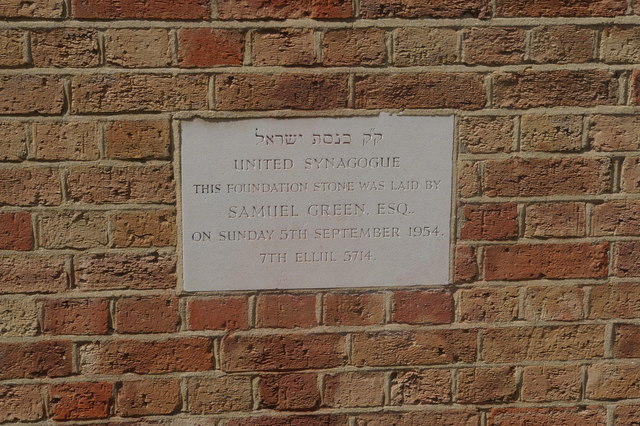

Construction dates decorate the outside of Tifereth Israel synagogue. The year the building was constructed is 1954 — 5714 by the Jewish calendar. The synagogue is celebrating its 100th anniversary this year.MATT RYERSON/Lincoln Journal Star
Erin Andersen – Jul 28, 2013 Updated Jul 29, 2013 – Lincoln Journal Star
My cmnt: I went all the way through public schools with a several Jewish children. I remember one boy very well tho’ we weren’t close friends. However there was one girl, I won’t state her name here, who came to my high school from Argentina. She was so cute and very smart. She knew three or four languages and could write forwards or backwards which was fun to watch. We went to the university together and were briefly friends. She could not date me because I was not Jewish. I didn’t even know she was Jewish but was determined to win her over. I never did.
“Yes, Virginia, there really are Jews in Nebraska.”
Such is the suggested start to Marcia Kushner’s Power Point program looking at the first 100 years of Tifereth Israel, Lincoln’s only conservative synagogue.
Sure it’s flippant — a reference to Francis Church’s famous 1897 Christmas editorial in The New York Sun.
But it is also an accurate reflection on what incredibly few Nebraskans — as well as Jews in other states — know about the state’s rich Judaic history.
The first Jewish settlers arrived before Nebraska became a state. Fleeing persecution and annihilation in Russia and eastern Europe, they arrived in America by the tens of thousands in search of freedom.
“They were looking for a place to practice Judaism, rather than just looking for freedom,” explained Nancy Coren, a lifelong Tifereth Israel member and the synagogue’s longtime spiritual lay leader.
Today, an estimated 8,000 Jews live in Nebraska. The vast majority call Omaha home.
About 800 Jews are in Lincoln — about 100 belong to Tifereth Israel — and many are direct descendents of some of Lincoln’s very first Jewish settlers.
There is an old Hebrew phrase: L’dor VaDor.
It translates to “from generation to generation” and it aptly captures the story of Tifereth Israel.
* * *
This week, nearly 200 past and present congregants, cantors and rabbis will gather at the synagogue at 32nd Street and Sheridan Boulevard. The celebration begins with Shabbat (sabbath services) at sundown Aug. 2 and will stretch to Aug. 4 with bountiful meals, participatory worship and memories galore, said Kushner, who is helping to organize the event.
In contrast to its older and architecturally stunning sister — Congregation B’nai Jeshurun (aka South Street Temple) at the corner of South and Harwood streets — the red brick Tifereth Israel shul is rather nondescript — looking more like a small school than a house of worship. Tucked behind towering trees and mere yards from a boulevard roundabout, it is easy to miss in this neighborhood of historic mansions. Many Lincolnites probably don’t know it’s there — let alone have heard about it.
But that is about to change as we take you on a journey of Lincoln’s Judaic history and the little synagogue that created the bridge between orthodox Judaism and the always-changing world.
* * *
A synagogue is not exactly the Judaic equivalent of a Christian church.
Yes, it is a house of worship, but it is also a school, a gathering place and, in many respects, a home — with lots of Jewish mothers and fathers. It is the nucleus of a vibrant conservative Jewish community.
“Judaism is more than a way of prayer. It is a way of life,” Coren said. “From the way you eat, to the way you study to the way you approach individuals on a one-to-one basis … it affects everything you do.”
It is based on Jewish law as laid out in the Torah, the first five books of the Hebrew Bible.
At the core is the belief that God created a good world that is intended to be harmonious, just and peaceful. The task for humanity is to take care of that world and to imitate God’s qualities as well as possible. Taking care of others, putting their needs first, is principle.
There are three branches of Judaism:
* Orthodox Jews strictly follow all 619 of the Jewish laws, viewing every word of scripture as divinely inspired.
* Reform Jews remain bound to the ethical principles but leave it up to individuals to decide whether to follow dietary and other traditional rules.
* Conservative Judaism — of which Tifereth Israel is — falls between the two. A more moderate movement, it follows traditional Jewish legal laws but allows flexibility in dealing with new and changing situations that come with time, technology and modern society.
“If you want a place in Lincoln, Nebraska, where you can go to synagogue and find a kosher kitchen, then this is the place,” Coren said. “If you want a place that still observes Holy Days in accordance with the Jewish calendar, then this would be the place. We have a different way of looking at our responsibilities — where it is OK to be lenient and where it is not.”
And change, while not always easy, definitely has come to Tifereth Israel during the past 100 years.
“Nothing stays stagnant,” Kushner said. “Conservative is a way to adapt old Jewish law with a changing society.”
* * *
According to historical newspaper clippings, the first Jews — two brothers from St. Louis — arrived in 1855.
During the next few decades, more Jewish settlers trickled into Nebraska — many of central European origin.
Marcia Kushner’s in-laws were among the the early arrivals. They fled Russia and the czar’s “pogroms” limiting where Jews could live, what they could do and what they could own for as long as they refused to convert to Christianity.
As the czar’s rule became more violent — rape, murder, genocide — Jews fled en masse, Kushner said. By 1881, the number of Jews arriving — and staying — in New York City became unsustainable. Fearing over-population would trigger more anti-semitism and cut off the flow of immigrants, a plan was forged to move Jewish immigrants out West.
Historical records show that 2,000 Jews were relocated to Nebraska between 1901 and 1917 by the Industrial Removal Aid Society, a program that trained Jews and provided loans so they could become farmers.
Another effort — the “Galveston Plan” — had Jewish immigrants completely bypass New York City. Kushner’s parents arrived in the United States at Galveston, Texas — from there, like 10,000 others, they were resettled in nearly every state west of the Eastern Seaboard.
The Hebrew Immigrant Aid Society was formed, relocating Jewish newcomers to communities in need of their individual talents and vocations. In turn, they found jobs, support, a Judaic education for their children and a sense of family.
In essence — Jews taking care of their own — it’s a tradition that continues in the 21st century.
“The concept of being able to maintain cultures and traditions and be who you are always has been very much of this congregation,” Coren said.
In fact, it was the reason Coren’s father, Leon Chesnin, took the post of professor of agriculture at the University of Nebraska in the 1940s — because of its vibrant Jewish culture, Coren said.
Tifereth Israel actually was Lincoln’s third synagogue.
B’nai Jeshurun (South Street Temple), the reform congregation, began in 1884.
In 1898, Talmud Torah, a small orthodox congregation, started.
Five years later, Tifereth Israel formed, offering a balance between Jewish traditions and life in a largely Christian community.
Like the orthodox synagogue, Tifereth Israel’s congregation was small — frequently too small to gather a quorum of 10 “minyan’’ for services or gatherings. Back then, only men — ages 13 and older — were counted toward a minyan. Both congregations also struggled to provide a strong Jewish education for their children — an education that begins with preschool and continues through high school with youngsters learning how to read, sing and write Hebrew — the language of the Torah.
In 1910, Talmud Torah merged with Tifereth Israel.
Three years later, Tifereth Israel opened its first synagogue at 18th and L streets.
The $13,000 structure was built in a neo-classical revival style of architecture commonly used for small-scale synagogues of the time.
Most congregants lived within walking distance — allowing them to adhere to a Jewish law forbidding driving on the sabbath (sundown Friday to sundown Saturday).
For 41 years the building served as the synagogue, then in 1954, Tifereth Israel built a new synagogue on the corner of 32nd Street and Sheridan Boulevard.
Coren, who was only 4 years old at the time, remembers the procession of congregants carrying Torahs and artifacts from the old building to the new.
Today, the original building is a landmark, listed on the Register of Historic Places. For a time it was home to Circlet Community Theatre (a precursor to the Lincoln Community Playhouse) and later housed Bedient Organ factory. Today, it houses apartments.
* * *
“We are a very close-knit society,” Kushner said. “Our lives revolved around the synagogue.”
Looking back, Sherrill Kushner, Marcia’s niece, estimates she probably spent more time growing up at Tifereth Israel than she did in her family’s home.
“Between Hebrew school, junior congregation, Shabbat services, holiday celebrations and later USY (youth club) meetings … Tifereth Israel was my home away from home,” Sherrill Kushner wrote in an email.
Nearly all of life’s activities, celebrations and remembrances occur in the synagogue, all voluntarily conducted by its congregants — be it teaching Hebrew classes, cooking meals, sending money to oppressed Jews overseas or taking part in national movements to end antisemitic activities. The synagogue also promotes health care and education, and it advocates on behalf of women’s issues in the Jewish community.
Always, the congregation has opened its arms, wallets and synagogue doors to Jewish immigrants — be they Holocaust survivors or the 1960s “refuseniks” in the Soviet Union.
Children begin learning Hebrew at age 3. During the next 10 years, they prepare for their bar/bat mitzvahs (coming of age) ceremonies and celebrations. During that time they learn to read, write and speak Hebrew. They learn how to read the Torah and understand the various interpretations of Jewish law over the millennia.
The synagogue takes care of the education. Members teach classes. The congregation foots the entire bill, allowing families to send their children tuition-free.
“The children who grew up here are all of our children,” Coren said, with dozens of “parents” teaching them right from wrong, helping them learn to walk independently and standing by their sides through thick and thin, good and bad.
Always the hub of the conservative Jewish community, Tifereth Israel has had to change with the times — particularly with the role of women.
Men and women once sat in different areas of the synagogue. The original Tifereth Israel building at 18th and L streets had a balcony for women and children. Marvin Friedman remembers sitting beside his grandmother Sarah Diamond during many services.
“Grandma Sarah came to America from Russia in 1923, and, both in the old country and in Lincoln, she was a ‘zogarke’ — literally ‘one who tells,’” Friedman wrote in a letter. “This meant she could read and write in Yiddish. She had a Yiddish prayer book and was surrounded in the synagogue balcony by a group of illiterate immigrant women. She would read the prayers to them in Yiddish so that they could follow the service being conducted on the main floor.”
Women were not counted as “minyan” quorum. They could not read from the Torah during services.
But in the 1970s, Marcia Kushner’s daughter Cathy Kushner became a driving force in a change the likes of which the congregation never anticipated.
Cathy Kushner chaired a committee to study whether to expand the role of women — as many other conservative synagogues were beginning to do across the country.
The study took 18 months. The recommendation to expand the role of women was divisive. It passed by only one or two votes, Marcia Kushner recalled. But the issue was hardly over. As a compromise, the synagogue gave men and women an option of attending a smaller service in keeping with long-held traditions.
“Nobody left the synagogue over it,” Marcia Kushner recalled. By the early 1980s the issue dissolved, “and it became the most natural thing in the world for females to carry the Torah and read from the Torah.”
One cannot reflect on Jewish history — and Jewish women — without mentioning food.
As with all cultures, food is an integral part of every life occasion. And at Tifereth Israel women always were in the kitchen cooking, Marcia Kushner said, making dinners for Friday nights, Saturday afternoons, bar and bat miztvahs, weddings, funerals, holy holidays and just about everything else.
Many women became identified by their specialty baked goods, Kushner recalled — Louise Lottman’s tiny tarts, Elaine Evnen’s chocolate-dipped cherries, Mrs. Misle’s challah and challah rolls and ultimately Kushner’s own peanut butter balls.
Today, those and all the other old traditions continue to be passed from generation to generation.
L’Dor Va Dor.
“We are a very participatory synagogue. That’s the beauty of living in Lincoln. If you are going to be here, you have to participate,” Coren said. “We have a more engaged and invested group of individuals — they do it for themselves and the people who will come after, as a tribute to those who were here in the beginning.”
Reach Erin Andersen at 402-473-7217 or eandersen@journalstar.com.
 Lord Buckbeak: "Will you come into my parlor?," said the Spider to the Fly.
Leave a comment