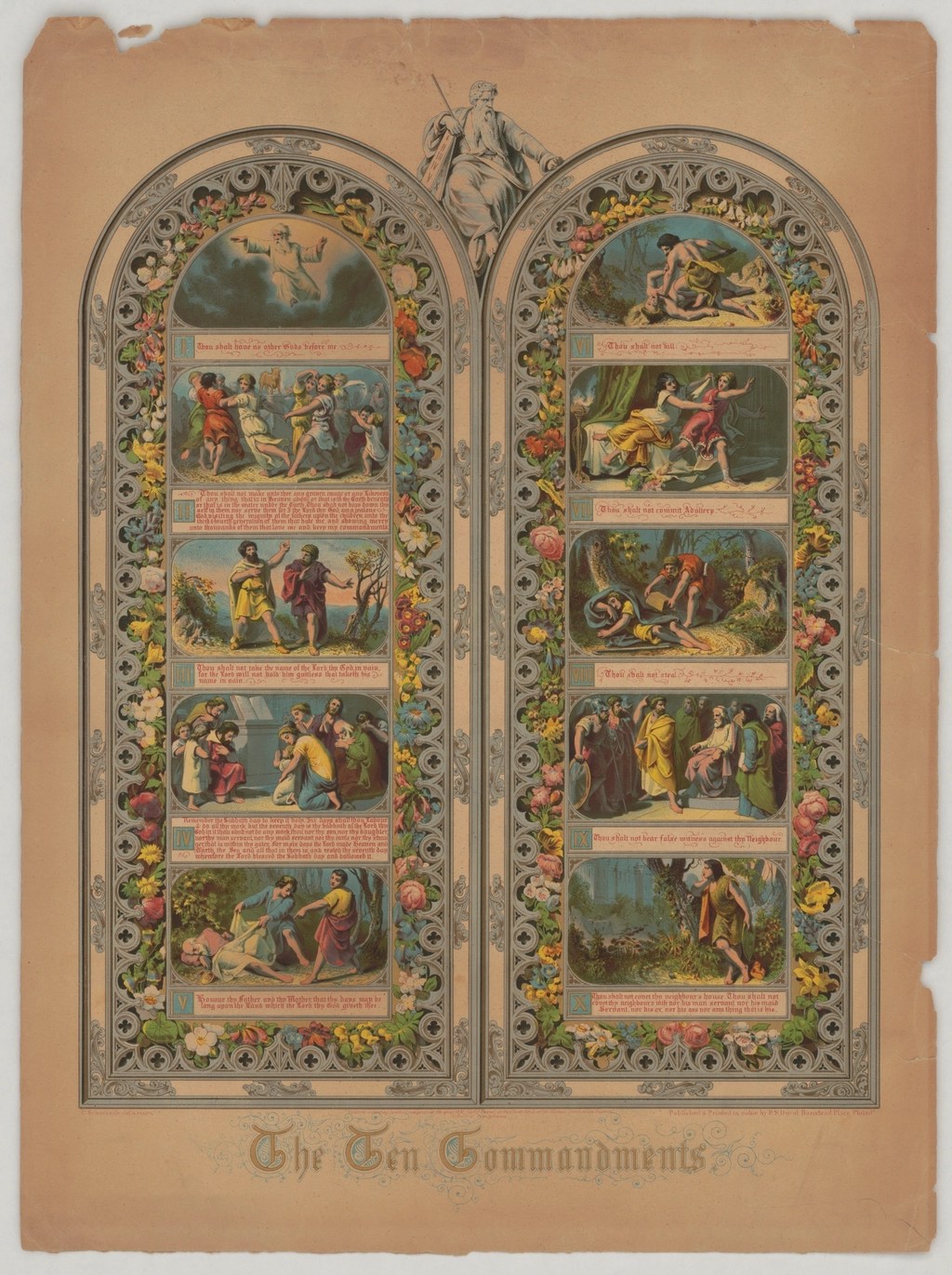
Note: You can read the Ten Commandments here in Deuteronomy 5.
It is important to note that not everything in the Ten Commandments is a negative “Thou shall not” for there are two “Thou shall”s in there also. The fourth commandment states to observe the Sabbath rest and the fifth to honor your father and your mother, the first commandment with a promise.
Now I’ve heard many a sermon on keeping the Sabbath holy but none on the other part of that commandment which states “Six days you shall labor and do all your work”. Somehow (I know how) in the 20th century we got a weekend to rest rather than one day and the work day shrunk to eight hours. So I’m stating here that IF you are an invested Sabbath keeper then you must also be a six day worker, and that means 12 hour days not just 8 (for Jesus said “Are there not 12 hours in a day”).
I point this up because the big national sin of our day is failing to work. Since WWII we have been chided by the Europeans for being workaholics while they have consistently moved towards a 32 hour work week with six weeks (or more) of paid vacation whether you’ve earned it (by seniority) or not. I have listed here as many scriptures on work as I have been able to find, and there are a lot of them. Work is not a curse but a blessing and if I Robot (at least the movie) ever comes to past it won’t be sentient robots (or androids) that we have to worry about but a whole nation become like every big, democrat-run, blue inner city. When unattached males have no work skills, will not work (except prostitution, drug-running, muggings and theft) and have too much dead time on their hands – there will be blood (see the numerous postings on this website under the category of “democrat gun violence”).
This general blindness to the other “thou shall” in the fourth commandment is also found among most conservative commentators on Genesis 2 and 3 concerning the Garden and the Fall.
Typically they will state that God gave only ONE command to Adam in the Garden of Eden which was to NOT eat of the Tree of Knowledge of Good and Evil. But there was also given a positive command to EAT of EVERY tree in the Garden except the Tree of Death.
Gen 2:15-17 “The Lord God took the man and put him in the garden of Eden to work it and keep it. 16And the Lord God commanded the man, saying, “You may surely eat of every tree of the garden, 17but of the tree of the knowledge of good and evil you shall not eat, for in the day that you eatd of it you shall surely die.”
Most commentators completely ignore the most significant and important Tree in the Garden, that is the Tree of Life. To eat of the Tree of Life is to live forever. To not eat of the Tree of Life is to be subject to the will and power of the Devil. I have written about this here.
So to reiterate, there are two positive commands in Holy Scripture (i.e., the Bible) that we ignore at our peril. The first was to eat of the Tree of Life and the second is to work six days and rest one. We are urged to again eat of the Tree of Life which is Christ and to live forever. To not eat of Him is eternal death. Yet as Paul notes, and surely happened in the Garden, the Tree of Life smells like death to those who are perishing but has the very aroma of life to those who are being saved. The Tree of Death is perceived with the eyes and therefore deceives unto eternal damnation while the Tree of Life is perceived with the eyes of Faith and brings us from death into eternal life in Christ.
Barnes’ Notes on the Bible
Matt 13:56
Is not this the carpenter’s son? – Mark says, “Is not this the carpenter, the son of Mary?” Both these expressions would probably be used in the course of the conversation, and Matthew has recorded one and Mark the other. The expression recorded by Mark is a strong, perhaps decisive proof that he had himself worked at the business until he was 30 years of age. The people in the neighborhood would understand well the nature of his early employments. It is therefore almost certain that this had been his manner of life. A useful employment is always honorable. Idleness is the parent of mischief. Our Saviour, therefore, spent the greatest part of his life in honest, useful industry. Until the age of 30 he did not choose to enter on his great work; and it was proper before that time that he should set an example to the world of honorable though humble industry. Life is not wasted in such employments. They are appointed as the lot of man; and in the faithful discharge of duties in the relations of life, though obscure; in honest industry, however humble; in patient labor, if connected with a life of religion, we may be sure that God will approve our conduct. It was, moreover, the custom of the Jews – even those of wealth and learning – to train all their children to some “trade” or manual occupation. Thus Paul was a tent-maker. Compare Acts 18:3.
This was, on the part of the Saviour, an example of great condescension and humility. It staggers the faith of many that the Son of God should labour in an occupation so obscure and lowly. The infidel sneers at the idea that “He that made the worlds” should live thirty years in humble life as a poor and unknown mechanic. Yet the same infidel will loudly praise Peter the Great of Russia because he laid aside his imperial dignity and entered the British service as a “ship-carpenter,” that he might learn the art of building a navy. Was the purpose of “Peter” of more importance than that of the Son of God? If Peter, the heir to the throne of the Czars, might leave his elevated rank and descend to a humble employment, and secure by it the applause of the world, why might not the King of kings evince a similar character for an infinitely higher object?
His brethren, James … – The fair interpretation of this passage is, that these were the sons and daughters of Joseph and Mary. The people in the neighborhood thought so, and spoke of them as such.
 Lord Buckbeak: "Will you come into my parlor?," said the Spider to the Fly.
Leave a comment