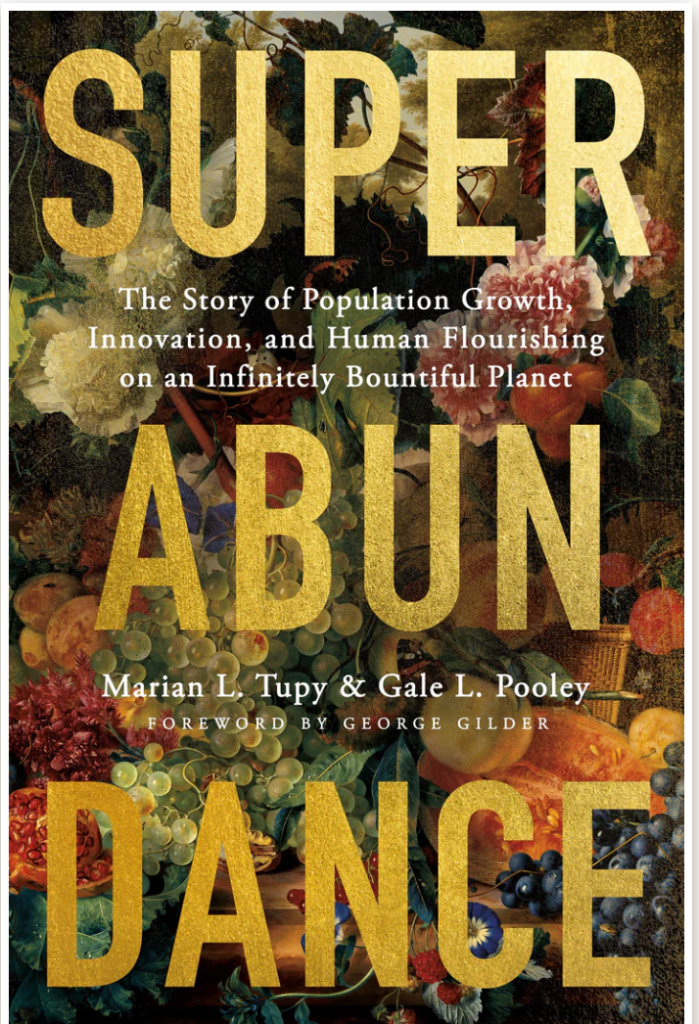
The Story of Population Growth, Innovation, and Human Flourishing on an Infinitely Bountiful Planet
This controversial and counterintuitive new book examines why population growth and freedom to innovate make Earth’s resources more, not less, abundant.
AUGUST 2022 • PUBLISHED BY CATO INSTITUTE
By Marian L. Tupy and Gale L. Pooley
“For centuries, the ivory towers of academia have echoed this sentiment of multitudinous ends and limited means. In this supremely contrarian book, Tupy and Pooley overturn the tables in the temple of conventional thinking. They deploy rigorous and original data and analysis to proclaim a gospel of abundance. Economics―and ultimately, politics―will be enduringly transformed.”
―George Gilder, author of Life after Google: The Fall of Big Data and the Rise of the Blockchain Economy
Generations of people have been taught that population growth makes resources scarcer. In 2021, for example, one widely publicized report argued, “The world’s rapidly growing population is consuming the planet’s natural resources at an alarming rate . . . the world currently needs 1.6 Earths to satisfy the demand for natural resources . . . [a figure that] could rise to 2 planets by 2030.” But is that true?
After analyzing the prices of hundreds of commodities, goods, and services spanning two centuries, Marian Tupy and Gale Pooley found that resources became more abundant as the population grew. That was especially true when they looked at “time prices,” which represent the length of time that people must work to buy something.
To their surprise, the authors also found that resource abundance increased faster than the population―a relationship that they call “superabundance.” On average, every additional human being created more value than he or she consumed. This relationship between population growth and abundance is deeply counterintuitive, yet it is true.
Why? More people produce more ideas, which lead to more inventions. People then test those inventions in the marketplace to separate the useful from the useless. At the end of that process of discovery, people are left with innovations that overcome shortages, spur economic growth, and raise standards of living.
But large populations are not enough to sustain superabundance―just think of the poverty in China and India before their respective economic reforms. To innovate, people must be allowed to think, speak, publish, associate, and disagree. They must be allowed to save, invest, trade, and profit. In a word, they must be free.

PRAISE FOR SUPERABUNDANCE
“With great writing and a mountain of good evidence, Tupy and Pooley remind us that we are immeasurably better off than our ancestors. In this day of pestilence, war, and climate change, we need that reminder, and we can hope that the doom‐mongers will be wrong about the future, just as they have always been wrong about the past.”
—ANGUS DEATON, Nobel Prize–winning economist
“For centuries, the ivory towers of academia have echoed this sentiment of multitudinous ends and limited means. In this supremely contrarian book, Tupy and Pooley overturn the tables in the temple of conventional thinking. They deploy rigorous and original data and analysis to proclaim a gospel of abundance. Economics―and ultimately, politics―will be enduringly transformed.”
—GEORGE GILDER, author of Wealth and Poverty, Knowledge and Power: The Information Theory of Capitalism and How it is Revolutionizing our World
“People don’t depend on stuff; they depend on ideas—formulas, algorithms, knowledge—which allow stuff, useless by itself, to satisfy our wants. In this lucid and illuminating book, Tupy and Pooley lucidly use this insight to explain a fact that, surprisingly, surprises people: over the centuries, our increasing knowledge has made more stuff available to us.”
—STEVEN PINKER, author of Enlightenment Now: The Case for Reason, Science, Humanism, and Progress
“There are those who wish for scarcities, and who work to inhibit economic growth, so that government can claim an excuse to ration this and that. Happily, they have met their match in Tupy and Pooley, who demonstrate that population growth is not a problem, it is the solution—the most important resource.”
—GEORGE WILL, Washington Post

“Superabundance pulls off the remarkable feat of being both exhaustive and entertaining at the same time. It adds a critical piece to the growing canon of books documenting the rapid improvements in the quality of human life: an explanation that is grounded in rapid population growth. Anyone who cares about the future of humanity should read this book.”
—JASON FURMAN, professor of the practice of economic policy, Harvard University, and former chair of the Council of Economic Advisers
“In their essential and provocative new book, Tupy and Pooley show that the ultimate resource remains human ingenuity. Superabundance is a must read for anyone who cares about the fate of humankind and our bountiful, beautiful planet.”
—MICHAEL SHELLENBERGER, author of Apocalypse Never: Why Environmental Alarmism Hurts Us All
“The decline of poverty and famine and disease and violence over the past few decades has been spectacular, as Tupy and Pooley demonstrate. There is every reason to think it can continue and our grandchildren will look back on today’s world with horror and pity. This book is a comprehensive, detailed, and devastating riposte to the perpetual pessimists who dominate modern discourse.”
—MATT RIDLEY, author of The Rational Optimist: How Prosperity Evolves and How Innovation Works: And Why It Flourishes in Freedom
PAUL ROMER, Nobel Prize winning economist and former chief economist, World Bank
“As the number of humans grew from millions to billions, the much-feared crisis of resource scarcity turned out to be a mirage. Fifty years ago, the Club of Rome said that civilization would collapse because of a scarcity of fossil fuel. Now, any thinking person has to recognize that the real, and very dangerous, problem is that there is too damn much. We live with the benefits (and occasional costs) of the superabundance exhaustively documented by the authors, yet for far too many people, the mirage of the scarcity crisis has hardened into delusion. Because they deny the many real benefits from superabundance, they cannot grasp the simple fact that when harmful side effects are present, it is abundance that threatens us, not scarcity. As a result, they fail to see that all it takes to address the few cases of harmful abundance is to redirect the dynamic of discovery behind superabundance. After scientists learned that CFCs were destroying the ozone layer, governments adopted policies that halted the production of CFCs and encouraged an abundance of safe alternatives. If the facts documented here can free people from the apathy of delusion and help them see the optimistic possibilities revealed by pervasive superabundance, the way forward will be obvious.”

5.0 out of 5 stars There are no limits to growth other than those we self-impose.
Reviewed in the United States on November 25, 2022
Ronald Reagan said “There are no limits to growth and human progress when men and women are free to follow their dreams.” In Superabundance: The Story of Population Growth, Innovation, and Human Flourishing on an Infinitely Bountiful Planet the Cato Institute’s Marian Tupy and Brigham Young professor Gale Pooley make a cogent, empirically-grounded case for Reagan’s full-throated optimism.
For the last several centuries affluence and lifespans have been increasing. The authors enthuse “we have accumulated a store of knowledge that has allowed us to reach escape velocity from scarcity to abundance somewhere toward the end of the 18th century.” In the 20th century with a massive increase in population, abundance has exploded worldwide.
Yet notwithstanding mankind’s enormous and continued progress, an almost religious pessimism persists.
In “Essay on the Principle of Population”, Malthus argued resources were finite, and, consequently, population growth would bring ruin on mankind. The Club of Rome’s The Limits to Growth and Paul and Anne Ehrlich’s The Population Bomb, picked up the doomsaying baton. Their contention that limited natural resources meant more people were an existential threat to humanity today holds sway among the Davos set.
In the 1970s grim Malthusianism informed Communist China’s brutal program of one-child-per-family and forced abortions. The authors persuasively assert China would be massively more prosperous today with 400 million more “somewhat free” people. Faced with a demographic crisis of its own making, the CCP has reversed course and relaxed restrictions on having children.
Many Western elites still view people as a liability rather than as an asset. Climate-change and Malthusian apocalyptists thunder more people will exhaust limited resources and attendant economic activity increasing atmospheric CO2 will cause climate catastrophes.
Yet more affluent societies are better able to deal with Mother Nature. Since 1920, with higher atmospheric CO2 levels from increased fossil-fuel use, climate-related disaster deaths have plummeted by 98%. Pious Greens virtue-signal by not having children. While not having children is a choice couples are free to make, it won’t help humanity.
Tupy and Pooley persuasively contend knowledge not physical stuff drives ever-increasing abundance. People free to innovate and increase the stock of knowledge are, therefore, an asset.
Natural physical resources haven’t limited growth. “The Earth’s atoms may be fixed, but the possible combinations of those atoms are infinite.” What matters isn’t our planet’s physical limits but rather people’s freedom to experiment, reimagine, and improve use of existing resources. More knowledge and people beget more knowledge, producing ever-greater abundance.
Economist Tom Sowell observed cavemen had the same natural resources as 21st-century men. Greater knowledge is why we enjoy more prosperous and longer high-quality lives than cavemen.
When resources increase faster than population, it’s “superabundance.” Viewed through the lens of “time prices” the world is enjoying an era of superabundance.
Tupy and Pooley use time prices rather than the more familiar measures of real GDP and PPP per capita, to document global superabundance. Time prices calculate the hours and minutes needed to earn the money to buy goods and services. They’re universal true prices.
The time price to acquire rice as food for a day in India dropped from about seven hours in 1960 to under an hour today. The time price of wheat for a day in Indiana dropped from an hour to 7.5 minutes. The Indian has gained 6 hours and 2 minutes and the Hoosier 52 minutes.
From 1850 to 2018 US blue-collar workers’ average nominal hourly compensation rose from $.06 to $32.06. Using nominal prices, the average time price of 26 commodities like sugar, nickel, corn, steel, and coal, fell by a whopping 98.3%. “Personal resource abundance” (PRA) measures how much people can buy in time prices. The average PRA increased by 5,762% during this 168-year period.
Between 1919 and 2019 US blue-collar workers’ average nominal hourly compensation rate rose from $.43 to $32.36 while the time price of 42 food items fell 91.2%. The average PRA increased by 1,032%.
Turning to information processing, the authors calculate for the same amount of work a blue-collar worker had to do in 1969 to perform a slide-rule-based calculation, using an iPhone12 in 2020 he could buy 1.574 trillion calculations.
Superabundance can and should continue indefinitely. Reversing course would be a choice, a choice for malaise over a world of plenty.
The limits to human flourishing are self-imposed anti-growth policies whether animated by millenarian climate-change apocalyptists or imposed by oppressive regimes like North Korea and Venezuela.
Innovation relies on population growth and the freedom to exchange goods and ideas. The larger the population, the larger the market and the more specialized people can become. In the book’s forward futurologist George Gilder rhapsodizes “everywhere entrepreneurs are free to create and market their inventions, time prices fall.”
“Economics prosper to the extent that knowledge, intrinsically dispersed through the system in the minds of individuals, is complemented by a similar dispersion of power.” Combinations of government and business frustrate it.
Prices guide capital – human, intellectual, financial, social, cultural, and physical, to address problems and opportunities. Doomsayers underestimate or ignore motivated men’s capacity to solve problems and improve the human condition.
Superabundance is an eminently-readable antidote to dour Malthusian and Green-fundamentalist dogma. The bigger and freer the global network of people, the greater superabundance.
ABOUT THE AUTHORS
GALE POOLEY is an associate professor of business management at Brigham Young University‐Hawaii, coauthor of the Simon Abundance Index, and a senior fellow with the Discovery Institute.
Gale L. Pooley is an associate professor of business management at Brigham Young University-Hawaii. He has taught economics and statistics at Alfaisal Univerity in Riyadh, Saudi Arabia; Brigham Young University-Idaho; Boise State University; and the College of Idaho. Pooley has held professional designations from the Appraisal Institute, the Royal Institution of Chartered Surveyors, and the CCIM Institute. He has published articles in National Review, HumanProgress.org, The American Spectator, the Foundation for Economic Education, the Utah Bar Journal, the Appraisal Journal, Quillette, Forbes, and RealClearMarkets. Pooley is a senior fellow with the Discovery Institute, a board member of HumanProgress.org, and a scholar with Hawaii’s Grassroot Institute. His major research activity has been the Simon Abundance Index, which he coauthored with Marian Tupy.
Marian L. Tupy is the editor of HumanProgress.org, a senior fellow at the Cato Institute’s Center for Global Liberty and Prosperity, and coauthor of the Simon Abundance Index. He specializes in globalization and global well-being and the politics and economics of Europe and Southern Africa. He is the coauthor of Ten Global Trends Every Smart Person Should Know: And Many Others You Will Find Interesting (Cato Institute, 2020). His articles have been published in the Financial Times, the Washington Post, the Los Angeles Times, the Wall Street Journal, The Atlantic, Newsweek, the UK Spectator, Foreign Policy, and various other outlets in the United States and overseas. He has appeared on BBC, CNN, CNBC, MSNBC, Fox News, Fox Business, and other channels. Tupy received his BA in international relations and classics from the University of Witwatersrand in Johannesburg, South Africa, and his PhD in international relations from the University of St. Andrews in Great Britain.
MARIAN L. TUPY is a senior fellow at the Cato Institute’s Center for Global Liberty and Prosperity, coauthor of Ten Global Trends Every Smart Person Should Know: And Many Others You Will Find Interesting, coauthor of the Simon Abundance Index, and editor of the website HumanProgress.org.
 Lord Buckbeak: "Will you come into my parlor?," said the Spider to the Fly.
Leave a comment