14-year-old college recruit tames ‘secret storm’ on the court
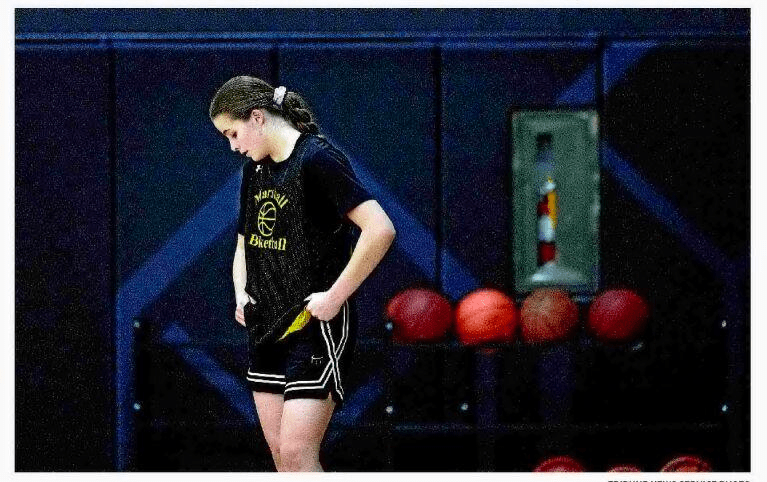
Chloe Johnson takes to the court for practice at Marshall High School in Duluth, Minnesota. The 14-year-old is the star of the varsity team even though she has been challenged by OCD since she was young. TRIBUNE NEWS SERVICE PHOTO
CHIP SCOGGINS | Star Tribune – Jan 28, 2024 – Lincoln Journal Star
My cmnt: I’m fairly OCD tho’ nothing as deep as Chloe. Our son was (and is) even more OCD than myself. My personal testimony is that by placing my trust in Christ and knowing that His power and His love conquers all freed me from the overwhelming superstitious behavior that was starting to torment me and so often accompanies OCD.
HERMANTOWN, Minn. — The basketball gym attached to Chloe Johnson’s house is 64 paces from her bedroom, and her mind is often a whirl of thoughts as she strides past the living room, past the kitchen and through the garage. The distractions in her head disappear when she opens that door and steps onto the court.
This is where 14-year-old Chloe feels free.
Free from worry. Free from intrusive thoughts that can paralyze her. The medical term is “obsessive-compulsive disorder.” Her family calls it a “secret storm.” Not visible by outward appearances, its cruel impact they know too well.
The daily routines and rituals that go by in minutes for others would throughout Chloe’s childhood take her family hours. In addition to OCD, Chloe has been diagnosed with generalized anxiety disorder and a rare childhood condition known as selective mutism. Just leaving the house or talking in public became intense challenges, and Chloe’s parents searched for answers, coping mechanisms, help — anything.
Basketball became their anything, and when it entered Chloe’s life, in some ways, it saved her. For reasons that everyone, including Chloe herself, find difficult to explain, the storm clears on the court.
“It’s my safe place,” she says. In this clarity, there is power. Today, the 5-11, blue-eyed kid with a long, braided ponytail and sweet nature is a straight-A, eighth-grade student and force for the Duluth Marshall varsity team.
She is regarded as one of the best, if not the best, players her age in the country. She already holds scholarship offers from eight universities, including Minnesota, Wisconsin and Maryland.
Her game is a blend of strength and grace. Her brilliance shines not in being flashy but with skills so exceptionally sharp she makes basketball look effortless. Chloe is not yet in high school, but she ranks among the state’s leaders at the varsity level in every statistical category.
Special. Unique. Different. She hears these words often. Chloe will tell you that she is different from other kids, and the tapestry of her young life reveals it.
She is a teenager who doesn’t enjoy being on her phone or using social media. A waste of valuable time, she says. She averages only 18 minutes of screen time per day.
She typically doesn’t listen to music unless she’s on a basketball court, preferably Christian music or a Drake song that doesn’t have profanity. She’d rather binge-watch basketball videos than anything on Netflix or TikTok.
Her bedroom features dozens of figurines of NBA players aligned in a row. If one is shuffled out of the order she has arranged them in, she can spot it immediately after entering the room.
Her basketball trainer refers to her as a savant. Her grandparents call her a miracle.
Chloe has learned to manage her OCD symptoms, but she does not hide her challenges from the world. They make her who she is.
Besides, she says, “I think it’s cooler to stand up for who you are rather than pretending to be someone you’re not.” •••
Her family thought she was just a shy child, totally different from her older brother, Brooks, who is outgoing and chatty. But by age 4, doctors began suggesting therapy. One therapist mentioned selective mutism as an explanation.
Chloe would talk in the presence of her parents, but few others. She often hid behind her parents when they visited friends or relatives. They would reintroduce Chloe to her grandparents and aunt each time they visited, even though they all live a few miles apart and regularly spend time together. Facial expressions were rare.
The first sign of hope — a divine intervention, family members say — happened when she was 7. The entire Johnson clan had gathered for Thanksgiving dinner at Chloe’s grandparents’ home. Someone asked if anyone would like to bless the meal.
Chloe shot her hand up, then started to pray aloud with her eyes closed. Her parents and grandparents and uncles and aunts all looked at each other in stunned silence. They had no idea what prompted her. It just happened.
“Sobbing,” Chloe’s mom, Heather, says. “Goosebumps everywhere.”
Soon after, Chloe ordered for herself at a restaurant, another sign of progress.
“It was almost like she was trapped and all of a sudden, this little gate opened,” Heather says. “Before, she was just a shell.”
Heather is professionally trained in mental health care, but even she was perplexed by Chloe’s exacting routines.
She had to brush her teeth and hair a certain way. When leaving the house, Chloe needed to know where they were going and why, what she should wear, how they would get there, what she should expect once they arrived. Sometimes, they would start the process an hour before they left to make her feel comfortable.
When Chloe was a first-grader, Heather’s sister Steph visited her school daily to provide a calming therapy called dry brushing. She would brush Chloe’s arms and legs and do joint compressions to help relieve anxiety.
If Chloe accidentally brushed up against a classmate’s jacket, she would insist on going home to change clothes. She would throw away pencils if she made a mistake on an assignment.
Her parents prayed for answers and tried different parenting tactics. Nothing provided more than a brief respite. Medication made matters worse.
“We were at our absolute lowest we’ve ever been in our whole life,” Heather says.
Chloe was 10 years old. Two things changed everything: A coach and a story. •••
A friend’s birthday was approaching in the summer of 2019, and Chloe wanted to make a special book that expressed how much he meant to her. She included pictures of the two of them together and put a lot of thought into her words.
The last page had Dyami Starks sobbing.
“Thank you mostly for letting me be me. You changed my life and I’m going to make you proud. Thank you for always making me feel important and thank you for believing in me. I’m different and I’m glad you are, too.
Best buds forever, Chloe #5″ “I make her feel like she’s not alone in this world,” Starks says, still amazed by all that has transpired in the five years since they met.
He grew up in Duluth, a standout at Duluth East before playing Division I basketball at two schools, Columbia of the Ivy League and Bryant University in Rhode Island.
Starks played four seasons overseas, then moved home to help support his mom and younger sister after his dad died in 2015. Will Starks was well known in the Duluth basketball scene as a coach and skills instructor. Dyami picked up the torch.
The Johnsons wanted to find extra training for Brooks when he was in sixth grade and heard about Starks. They brought third-grader Chloe, too.
Chloe didn’t say a word. She treated every drill with a seriousness that was astonishing for someone so young. Starks was struck by how hard she worked.
The Johnsons kept going back. Starks could tell something was different about Chloe. On the court, she was strong and fluid in her movement. She worked tirelessly at everything he threw at her. She attacked drills with purpose, as if needing to perfect them.
Chloe insisted on training with Starks every day, sometimes twice. Any break in the routine made her feel uneasy, even on family vacations. Starks, 31, became so integral in her daily existence that Chloe’s parents essentially welcomed him into their family.
Why him? That’s a question he finds hard to answer, beyond their mutual love of basketball. Perhaps it’s because he’s supremely detailed and focused like Chloe.
“I can crack her code,” he says. But away from basketball, OCD kept an unrelenting grip on Chloe and her family. By fourth grade, not long after Starks came into her life, Chloe’s challenges reached a point that felt untenable. Then, Heather’s sister Steph called one morning in February 2019.
A profile of Jake Sullivan, who broke the Minnesota all-time scoring record while wrestling with OCD as a Tartan High star, had appeared in the newspaper. In it, Sullivan shared his struggles and the steps he took to manage his condition. Steph encouraged her sister to contact Sullivan. He listened and provided guidance on how to handle Chloe’s symptoms based on his own experiences. It would require firm parenting, tough love.
Little by little, life improved as Chloe learned to manage her symptoms. Her OCD became less debilitating.
“Did that article change Chloe’s life?” Heather says. “It saved her life.” •••
The Johnsons sold their former home and built a new house with the gym during the pandemic because they recognized the importance of basketball in their kids’ lives. Brooks is a Division I recruit and one of the state’s leading scorers as a junior. The gym serves as a home inside their home.
“Chloe’s mental health largely depends on her ability to be in a situation where she can play basketball,” Greg says. “This is where she feels calm and safe.”
Chloe leaves herself little free time outside of basketball. Her days consist of individual workouts, group workouts, film study and strength training at an ETS Performance center. When she shoots on her own, she tracks her shots to see if she can beat her previous percentages. The idea of goofing around on a basketball court without purpose mortifies her. Friends say she would spend 24 hours a day in a gym if permitted.
Identifying her strength as a point guard is difficult because she excels at everything. Shooting. Passing. Ball-handling. Defense. Starks calls her basketball intelligence “better than anyone I’ve ever known.” •••
Tip-off is at 9:30 a.m. on the first Saturday of December. Marshall’s second game of the season is against Class 2A powerhouse Albany in a tournament at Hopkins High.
Assistant coaches from five Division I programs are scattered across the gym. Minnesota. Maryland. Marquette. Wisconsin. Iowa State. All here to watch the eighth-grader.
Chloe looks dynamic in a loss with seven 3-pointers, 28 points, nine rebounds and eight assists. A typical box score for her.
She joined Marshall’s varsity as a seventh grader and led the team in scoring, rebounding, assists, steals and blocks. The curtain lifted entirely this past summer.
Chloe began the offseason AAU circuit playing at age 13 for the MINN Starks team, coached by Dyami. In June they faced All Iowa Attack’s secondary 17U team, which featured three Division I signees and a few Division II recruits.
Chloe was the best player on the floor, scoring 40 points.
Dickson Jensen, who founded the nationally renowned All Iowa Attack program and coaches the top team, met Chloe and her parents the next day. He invited Chloe to practice with his team the following weekend, which included a scrimmage against players from Drake University. Chloe fit right in.
“I could tell from Day 1 that she is special,” Jensen says.
He felt comfortable enough in his evaluation that he did something he had never done: He put a rising eighth grader on his top team. Iowa’s Caitlin Clark, now a mega-star in college basketball, joined the 17U team the summer before her freshman year.
All Iowa Attack made it to the national championship game of the Nike-sponsored circuit in Indianapolis. Chloe held her own competing against some of the top high school seniors in the nation.
A secret no more, college coaches began contacting Starks to arrange phone calls with her, per NCAA rules.
Starks advises every coach inquiring about Chloe: Don’t talk to her as if she’s a normal 14-year-old kid. Discuss basketball like you would with college players. Her favorite conversations with coaches are high-level, sophisticated ones that go deep on strategy.
Sometimes Heather will listen and can’t help but smile. The kid who barely spoke as a little girl will chat for hours with college coaches without any impediment. •••
The pressure on star athletes being recruited can feel suffocating. Chloe’s timeline in that space started before she reached her teenage years, all while still learning to manage her OCD and anxiety. Her circle makes sure she never feels alone.
She attends a small private school that prioritizes her needs. Chloe finishes the school day two hours earlier than other students because fatigue can exacerbate OCD symptoms. She is permitted to carry her phone with her to class to remove anxiety about whether she would be able to reach her parents if needed.
Routines remain a constant presence in Chloe’s daily life, particularly in the form of counting rituals. She has a certain number of times she brushes her hair when getting ready, a pattern for closing apps on her phone before a game.
Time is meticulously calculated to the minute. She will tell her parents that she will be ready at 3:27 p.m., never rounding off to 3:30.
OCD is not a valve that shuts off completely, but Chloe and her family understand far more about the storm now and how to weather it.
During her hardest moments, Chloe fills pages in journals. One night, she put pencil to paper to explain her willingness to share this story.
“I want people to know I have OCD and I have to work through it every day, but it is possible to be able to have control of it and it can be managed …
“Basketball has helped me through everything I’ve been through and it’s my safe place. I don’t play for highlights and write-ups. I play because I love it and when I play my brain stops worrying and just feels free …
“I also think it’s OK to talk about your struggles because everyone has struggles and you can help other people who are going through the same things.”
 Lord Buckbeak: "Will you come into my parlor?," said the Spider to the Fly.
Leave a comment