BY MARY MCNAMARA – CULTURE COLUMNIST AND CRITIC – NOV. 9, 2023 3 AM PT – LA Times
FOR SUBSCRIBERS (yes, I do subscribe)
My cmnt: I include this column because I always enjoy when Hollywood hypocrites, either the studios or the actors employed by them, fight amongst themselves and reveal their true colors.
The Hollywood strikes may be over, but in many ways the pain has just begun.
For reasons of their own — Greed? Stupidity? Master of the Universe arrogance? — the studios, represented by the Alliance of Motion Picture and Television Producers, decided this spring that it was perfectly acceptable to force the entertainment industry, the state of California and the entire country to suffer through a combined 191-day work stoppage before they would offer contracts acceptable to the Writers Guild of America and the Screen Actors Guild-American Federation of Television and Radio Artists, whose negotiating committee on Wednesday approved a tentative deal that would finally end the actors’ walkout.
For six months, the AMPTP repeatedly offered deals that it knew did not address well-documented industry trends and clearly stated union concerns, and when those deals were not accepted, the “negotiators” walked away and watched their own salaries accrue while the strikers took side gigs and watched their savings vanish.
Now, with Christmas music on the radio and Thanksgiving turkeys in grocery stores, the studios have finally offered the deals they should have offered months ago. And the rest of us are left to reckon with the damage.
The true economic impact won’t be known for some time, but early estimates as to what the combined strikes have cost the California economy hover at more than $6 billion.
Six. Billion. Dollars. While Netflix Chief Executive Ted Sarandos, who pulled in $50 million last year, wittered on about how SAG’s demand for residuals boiled down to a “levy” on subscribers. While Disney CEO Bob Iger expressed his disappointment over the unions’ failure to understand the difficult position the studios were in — even as his company stood poised to pay Comcast at least $8.6 billion for its stake in Hulu.
While more than 100,000 actors and writers languished unemployed for months, with all of the financial fallout for individuals, families and communities that implies.
Even more important, economically speaking, was all the other work stopped by the strikes.
On most movie or TV sets, writers and actors are in the minority, invariably outnumbered by an enormous production team including, but not limited to, directors, the camera department, the art department, lighting and grip, sound, wardrobe, film editors, hair and makeup, stunts and visual effects, craft services, drivers, special effects, security, a gazillion production assistants and, if children and/or animals are involved, tutors and trainers.
Add to that publicists, costume and prop houses and all the local businesses that cater to people working on sets and in writers’ rooms. And every stylist, florist, hotelier, restaurant owner and limo driver who earns money during industry-centered events like film premieres, festivals and galas.
All of whom experienced financial loss and mental anguish during the strikes. None of which will be miraculously corrected the moment production resumes. It will take longer than the strikes lasted for many people so long out of work to regain personal financial stability.
As for the psychological effects, those may be incalculable. How many talented people did the entertainment industry lose when the studios seemed to go out of their way to make it clear that writers and actors — and, by extension, everyone else who makes film and television — were not worth the trouble of coming up with a fair deal in time to avoid the strikes? Then extending the agony again and again before finally offering acceptable contracts?
Many writers I’ve spoken to describe feeling shell-shocked, six weeks after the WGA and the AMPTP first reached a tentative agreement. Though they’re happy to be writing again (even happier now that returning actors will make production possible), some have lost their series, or their deals, and all seem unsure of what the studios want in the already contracting landscape. Longer seasons with more traditional templates? Cost-cutting measures like fewer locations and big-name stars? More emphasis on drawing a big audience than potential awards nominations?
As for the audience, the impact of the dual strikes is just beginning to be felt. Some of us missed seeing red-carpet appearances and interviews with the stars of “A Haunting in Venice,” “She Came to Me,” “Killers of the Flower Moon” or “Exorcist: Believer,” and many of those films suffered at the box office because of it. And I cannot be the only one who was looking forward to “Dune: Part II,” “Challengers” and “Ghostbusters: After Life,” pushed from this fall to 2024.
But the cascading consequences of the strikes will continue for the foreseeable future. Films that were scheduled for 2024 now won’t appear until 2025, including the next “Avatar” sequel. On TV, we’ll have to wait a year for all of HBO and Max’s most popular shows, including “Hacks,” “The White Lotus,” “The Last of Us” and “House of the Dragon,” while Netflix’s “Stranger Things” must cope not only with the added delay but also with the impact that time will have on its young cast and, by extension, the narrative.
And that’s just what’s onscreen. Streaming itself has become an increasingly unattractive proposition for consumers, with platforms raising prices and introducing ad-supported tiers even before the actors’ strike ended. The once-maligned cable bundle now appears to be a bargain.
Even when actually addressing a long-gestating problem, the studios made things worse. For years, executives stubbornly refused to acknowledge what everyone and her sister was telling them — that there were increasingly too many series on too many platforms. Apparently unable to figure out how to fix the problem on their own, they instead forced two strikes to do it for them and now will deliver several years’ worth of course correction all in a lump, blowing up advertising streams, derailing post-pandemic recovery at the box office and battering an ever-diminishing awards season along the way.
But the biggest casualty may be whatever remained of Hollywood’s “magic.”
The dual strikes pulled apart the machinery, proving that the “dream factory” is, in fact, just a factory, with all the financial disparity, disrespect, exploitation and often open hostility between worker and management that afflicts any workplace. All the grateful celebrity interviews and “I want to thank [insert studio here]” awards speeches in the world cannot undo the amount of professional and at times personal rancor that was exposed in the past six months.
Netflix‘s image as a populist, global innovator was dented by Sarandos’ we-own-all-the-data outrage over the unions’ demands for transparency and residuals. Disney‘s family-friendly brand was nowhere to be seen when Iger, speaking from a rich-guy conference in Sun Valley, Idaho, criticized the strikers as unrealistic and “disruptive.” Warner Bros. Discovery CEO David Zaslav, who categorically dismissed the power of HBO by mixing it in with a bunch of Discovery programming and threatened to gut Turner Classic Movies, suggested that writers’ “love for working,” as opposed to fair compensation, would eventually end the strike.
There is cause for celebration, of course. The writers and the actors stood strong, sacrificed much and walked away with far more than they would have received if they had not struck. More important, they exposed the ways in which the digital age has exploited creative workers while purporting to give them more freedom, which should give everyone pause.
Soon people in every part of the entertainment industry will return to work. Empty soundstages will be filled and city streets lined with Star Waggons. Production-adjacent dry cleaners, cafes, florists and delis once again will be flooded by harried assistants. Late-night shows and red-carpet step-and-repeats will sparkle with actor interviews and SAG members can wear their best “Barbie” holiday outfits with no fear of reprisal.
With any luck, the hand-wringing (including mine) about the state of the industry will prove to be overblown. After the 2007-08 writers strike, everyone had all but agreed that reality programming would soon dominate the small screen. Instead, scripted television entered a new and wondrous age and streaming changed the world. After all, the true magic of Hollywood has always been reinvention.
Still, coming off a bruising six months for the industry and the city, it’s not going to be easy to forget the factory and focus on the dream. That’s the thing about magic: Once you’ve seen how it’s done, it’s hard not to feel, well, tricked.

Mary McNamara is a culture columnist and critic for the Los Angeles Times. Previously she was assistant managing editor for arts and entertainment following a 12-year stint as television critic and senior culture editor. A Pulitzer Prize winner in 2015 and finalist for criticism in 2013 and 2014, she has won various awards for criticism and feature writing. She is the author of the Hollywood mysteries “Oscar Season” and “The Starlet.” She lives in La Crescenta with her husband, three children and two dogs.
Actors react to SAG-AFTRA strike ending: ‘We worked hard … didn’t cave … got the deal we needed’
BY CARLOS DE LOERA – NOV. 8, 2023 6:16 PM PT – the LA Times
It only took 118 days, but the actors’ strike finally appears to be over.
On Wednesday afternoon, the SAG-AFTRA negotiating committee approved a tentative deal with the major studios that would end the almost four-month-long work stoppage. “The strike officially ends at 12:01 a.m. on Thursday, November 9,” the union said in a statement Wednesday evening.
“We did it!!!! The Billion+ $ Deal! 3X the last contract! New ground was broke everywhere!,” union president Fran Drescher said on Instagram. “Ty sag aftra members for hanging in and holding out for this historic deal! Ty neg comm, strike captains, staff, Duncan & Ray, our lawyers, the IA team , family and friends. Our sister unions for their unrelenting support! And the amptp for hearing us and meeting this moment! #sagaftrastrong”
To celebrate the end of the historic strike, many actors took to social media to express their joy and relief over the new deal.
“Eternals” actor Kumail Nanjiani wasted no time in sharing his excitement and nodding toward his future self-promotions in an X post Wednesday evening.
“YES!!! Hallelujah. I can tweet a certain trailer that I am VERY EXCITED ABOUT at midnight,” he wrote.
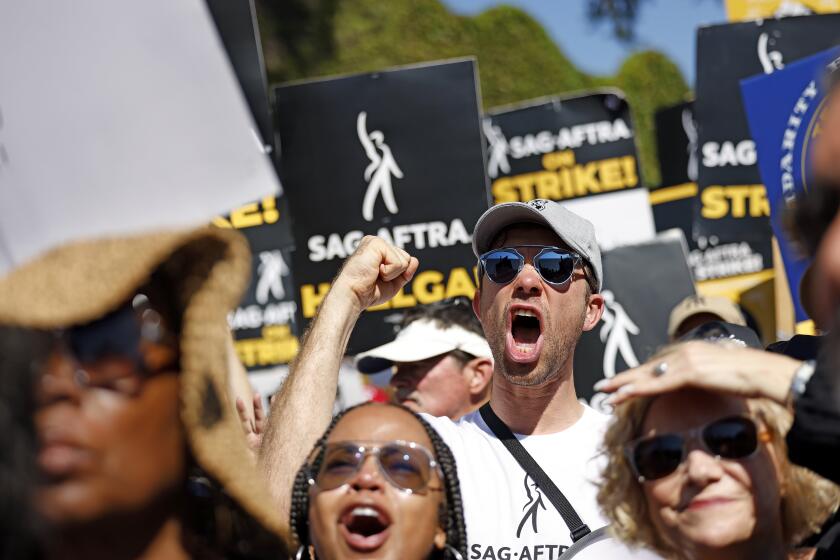
SAG-AFTRA committee approves deal with studios to end historic strike
Nov. 8, 2023
“Yesss! Thank you Negotiating committee!!!! #SAGAFTRA,” Felicia Day of “Supernatural” and “Mystery Science Theater 3000” fame wrote on X.
English journeyman actor Dominic Burgess — who has appeared in the shows “Doctor Who” and “It’s Always Sunny in Philadelphia” and the 2019 film “Ma,” alongside Octavia Spencer — thanked everyone who supported his union for months on end.
“I’m an emotional wreck… thank you to all the wonderful Strike Captains! The negotiating committee! IATSE! Teamsters!” he wrote in an X post. “Everyone who joined us out on the lines! Thank you! From day one of the Writers Strike to the last day of the SAG-AFTRA strike (and down 35lbs).”
“We worked hard,” Lisa Ann Walter of “Abbott Elementary” and “Parent Trap” tweeted. “And didn’t cave when some were trying to force it. And got the deal we needed at the end. #UnionStrong”
“What a tremendous early birthday gift!! #SAGAFTRA,” “Superstore” actor Franchesca Ramsey wrote on X.
Dani Fernandez, who is a union actor and writer, marked the end of her months of striking while advocating for the effectiveness of strikes.
“Union strong. Being both WGA and SAG I have been on strike since May 2nd. Good lord. Thank you to everyone who had our back,” she wrote on X. “Thank you to all my sister unions for joining the lines. Thank you to our strike captains, neg com, and pre guild folks who showed up. Strikes work.”
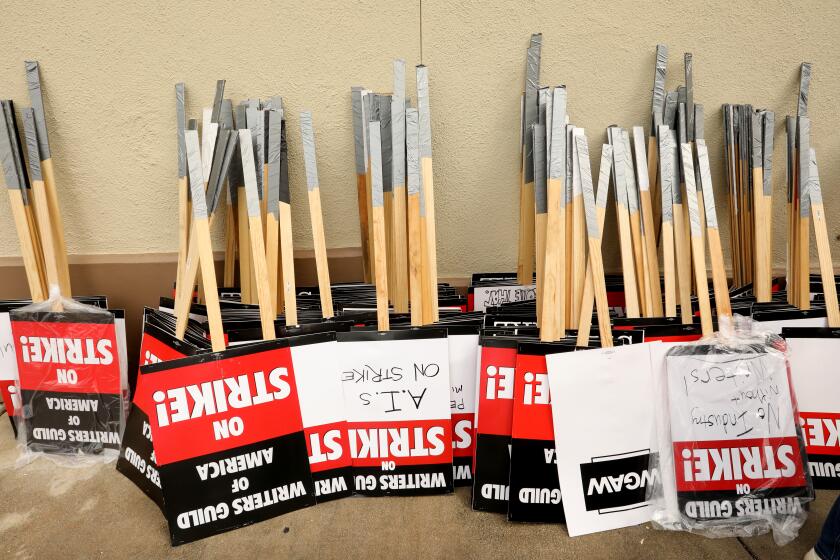
WGA members easily ratify new contract to end 148-day strike as anxieties loom
Oct. 9, 2023
“This almost doesn’t feel real! I’m thrilled and excited to get back to work!” wrote “Being the Ricardos” actor Jamie Miller. “No details released yet but rumor is that the deal is fantastic and that the fight was worth it.”
“Chicago Med” actor Conor Perkins rejoiced over the seeming end of the strike while also clarifying that there are still a few steps to go before the entire ordeal is over.
“We’re not out of the woods just yet. The deal must be approved by a national board vote before being accepted my the membership at large,” Perkins wrote on Threads. “But today is a good day and we cannot thank our @sagaftra. Negotiating Committee enough for their work. Exhale, relax your shoulders, hug somebody. Solidarity forever.”
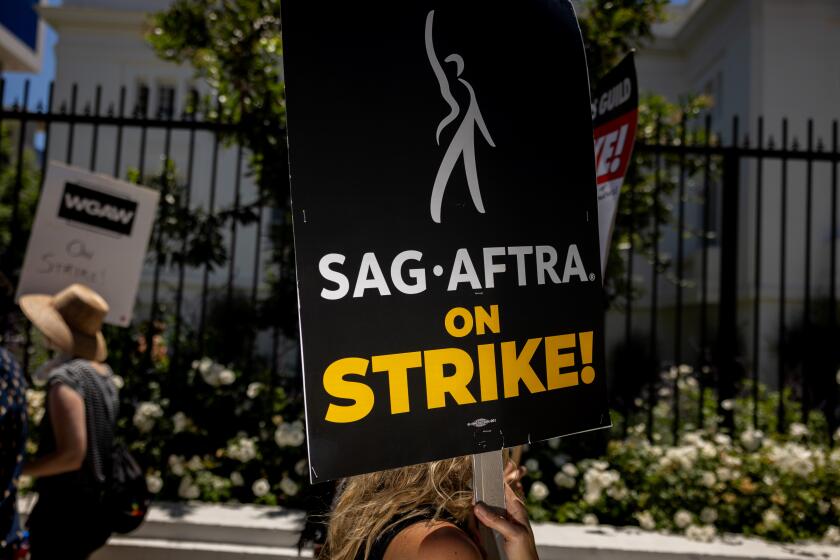
Actors’ strike ends: The SAG-AFTRA deal, what happened and what’s next
2 hours ago
Members of the Screen Actors Guild-American Federation of Television and Radio Artists walked out July 14, joining striking Writers Guild of America members and launching the industry’s first twin strikes since 1960. Writers spent nearly five months on picket lines before reaching a new contract in late September with the media companies’ bargaining arm, the Alliance of Motion Picture and Television Producers.
The tentative SAG-AFTRA contract with the AMPTP — which still must be ratified by the union’s board and members — would boost minimum pay for members, increase residual payments for shows streamed online and bolster contributions to the union’s health and pension plans. It also establishes new rules for the use of artificial intelligence, a major source of concern for actors.
Times staff writers Meg James, Christi Carras and Wendy Lee contributed to this report.
 Lord Buckbeak: "Will you come into my parlor?," said the Spider to the Fly.
Leave a comment