BY EMILY BARONE – MAY 26, 2022 2:36 PM EDT – Time Magazine
My cmnt: A more accurate title would be “The Health and Trauma Costs of illegal handgun shootings in democrat-controlled Inner-cities”. Outside of this on-going gun violence the vast, vast majority of Americans have very little gun violence. Because of democrat-sponsored defund the police actions, no bail, and catch and release policies violent crime (such as car jackings, muggings, etc.) are up – again in large, democrat-controlled cities like Washington D.C. and San Fransisco.
My cmnt: When there is a mass shooting almost every time the shooter was previously identified by friends and relatives, postings on social media, or even the authories themselves, as being dangerous and unbalanced but were ignored by the authorities. The latest mass murderer in Maine was discharged from the military because he was unstable yet the Libs still allowed him to go out and purchase a weapon. These evil bastard democrats WANT more mass shootings so that they can convince the ignorant, stupid or uninformed to allow them to confiscate legal guns from the 100 million Americans who own them for self-defense and as a deterrent to government overreach and oppression.
My cmnt: This article, originating with Time, is therefore biased towards the Left. It tries to equate the relatively few mass shootings (in raw numbers) with the constant and daily shootings (mass and otherwise) that go on forever in our democrat-run inner cities such as Chicago and St. Louis. It does however a good job of showcasing the extensive pain and suffering survivors and their families must endure.
My cmnt: Whenever there is a mass shooting the Libs jump all over themselves demanding the disarming of the millions of middle-class Americans who own guns for self-defense and rarely if ever shoot their neighbors and only occasionally shoot armed criminals trying to do them harm. Whereas almost all of the gun violence in America occurs as black-on-black violence in urban settings. These cities all have the strictest gun control laws in the country yet find it impossible to control the gun violence that still goes on endlessly.
My cmnt: Fatherless young men (or more correctly young men with no father in the home) are the source of almost all of our deadly violence and property crimes. Yet when Republicans seek solutions to this ongoing problem the dems demagogue the issues and invariably accuse Republicans of racism, which also tacitly acknowledges that they know exactly where the criminal violence in our country comes from but steadfastly refuse to do anything constructive about it.
My cmnt: As an aside, when we have a “national conversation” (to use a stupid Lib phrase) about gun violence and start tossing around death-by-guns statistics it s/b remembered that upwards to 65% of gun deaths are due to suicide which costs the public very little financial burden in terms of hospital or long-term care.
It’s impossible to quantify the cost of gun violence. There’s no way to add up pain and grief. No way to multiply that by shock and outrage. But emotional suffering and physical injuries do become real numbers when traumatic shooting events, like other public-health epidemics, contribute to the national health care burden. A 2021 review of hospital costs from the Government Accountability Office revealed about 33,000 inpatient stays and about 51,000 emergency room visits every year to treat firearm injuries. Those initial hospital visits were nearly triple the average patient cost, and collectively topped $1 billion annually. More than half of the cost was for patients with Medicaid and other public coverage.
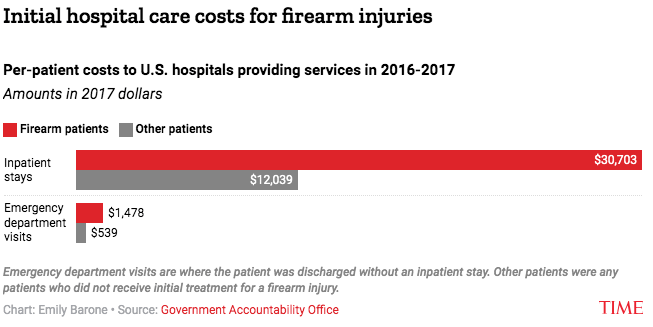
For gun-wound survivors and their families, there’s a hefty price tag affixed to the healing process following a shooting incident, according to a Harvard Medical School study published in April that analyzed Medicare and commercial insurance claims between 2008 and 2018. Compared with their peers, gunshot survivors had a 40% increase in pain diagnoses, a 51% increase in psychiatric disorders, and an 85% increase in substance-use disorders in the aftermath of the shooting. Their family members had a 12% increase in psychiatric disorders.
Among injured survivors in the study, medical spending topped $25,000 per person one month after the shooting. Over 12 months, the costs totaled about $30,000 per survivor—or approximately $2.5 billion when multiplied by the 85,000 people who survive firearm wounds every year in the U.S., the study found. The costs were linked to treating survivors’ physical injuries and also subsequent mental health conditions in the first year following the shooting.
Gunshot survivors included in the study all had insurance coverage, and so didn’t pay out of pocket for all those expenses. Still, the study found that their co-pays and deductibles combined went up about $100 per month, on average, in the first year. What’s more, that financial burden didn’t account for lost productivity, wages, or employment (which could impact their ability to pay for health care), nor did it account for longer-term rehabilitation costs in later years.
For survivors’ significant others, parents, and children, medical spending was nearly $80 higher per person in the first month after the injury, but not statistically different over a one-year period. However, the study didn’t account for the population of families that lost a loved one to gun violence, nor the financial hardships associated with caring for a gunshot victim.
Another analysis from Everytown Research, a gun safety advocacy organization, puts medical costs even higher than the Harvard study, at $3.5 billion a year, though that figure accounts for survivors’ long-term care, coroner services for fatally shot victims (of which there are some 40,000 a year), and mental-health services for family members.
The Everytown analysis notes that, beyond the direct medical and health costs, the overall financial toll of gun violence on American society is hundreds of billions of dollars, including quality-of-life costs that are inherently intangible, but can be loosely estimated based on jury awards and victim settlements.
In the wake of high-profile mass shootings, like the most recent shootings at a Buffalo, N.Y. supermarket and a Uvalde, Texas elementary school, there’s often a flurry of fundraisers to support the affected families and communities. Some instances of gun violence result in remuneration following lawsuits. Such financial buffers—that is, the ones that no one ever wishes for—don’t bring down the costs that the broader health care system has to shoulder. Nor do they relieve the personal and collective sorrow that the U.S. has endured time, and time, and time again.
 Lord Buckbeak: "Will you come into my parlor?," said the Spider to the Fly.
Leave a comment