James Meigs5-Minute Videos – Jul 24, 2023 – Prager U
My cmnt: Nuclear waste in the United States is neither dangerous nor burdensome yet it is being demagogued by the Left (i.e., The Simpsons is a prime example) because they hate truth, justice and the American Way.
Whenever I talk to people about the benefits of nuclear power—how dependable, how efficient, how clean it is—I’m always challenged with this: Yeah, but what about the waste?
Their question is hardly surprising.
The New York Times claims that the U.S. is “awash in radioactive waste.”
The Los Angeles Times writes that “figuring out where and how to safely store radioactive waste is one of the biggest obstacles to nuclear power…”
And Wired magazine warns that even our next generation of reactors “may still have a big nuclear waste problem.”
And so it goes.
Even though the greenest of Greens will admit that nuclear power is a clean source of abundant, reliable energy, many stop short of supporting it.
The nuclear “waste” problem ends discussion before it begins.
After all, why develop this great source of energy if it’s going to poison our air and water with deadly radioactivity?
There’s only one problem with this well-worn disaster scenario. It’s not true.
The nuclear “waste” problem is a myth.
How so?
Let’s start with what nuclear waste actually is or to be more precise what it isn’t.
It’s not a green goo oozing out of rusted barrels like you see on the Simpsons. That’s literally a cartoon.
The real radioactive stuff—usually Uranium-235—comes in hard ceramic pellets. A single pellet contains more energy than a ton of coal or three barrels of oil. Ten pellets can power a typical American home for a year.
These pellets are stacked into narrow, very strong tubes made from zirconium, a natural element much stronger than steel. These are the fuel rods.
There’s nothing gooey or green about this picture. Then, these fuel rods are loaded into a reinforced chamber full of water. This is the reactor.
After the reactor is done using the fuel there is very little material—now called “spent fuel”—to dispose of. If all the electricity you ever used for your whole lifetime came from nuclear power, the spent fuel would only fill a soda can.
According to the U.S. Department of Energy, if you took all the spent fuel generated by all American nuclear power plants for the last six decades and then you piled it on a single football field, it would form a stack just 30 feet high.
That’s it.
America’s entire stockpile of spent nuclear fuel would fit on a single football field. And it wouldn’t even reach the top of the goalposts.
But nuclear waste is uniquely dangerous, activists say. It remains radioactive for thousands of years!
Yes, spent nuclear fuel is hazardous if you get too close to it or ingest it.
But you can say the same thing about ammonia, mercury, chlorine, and other deadly chemicals we use every day in industry—and even in our homes.
Industries follow strict rules to keep the public and the environment safe from those toxins.
Nuclear plants follow much stricter rules when it comes to storing their radioactive materials. Fortunately, it’s not that difficult to keep spent nuclear fuel safe and secure.
After about five years in the reactor, the fuel rods are removed and submerged in a water tank, where their heat and radioactivity gradually subside for several more years.
Finally, the rods are placed in an airtight, stainless-steel vault that’s welded shut and wrapped in a thick layer of reinforced concrete. These are called dry-cask storage units.
These casks are stored—under armed guard—at dozens of nuclear facilities around the country. They don’t take up a lot of space. And they’ve never been involved in a serious accident.
Still, not everyone is happy with this solution.
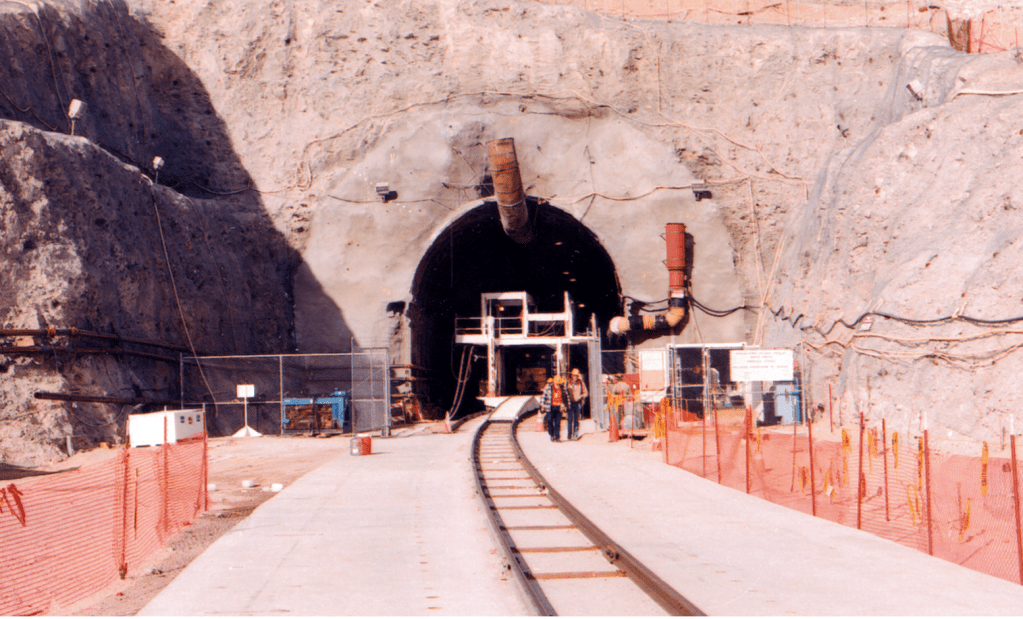
Some experts think we need to collect all that spent fuel and put it in an underground storage facility where it can be locked away basically forever. In 2002, Congress approved building a deep geological repository under Yucca Mountain in Nevada. But the Obama Administration killed that plan. No number of safety studies could convince them it was safe. Maybe they didn’t want to be convinced.
Today, some anti-nuclear activists say we shouldn’t build any more nuclear plants until some sort of underground repository is completed.
They’re wrong.
First, today’s storage casks are perfectly safe. They are well guarded, too heavy to steal, and too tough for bad guys to break into.
Second, the spent fuel inside those casks still contains a lot of usable energy. France, Japan, and other countries reprocess their spent fuel and use it again. We should do the same.
So let’s stop thinking of our dry-cask storage sites as dangerous nuclear waste dumps. They’re safe just as they are. And someday, they could be a convenient source of affordable, climate-friendly fuel.
America needs the abundant clean energy that nuclear power provides. We shouldn’t let groundless fears hold us back.
Let the nuclear power renaissance begin.
I’m James Meigs, senior fellow at the Manhattan Institute, for Prager University.
 Lord Buckbeak: "Will you come into my parlor?," said the Spider to the Fly.
Leave a comment