Term life insurance is cheaper than whole life insurance, but it covers you for only a set number of years.

By Georgia Rose – for Nerd Wallet Updated May 10, 2023
My cmnt: Insurance in general is a real racket. The concept is easy enough while the execution of the idea is a huge money maker for all involved – except the recipients. Warren Buffett is a prime example of a person who realized the potential to get your hands on vast piles of cash by purchasing insurance companies.
My cmnt: The idea of life insurance, which has been around for hundreds of years, is that by a group of people with some fraternal connections (i.e., same church or religion, same company or city or region) pooling their funds into a common kitty then in the event of an untimely death of one or a few of the participants the kitty would be available to keep the family(ies) solvent and safe from financial ruin.
My cmnt: Like the idea of Social Security which was to provide a national pension pool for the common man who would participate by donating a portion of his paycheck (currently 6.5% from you + 6.5% from your employer) into a common kitty then everyone would have some kind of pension upon retirement at age 65.
My cmnt: But as we have seen both with insurance and Soc-Sec the actual product has been perverted to be a lucrative source of employment for those who administer the funds. Currently SS has 65,000 well paid and benefitted employees and administrators who have used the funds for just about everything in additional to the original idea of a common national pension for workers. And insurance companies are so hugely profitable they can afford to name football stadiums after themselves and advertise on the Super Bowl.
My cmnt: So here is the bottom line. Multiply your monthly premium out for the number of years you think you need coverage (typically 30) and take the difference between some level of term vs the same level of whole or universal life (Term means no cash back, Whole means some cash back, & Universal is some combination of the two) and determine if you’re disciplined enough to take the savings and put them into some kind of IRA or if you will just spend it.
The difference between term and whole life insurance can be boiled down to cost and length. Term life insurance is cheaper than whole life and covers you for a set period of time. Whole life insurance typically lasts your entire life and can build cash value, which makes it a more complex and expensive product.
With either policy, your loved ones can spend the payout — called the death benefit — on a variety of costs, such as funeral expenses, mortgage payments and college tuition. But depending on your coverage needs, one type of life insurance may be a better fit than the other.
Term life vs. whole life: Overview
To better understand the difference between term life and whole life, here’s a quick rundown on how each type of coverage works.
Term life insurance
The way term life insurance works is simple: It covers you for a fixed period of time, such as 10, 20 or 30 years, and pays out if you die during the term. If you outlive the term and your coverage ends, your beneficiaries don’t receive any money. Most policies are a type of level term life; the death benefit and insurance premiums are guaranteed to stay the same throughout the term. A decreasing term life policy is slightly different, and less common. The death benefit gets smaller over the length of the term while the premiums stay the same.
Ideally, the length of your term life insurance should match the financial obligation you’re covering. For example, if you’re a new parent, you might buy a 20-year policy to cover you until your child no longer relies on you financially. All of the best life insurance companies sell term life, so it’s easy to find and compare life insurance quotes online.
Whole life insurance
Whole life insurance is the most common type of permanent life insurance and costs more than term life. This is because most policies offer coverage that matures late in life—at 90, 100 or 120 years old, in some cases. Whole life insurance also has a cash value component. A portion of your premium goes toward the cash value, which can grow over time. Once you’ve built up enough cash value, you can borrow against it or surrender the policy for cash.
Although it’s more complicated than term life, the way whole life insurance works is more straightforward than other types of permanent life insurance. Premiums remain level and the cash value grows at a guaranteed fixed rate. The death benefit is also guaranteed, but be mindful of taking out cash value loans or withdrawals without paying them back. While you’re not required to repay them, your insurer will subtract any outstanding loans or withdrawals from the final death benefit paid out to your beneficiaries.
Many whole life insurance policies are “participating” policies, which means you may earn dividends based on the company’s financial performance. You can use your dividends in a few different ways — including boosting your policy’s cash value.
Key differences between term life and whole life
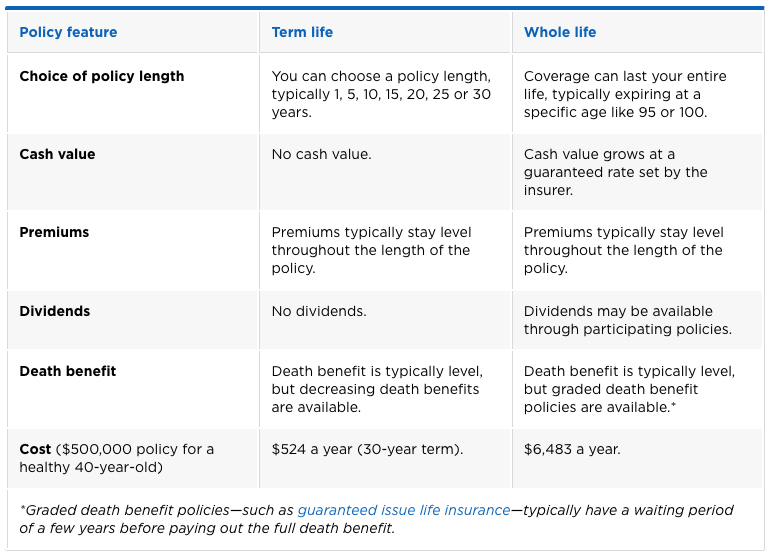
Cost of term life vs. whole life
Term life is often the most affordable life insurance because it’s temporary and has no cash value. Whole life premiums are much higher because the coverage typically lasts your lifetime, and the policy grows cash value. Here’s how annual premiums compare for term life policy vs. whole life.
Average annual life insurance rates for women

Average annual life insurance rates for men

How to choose between term and whole life insurance
Term life is sufficient for most families, but whole life and other forms of permanent coverage can be useful in certain situations.
Choose term life if you:
- Only want coverage for a specific period of time. A term life policy can replace your income if you die while you still have major financial obligations, such as raising children or paying off your mortgage.
- Want the most affordable coverage. Term life insurance is the least expensive option, especially if you’re young and healthy.
- Think you might want permanent life insurance but can’t afford it right now. You may be able to convert your term life policy to permanent coverage at a later date. The deadline for conversion varies by policy, and not all policies offer conversion.
- Don’t want to use life insurance to accumulate a cash value. Buying a cheaper term life policy lets you save what you would have paid for a whole life policy, and perhaps invest the money elsewhere.
Choose whole life if you:
- Can comfortably afford the higher premiums. Whole life insurance is a lifelong commitment, so you want to make sure you can afford it. If you miss your premium payments, your policy could lapse.
- Want coverage that essentially lasts your lifetime. The death benefit from whole life policies typically pays out whenever you die. If you name life insurance beneficiaries on your policy, the payout will go directly to them and not through your estate.
- Have a lifelong dependent like a child with disabilities. Life insurance can fund a trust to provide care for your child after you’re gone. Consult with an attorney and financial advisor before setting up a trust.
- Want life insurance that builds guaranteed cash value. The cash value of whole life policies grows at a guaranteed rate set by the insurer.
» MORE: Is whole life a good investment?
Alternatives to term and whole life insurance
If you need lifelong coverage but want more flexibility than whole life provides, consider other types of permanent life insurance.
- Universal life insurance.
- Variable life insurance or variable universal life insurance.
- Indexed universal life insurance.
These other options often have varying costs and features depending on the type of coverage you buy and the performance of your cash value. That can lead to great savings or to unexpected expenses. As always, discussing your individual needs with a fee-only life insurance consultant is a great first step.

Georgia Rose is a lead writer for NerdWallet and oversees our content on shopping for life insurance. Her work has been featured in The New York Times, The Washington Post, The Independent and ABC News
 Lord Buckbeak: "Will you come into my parlor?," said the Spider to the Fly.
Leave a comment