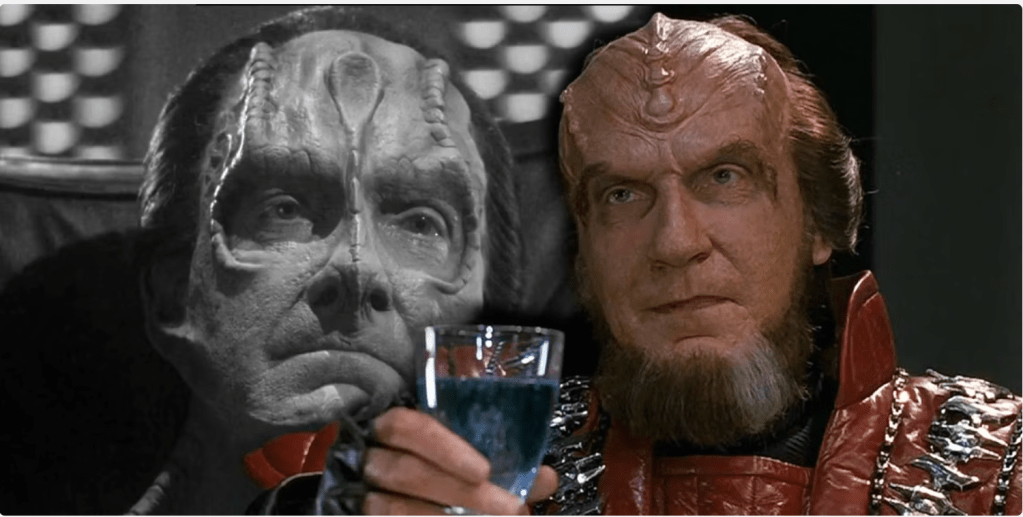
The Cardassians are a race of alien beings (a relative term as they are aliens only to humans or other species of sentient beings who haven’t met them yet) first introduced in Star Trek – The Next Generation.
The chief interrogator for the Cardassians was Gul Madred played by the great English actor David Warner.

David Warner’s full-on villainous turn as the evil Cardassian Gul Madred in the Star Trek: The Next Generation two-parter “Chain of Command” is perhaps his greatest Star Trek role. When the Cardassians capture Captain Picard while he’s on a secret mission, Madred personally conducts the Starfleet hero’s torture and nearly succeeds in breaking Picard’s will. “Chain of Command” is a master class between the two Shakespearean-trained thespians, and Trekkers will never forget Madred trying to convince Picard that he sees five lights (Madred being the fifth). But when he is rescued, Picard defiantly yells, “There are four lights!” and defeats Gul Madred’s sadistic manipulations at the end of the unforgettable Star Trek episode.
========================================
Who are the Cardassians
Tall, long-necked, humanoid in appearance, marked by several bony protrusions and ridges: one from the shoulder to under the ears, whose bottom lobes in turn are more pronounced forward to the jawline, and from above the eyes and back over the head to the rear base of the skull, showing through hair. Other ridges run from the nose line to the forehead, and along the chin to define a sharp jawline. Their skin type and hair vary from light purple to a greenish hue and near black. Predatory in large numbers, more cautious alone and instinctively searching out a dominant position in any social setting. Children may keep pets. Women as well as men are allowed to be Gul in ship command.
The occupiers of Bajor subjugated the people and mined its resources, annexing it outright some 19 years into its 60-year occupation (beginning 2309) and building Terek Nor, now known as Deep Space Nine, initially as a mining station in 235, perhaps using Romulan technology in some components. They then stripped the surface of Bajor and Deep Space Nine alike in vengeance when they withdrew less than two weeks before stardate 46388, leaving everything from basic systems to religious areas in shambles. Some who resisted, including four Promenade merchants, were killed.
The Cardassians also stole eight of the nine Bajoran prophets’ orbs, causing a worried Kai Opaka to charge Commander Sisko with locating their Celestial Temple before the Cardassians found and destroyed it. Despite that, as a show of faith, Commander Sisko allows Dukat’s crew aboard for shore leave. Their reputation for maltreatment of prisoners is well known, but in the world of commerce they are known for paying their bills. Their officials and officers were not above taking bribes from lowly Bajorans.
Other cultures don’t seem to share their taste in food, such as yamok sauce.
Their engineering standards tend to be lower than Starfleet specifications. Deep Space Nine’s fusion powerplant design considers a range of 20% in operating efficiency to be within normal. Cardassian genetic engineers are advanced enough to be well-known by their trademark use of monoclonal links in their DNA-building; whether by open exchange, captured record or espionage, the details are easily researched in Federation records.
They may have compulsory military service, at least for males. Death services are called “funerals” and they can be public occurrences, especially for major leaders. Military monuments line the planet, with some serving as burial sites.
One of their greatest characteristics is devotion to family; caring for parents as well as children. Families of up to four generations under one roof are not uncommon. Swearing the truth on the lives of one’s children is tantamount to the highest honesty a Cardassian can attest to — as Dukat does to Commander Sisko. Parents are manipulated by state media in the name of their children, and the presumed-guilty justice system aims to impress children against anti-state lawlessness and chaos, inviting some to the courtroom live and others to watch. The revelation that he abandoned a child on Bajor, even one thought dead, is enough to publicly and privately humiliate a politician like Pa’Dar, ruining his career. Despite that, true orphans have no status in society and are simply forgotten.
Another trait is an attention to detail. They taught record-keeping skills to many planets, including Bajor. Cardassians are famous for their photographic memories. When alleged that children at age 4 are put into intensive mind-training programs, it is acknowledged as the “unparalleled” educational system of the quadrant. Education is power and joy is vulnerability, Dukat asserts in Orwellian-like tones. The mental training can extend to enough discipline to deflect a Vulcan Mind Meld. Kovat says one old native saying is, “Confession is good for the soul.”
Their physiology and constitution is much stouter than the human norm, or at least Garak’s is. Showing immunity to the effects of depressants and anesthetics, neither two-plus bottles of Kanar nor 30cc’s of Triptacederine had any effect on the Cardassian. The latter amount would knock out an Algorian Mammoth.
Similar to Humans, Cardassians celebrate birthdays, respect marriage, and use a given name before the family name. Cardassians also respect advanced age as a sign of power and dignity.
It was recently determined that Bajorans made interstellar contact with Cardassians before they had the capability of spaceflight.
========================================
Who are the Ferengi

The homeworld of the Ferengi species is Ferenginar. The Ferengi have a culture which is based entirely upon commerce. They follow a code of conduct known as “The Ferengi Rules of Acquisition.” These rules ordain conduct such as “Never place family before business.” Reportedly these rules are subject to interpretation depending upon the situation. Plea bargaining is a legal tradition, as is the purchasing of an apprenticeship following the Attainment Ceremony. There is no distinction between business and pleasure in Ferengi culture.
Money is expected to accompany every interchange of life, even private visits to family and friends’ homes and government business. Quark pays to have his FCA charges announced and to get admission into his own mother’s home, as well as sign off on legal waivers there. Domes, rounded archways, low ceilings, food cellars and a lack of windows mark typical home architecture. Towels are provided at entrances to dry off from the constant rain. A typical home-welcoming greeting exchange between host and visitor is: “My house is my house/as are its contents.” Tooth-sharpening is a personal hygiene habit. Pressing noses is a loving familial greeting. A woman talking to a stranger is considered an insult; a clothed one is cause to shield or avert one’s eyes.
Ferengi typically emit a high-pitched shriek when attacked; they are likewise pained by ultrasonics too high for human ears — such as those aimed at eradicating Cardassian Voles. Due to their use of insects as edibles, Nog presumes Entomology is the study of becoming a chef.
Naming Day is an important landmark in a child’s life.
The Ferengi brain is composed of four distinct nodes, possibly what prevents them from being read empathically by Betazeds. Ferengi blood is yellow, turning dark blue-green when oxidized. Bodies are not autopsied or even touched until after death rituals — which have been seen to be the desiccation and sale of the remains. The Ferengi culture does not embrace science, except where it will provide profit. Large earlobes are a sign of virility in Ferengi culture, and also an erogenous zone, sexually stimulated when stroked as in the performance of Oo-Mox.
Ferengi females have smaller lobes then males and are not permitted to go out in public, hold jobs, wear clothing or participate in trade or commerce. Quark says spouses never argue and that divorce and broken homes are unknown. Women are even asked to cut up food and chew it softly for their mates and children. They are also forbidden to travel.
Quark threatens a diplomatic incident to guilt Ensign Harry Kim of the U.S.S. Voyager into buying an overpriced trinket at space station Deep Space Nine when the ensign says he was “warned about Ferengis” at the Academy. They are known to have deceived other passing ships by pretending to be damaged, according to the one-time Maquis Crewman Chell.
========================================
The races of Star Trek are loosely based on a variety of human cultures and civilizations. For example, the Klingons are based on the warrior culture of medieval Mongolia, while the Romulans are based on the Roman Empire. The Federation’s culture is heavily influenced by the United States of America, and the Vulcans are based on ancient Eastern philosophy and traditions. Additionally, various other races such as the Bajorans, Cardassians, Ferengi, and Dominion are also based on different human cultures and civilizations.
Don’t forget the Borg. Not a distinct race at all tho’ they all do seem to be white-looking Caucasian humans who have been assimulated into the Borg collective. Even the relatively pretty female Borg leader who attempts to seduce Data in the Star Trek film
=======================================
My cmnt: While I do not necessarily agree with this guy’s interpretations, here they are. I’ve edited them to make them more accurate and current.
Federation = USA, and UK and Western Europe
Klingons = USSR, China, Japan or better Genghis Khan and the Mongol Empire.
Ferengi = Ultra Capitalist to the max and sexist -No such nation exists. In their treatment of women they are closest to Islam.
Cardassians = uber Nationalist and their occupation of Bajor is based on Nazi Occupation of Sudetenland among other things. In their gas-lighting methods of propaganda/indoctrination they are closest to the democrat-media complex.
Bajorians = based on the Jews and Refugees and Religious Minorities in a society where the Religious Majority doesn’t like them.
Vulcans = the Classical Greeks or better the Shaolin priests as depicted in the TV series Kung Fu.
Romulans = the Roman Empire.
The Borg = Communism and Collectivism (i.e., the democratic party) taken to its logical conclusion
 Lord Buckbeak: "Will you come into my parlor?," said the Spider to the Fly.
Leave a comment