To be ‘beyond the pale’ is to be unacceptable; outside agreed standards of decency.
What’s the origin of the phrase ‘Beyond the pale’?
Firstly, let’s get the spelling clear here. It’s ‘beyond the pale‘ and not ‘beyond the pail‘ – the phrase has nothing to do with buckets.
The everyday use of the word ‘pale’ is as an adjective meaning whitish and light in colour (used to that effect by Procol Harum and in countless paint adverts).
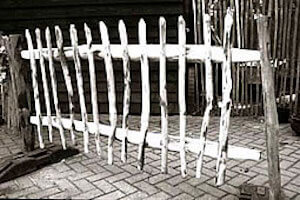
However, there is another meaning of ‘pale’ – ‘a stake or pointed piece of wood’. This meaning is now virtually obsolete except as used in this phrase. A variant of it – ‘paling’, is still in use, as in paling fence and ‘impale’ (as in Dracula movies).
The paling fence is significant as the term ‘pale’ came to mean the area enclosed by such a fence and later just figuratively ‘the area that is enclosed and safe’. So to be ‘beyond the pale’ was to be outside the area accepted as ‘home’.
Catherine the Great created the Pale of Settlement in Russia in 1791. This was the name given to the western border region of the country, in which Jews were allowed to live. The motivation behind this was to restrict trade between Jews and native Russians. Some Jews were allowed to live, as a concession, ‘beyond the pale’.
Pales were enforced in various other European countries for similar political reasons, notably in Ireland (the Pale of Dublin) and France (the Pale of Calais, which was formed as early as 1360).
The phrase itself originated later than that. The first printed reference comes from 1657 in John Harington’s lyric poem The History of Polindor and Flostella. In that work, the character Ortheris withdraws with his beloved to a country lodge for ‘quiet, calm and ease’, but they later venture further:
“Both Dove-like roved forth beyond the pale to planted Myrtle-walk”.
Such recklessness rarely meets with a good end in 17th century verse and before long the lovers are attacked by armed men with ‘many a dire killing thrust’. The message is clear – ‘if there is a pale, decent people stay inside it’, which conveys exactly the figurative meaning of the phrase as it is used today.
As a corresspondent has helpfully pointed out, although Harington’s poem was published in 1657, he died in 1612. That date, and most probably some years earlier, has to be the ‘not later than’ date for the origin of ‘beyond the pale’.
From the website phrases.org.uk


 Lord Buckbeak: "Will you come into my parlor?," said the Spider to the Fly.
Leave a comment