From the website: gotquestions.org
Mariology is the theological study of Mary, the mother of Jesus. Within the Roman Catholic Church, Mary is venerated over all other saints. Anglicans share some of the beliefs of Roman Catholic Mariology, but not all. The Eastern Orthodox Church calls Mary the “God-bearer,” emphasizing Mary’s status as the mother of God Incarnate, gives her the title “Ever Virgin,” and emphasizes her sublime holiness, her share in redemption, and her role as a mediator of grace.
Most Protestants endorse the Apostles’ Creed, which acknowledges the virgin birth of Christ, but they do not believe in most of the other tenets of Mariology. Protestants denounce the veneration of Mary as practiced by Roman Catholicism and Eastern Orthodoxy.
The four dogmas of Roman Catholic Mariology are: 1) the title “Mother of God”; 2) the Immaculate Conception; 3) the Perpetual Virginity of Mary; and 4) the Assumption of Mary.
Mother of God: In AD 431, the Council of Ephesus countered the Nestorian heresy by declaring that Mary was truly the Mother of God: “Not that the nature of the Word or his divinity received the beginning of its existence from Mary, but the holy body, animated by a rational soul, which the Word of God united to himself, was born from Mary.” One problem with this wording is that it awakened the old Arian heresy that the Logos (Jesus) was a created being. In AD 451, at the Council of Chalcedon, Leo, Bishop of Rome, ratified the decision that Mary was theotokos (“God-bearer”) only as to the humanity of Jesus. The title had nothing to do with Jesus’ divinity as the eternal Word of God. The Chalcedonian definition added the words “as to the manhood” immediately after theotokos, which should have ended erroneous thinking. But the populace took this word theotokos as an uplifting of Mary’s status and started to venerate her. The term theotokos was not incorporated into the Nicene Creed of 321 or the Constantinopolitan Creed of 381. Neither is that expression used in the Anglican Articles or in the Westminster Confession of Faith.
Immaculate Conception: This tenet of Mariology holds that Mary, at her conception, was sinless (immaculate), preserved from original sin. According to the Roman Catholic Encyclopedia of Theology, no statement of Mary’s being free from original sin is found in the West before AD 1000. It was not until 1854 that faith in Mary’s Immaculate Conception was taught as an official church dogma.
Perpetual Virginity: According to Roman Catholic Mariology, Mary was always a virgin before, during, and after giving birth to Jesus. The Roman Catholic Encyclopedia of Theology admits that the formula of “virginity before, in and after giving birth” did not come into use till after the 7th century.
Assumption: The Assumption of Mary teaches that Mary, when she died, was taken up (assumed) body and soul into heavenly glory. It was not until 1950 that Pope Pius XII defined the doctrine of “Mary’s bodily assumption into heaven.”
Mary’s role in salvation: Another element of Roman Catholic Mariology is the belief that, at the conception of Jesus, Mary entered into a spiritual union with Him. Pope John Paul II discussed Mary’s place in the plan of salvation in the encyclical Redemptoris Mater, emphasizing “the special presence of the Mother of God in the mystery of Christ and his Church. For this is a fundamental dimension emerging from the Mariology of the Council.” Pope Benedict XVI stated that “Christology and Mariology are inseparably interwoven.”
The Catholic Encyclopedia states, “In [Mary’s] Fiat of faith, she received salvation for all. . . . Mary’s mediatorship is to be understood on the level of the solidarity of all mankind which is in need of redemption. . . .The function of Mary in salvation determines her relation to the Church. . . . Mary is mother of the Church under this more individualistic aspect, since she is effectively concerned for the salvation of each individual” (pages 898–901).
Within Catholicism, there is a drive to define a new Marian dogma in which Catholics, as a matter of faith, would be obliged to accept these three doctrines: 1) Mary participates in redemption with Jesus Christ; 2) grace is granted by Jesus only through the intercession of Mary; and 3) all prayers from the faithful must flow through Mary, who brings them to the attention of her Son. This movement would, in practice, redefine the Trinity as a kind of Quartet. The idea that Mary is a co-redemptrix or mediatrix contradicts 1 Timothy 2:5, which says, “For there is one God and one mediator between God and mankind, the man Christ Jesus.” Jesus is the Mediator. There is no mediator between man and Jesus. Jesus Himself dwells in believers; thus, no other mediator is required (Colossians 1:27).
================================================
My cmnt: Did the current pope put to rest the idea of Mary as co-redemptrix, mediatrix and advocate?
Answer from Google Ai (March 20, 2026):
Yes, the Vatican under Pope Leo XIV (and supported by previous statements from Pope Francis) has formally and definitively rejected the adoption of “Co-Redemptrix” as an official dogma. A November 2025 document, Mater Populi Fidelis, instructed Catholics to stop using the title, emphasizing that Mary is not a co-savior and that such terminology risks overshadowing Jesus Christ’s exclusive role in salvation.
Key Details on the Vatican’s Position
- Rejection of “Co-Redemptrix”: The Dicastery for the Doctrine of the Faith (DDF) declared that using “Co-Redemptrix” is inappropriate and risks obscuring Christ as the sole redeemer.
- Rejection of “Mediatrix”: While Mary is honoured as a mediatrix of grace in a subordinate way, the Vatican warned against titles that imply she is on the same level as Christ.
- Papal Action: Pope Leo XIV approved the doctrinal note Mater Populi Fidelis in October 2025, ordering its publication to clarify this issue.
- Pope Francis’s Stance: Previously, Pope Francis stated that Marian titles are expressions of love, but calling her co-redemptrix is an “exaggeration”. He emphasized that love can lead to overstating her role, while reaffirming that Christ alone is the redeemer.
- Focus on Scripture: The Church maintains that Mary’s role is that of a mother leading people to Jesus, rather than a partner in the redemption itself.
The move aimed to promote ecumenical understanding, as these titles have long been viewed as obstacles to unity with other Christian denominations.
===============================================
My cmnt: According to the website United States Conference of Catholic Bishops:
Mary, mother of Jesus and all believers, is not co-redeemer, Vatican says
With the approval of Pope Leo XIV, the Dicastery for the Doctrine of the Faith published a long document on the titles of love and respect Catholics have for Mary and her motherly assistance to believers, but it also explained the problems with referring to Mary as “co-redemptrix” with Christ.
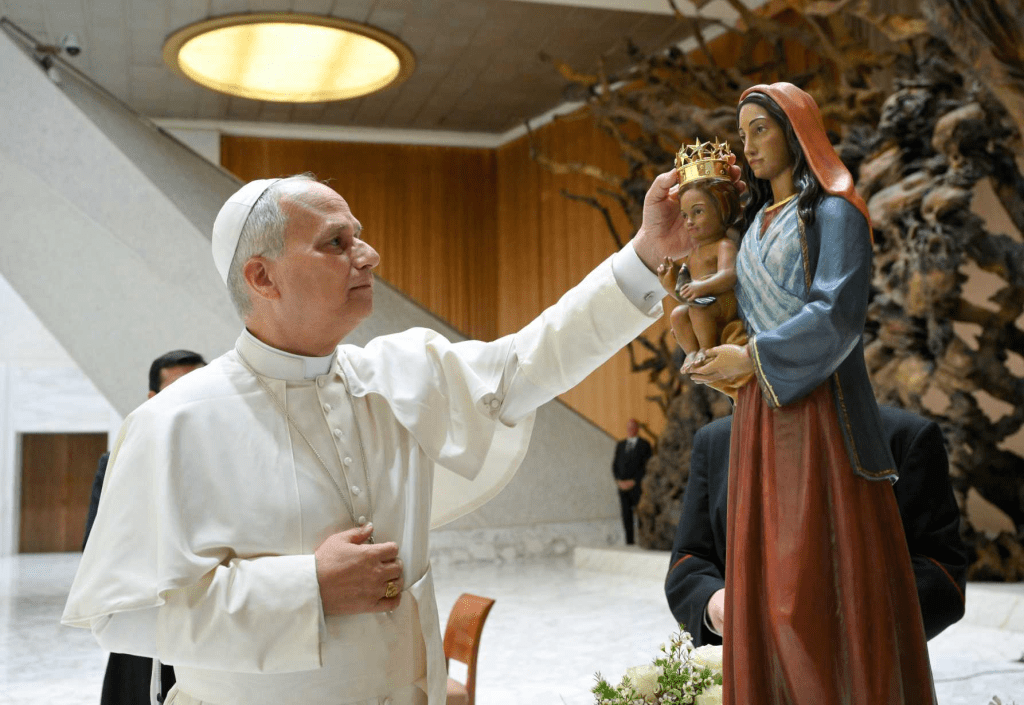
Pope Leo XIV places a crown on a statue of Mary and the Child Jesus during a meeting with participants in the Jubilee of the Roma, Sinti and Traveling Peoples in the Paul VI Audience Hall at the Vatican Oct. 18, 2025. (CNS photo/Vatican Media)
===============================================
Vatican officially says no to controversial titles for Mary: ‘Co-redemptrix’ and ‘Mediatrix of all Graces’
by Gerard O’Connell – November 4, 2025 – America – The Jesuit Review

Vatican clarifies Marian titles: She is not ‘Co-Redemptrix’ or “Mediatrix of all graces.’
===============================================
Nowhere in Scripture does Jesus or anyone else direct any praise, glory, or adoration toward Mary. Mary was present at the cross when Jesus died (John 19:25). Mary was also with the apostles on the day of Pentecost (Acts 1:14). However, Mary is never mentioned again after Acts 1. The apostles did not give Mary a prominent role. Mary’s death is not recorded in the Bible. Nothing is said about Mary ascending to heaven or having an exalted role there. As the earthly mother of Jesus, Mary should be respected, but she is not worthy of worship or adoration. The Bible nowhere indicates that Mary can hear our prayers or that she can mediate for us with God. Mary herself sets the example for us in directing her worship, adoration, and praise to God alone: “My soul glorifies the Lord and my spirit rejoices in God my Savior, for He has been mindful of the humble state of His servant. From now on all generations will call me blessed, for the Mighty One has done great things for me—holy is His name” (Luke 1:46–49).
 Lord Buckbeak: "Will you come into my parlor?," said the Spider to the Fly.
Leave a comment