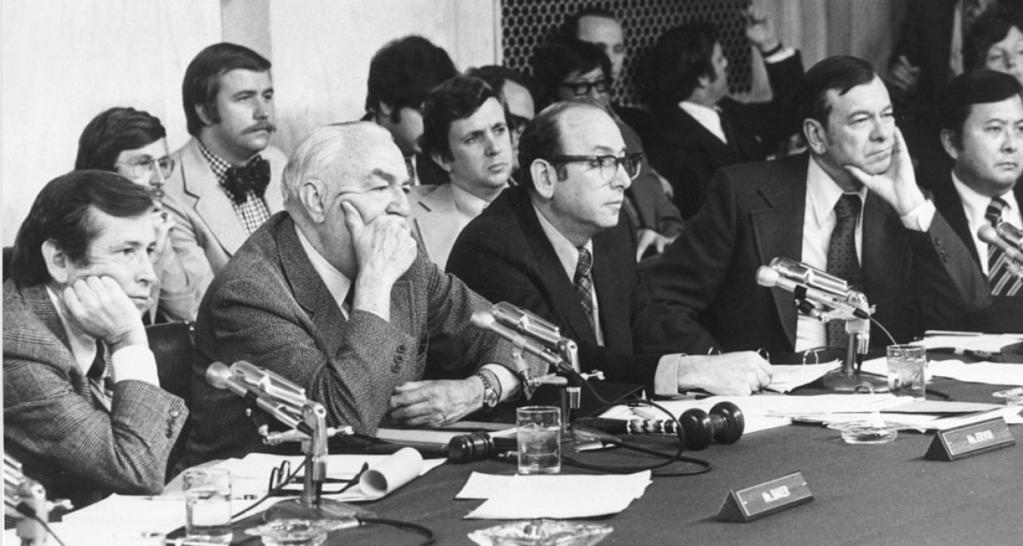
By Hugh Hewitt May 24, 2021 29.1k views – for Prager U
My cmnt: Note the striking parallels between the elite, Washington press corps (for Obama that word is pronounced KOR) and their treatment of President Nixon and their similar (even worse) treatment of President Trump nearly 50 years later.
The most famous political scandal in American history is, of course, Watergate. It’s so famous that even now, 50 years after it happened, almost every scandal of any kind comes with an obligatory “gate” after it.
If you ask most people to explain what Watergate was all about, they draw a blank. If they know a bit of history, or perhaps they lived through it, they might say something like this: “It was about a bungled break-in that brought down a president.” That’s true. But the break-in is the least significant part of the story.
Watergate was, first and foremost, a political war between the president, Richard Nixon, and the media, which in those pre-cable days meant ABC, CBS, NBC, the New York Times, and the Washington Post. The media’s aim, in the words of British historian Paul Johnson, “was to use publicity to reverse the electoral verdict of 1972.”
Why? What did the media have against Nixon? That’s a complex question, but we can essentially boil it down to three things: 1. He was despised by the East Coast liberal elite, of which the Washington press corps was a key component. 2. He was a staunch anti-communist. The media considered the communist threat to be overblown. 3. He refused to abandon South Vietnam. Nixon insisted on “a peace with honor.” The media was entirely “anti-(American)-war.”
Even though Nixon spent most of his adult life in New York and Washington, he never fit in. Born in a small town in California, there were no Ivy League degrees on his resume. To make matters worse, while not being part of McCarthyism, he made his reputation aggressively exposing Alger Hiss, a communist in the U.S. State Department in the late 1940s. After serving as vice president under Dwight Eisenhower for eight years, he ran against and nearly defeated John F. Kennedy, the paragon of East Coast elitism in 1960.
My cmnt: Many people, on both sides of the aisle, admit that the democrats cheated their way to victory over Nixon through dead voters in Chicago and Dallas. Nixon and the Republicans were aware of the cheating but for the sake of the country (something democrats know nothing about) Nixon graciously conceded.
Then, eight years later, and much to the media’s dismay, Nixon mounted an improbable political comeback to win that year’s presidential election. And then, as if rubbing the media’s nose in it, he won again in a 49-state landslide in 1972.
Something had to be done. Ironically, Nixon’s own people provided the opportunity the media had been waiting for. On June 17, 1972, five men associated with the Nixon re-election campaign broke into the offices of the Democratic National Committee headquarters in the Watergate office building in Washington, D.C. Presumably, they intended to gather information about the Democrats’ campaign strategy. Whatever their purpose, it was a painfully dumb plan that turned catastrophic when the burglars were caught in the act and arrested by D.C. police.
Nixon found out about it—like everyone else—in the morning papers. Initially, he didn’t think it was a big deal. “I had been in politics too long,” he later wrote, “and had seen everything from dirty tricks to vote fraud. I could not muster much moral outrage over a political bugging.”
My cmnt: The ‘vote fraud’ Nixon was referring to were the dead people Richard Daley, big-city boss of democrat-run Chicago, had ‘vote’ for Kennedy and the similar vote fraud Lyndon Johnson orchestrated in Texas to illegally swing the presidential election in 1960. Again eerily similar to what the democrats did to President Trump in 2020.
Today, most would conclude that if he had simply acknowledged his campaign’s responsibility—“owned it,” as we say, fired those responsible, and apologized, the whole sorry mess would have been rendered the minor incident it was. But, as historian Evan Thomas noted, Nixon “wasn’t paying attention and when he was confronted with the problems below deck, he didn’t really engage… by the time he did, it was too late.”
My cmnt: I’m not so sure that President Nixon could have done anything that would have got the evil, twisted democrat-media establishment off his back.
So the scandal grew beyond his control. Three men made sure of that: a publicity-seeking judge, a revenge-seeking FBI official, and a partisan special prosecutor.
The judge was John Sirica. Suspecting a vast conspiracy, Sirica threatened the burglars with lifetime prison sentences if they didn’t rat out the people who authorized the crime. The democrat-media complex loved Sirica. For a time, he was the most famous jurist in the country.
The vengeful official was FBI Deputy Director Mark Felt, known by his code name “Deep Throat.” Felt thought that he deserved to become head of the FBI, but Nixon appointed someone else. So Felt leaked a steady stream of tips to the Washington Post writing team of Bob Woodward and Carl Bernstein (a couple of useful idiots in the skillful hands of Felt). Meeting secretly, he told them where to look and what questions to ask. Without him, the duo would have gotten nowhere. Because of him, they became folk heroes.
With Sirica applying pressure from the bench and Felt from inside the FBI, the White House defenses began to weaken, then crack, and then shatter. Special Prosecutor Archibald Cox piled on, appointing 34 Democrat lawyers to investigate nearly every aspect of the Nixon administration.
My cmnt: I’m old enough to have watched the Watergate hearings and what I really remember most was that traitorous coward John Dean throwing his boss under the bus to save his own worthless hide and because he enjoyed the attention and fake love of the elites.
In April 1973, White House Counsel John Dean, the “chief desk officer” of the cover up, turned on his boss, testifying against the president in Senate hearings before a huge national TV audience. As the political jeopardy grew, Nixon naturally became more involved. One biographer wrote, “To Nixon, this was all routine hardball…” But really, this was quicksand: the more he struggled, the deeper he sank. He was caught in the cover-up.
When it emerged that many of Nixon’s private conversations were recorded, his fate was sealed. Citing executive privilege, he tried to keep the tapes from Sirica and Congress. On July 24, 1974, the Supreme Court ruled against the president, 8-0 with William Rehnquist recusing himself.
The support of Republican senators far from assured, and deeply concerned that an impeachment trial would paralyze the country in the middle of the Cold War, Nixon was boxed in. He resigned from office on August 9, the first and only president to do so.
The media had its victory. And a newfound sense of power.
The country has not been the same since.
I’m Hugh Hewitt for Prager University.
==========================================================
On January 22, 1973, the Supreme Court issued a 7–2 decision in favor of “Jane Roe” (Norma McCorvey) holding that women in the United States had an entirely new and invented constitutional right to an abortion prior to fetal viability. In practical terms it meant a right to an abortion anytime during a pregnancy.
The 7-2 decision held that women have a constitutional right to abortion and struck down the Texas law banning it. Justices Harry Blackmun, Warren Burger, William J. Brennan Jr., William O. Douglas, Potter Stewart, Thurgood Marshall, and Lewis F. Powell Jr. voted to uphold the right to an abortion, with Justices Byron White and William Rehnquist dissenting.
The full list of justices in 1973 includes:
- Warren E. Burger: Appointed Chief Justice by Nixon in 1969.
- Harry A. Blackmun: Appointed by Nixon in 1970.
- Lewis F. Powell Jr.: Appointed by Nixon in 1971.
- William H. Rehnquist: Appointed by Nixon in 1971.
- William O. Douglas: Appointed by President Franklin D. Roosevelt in 1939.
- William J. Brennan Jr.: Appointed by President Dwight D. Eisenhower in 1956.
- Potter Stewart: Appointed by President Dwight D. Eisenhower in 1958.
- Byron White: Appointed by President John F. Kennedy in 1962.
- Thurgood Marshall: Appointed by President Lyndon B. Johnson in 1967.
It took 50 years of ProLife peaceful, patient protests and prayers to realign the Supreme Court with conservative, originalist justices to overturn this horrendous and ridiculous ruling by the activist justices on the 1973 court.
President Richard Nixon was overall a good man and leader of the Free World. He was
=============================================================
| Justice | Appointing President |
|---|---|
| John G. Roberts, Jr. | George W. Bush |
| Clarence Thomas | George H.W. Bush |
| Samuel Alito | George W. Bush |
| Sonia Sotomayor | Barack Obama |
| Elena Kagan | Barack Obama |
| Neil Gorsuch | Donald Trump |
| Brett Kavanaugh | Donald Trump |
| Amy Coney Barrett | Donald Trump |
| Ketanji Brown Jackson | Joe Biden’s AutoPen |
In 2022, the Supreme Court’s justices who voted to overturn Roe v. Wade were Justices Samuel Alito, Clarence Thomas, Neil Gorsuch, Brett Kavanaugh, and Amy Coney Barrett. Justice Alito authored the majority opinion in Dobbs v. Jackson Women’s Health Organization, while Chief Justice John Roberts concurred with the outcome of upholding the Mississippi law but not with overturning Roe itself. The other justices, Elena Kagan, Sonia Sotomayor, and the late Stephen Breyer, were in dissent.
Justices who voted to overturn Roe v. Wade
- Samuel Alito: Wrote the majority opinion.
- Clarence Thomas: Joined the majority opinion.
- Neil Gorsuch: Joined the majority opinion.
- Brett Kavanaugh: Joined the majority opinion.
- Amy Coney Barrett: Joined the majority opinion.
Justices who voted against overturning Roe v. Wade
- John Roberts: Concurred with the judgment to uphold the Mississippi law but disagreed with the majority’s decision to overturn Roe.
- Stephen Breyer: Was in dissent.
- Sonia Sotomayor: Was in dissent.
- Elena Kagan: Was in dissent.

 Lord Buckbeak: "Will you come into my parlor?," said the Spider to the Fly.
Leave a comment